Nvidia and AMD to hand over 15% of China chip revenues to US
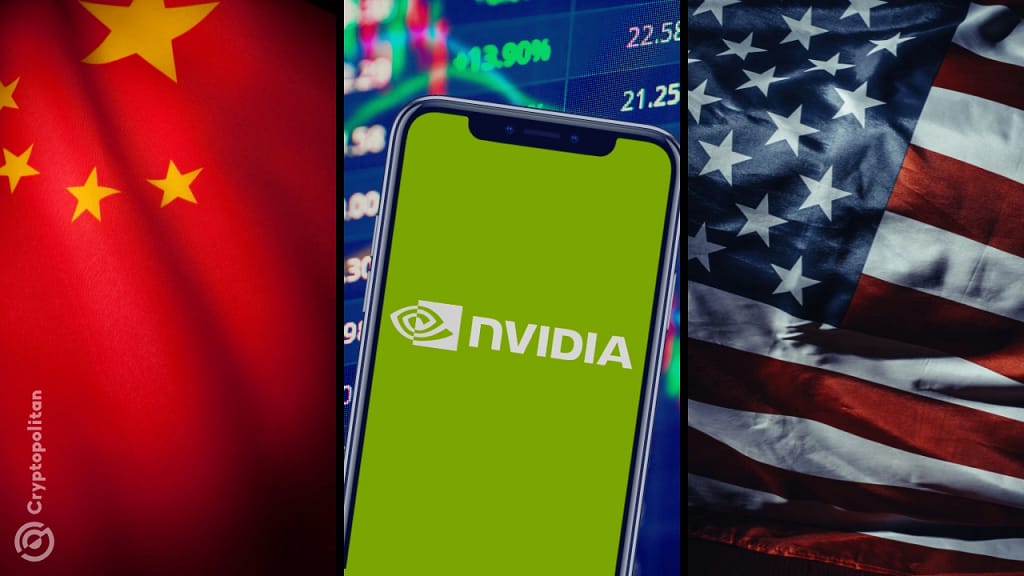
Nvidia and AMD have agreed to transfer 15% of their China chip revenues directly to the U.S. government as a condition for obtaining export licenses, marking an unprecedented arrangement that blends trade policy with national security considerations. The deal, which covers Nvidia’s H20 artificial intelligence processor and AMD’s MI308 chip, was finalized last week after months of regulatory delay and represents a significant shift in how Washington approaches semiconductor exports to strategic competitors.
The Revenue-Sharing Agreement
Both chipmakers designed their products specifically for the Chinese market to comply with existing U.S. export restrictions on advanced AI processors. The 15% revenue commitment emerged as a non-negotiable condition for the Commerce Department’s Bureau of Industry and Security to grant the necessary export licenses.
Nvidia acknowledged the arrangement without providing extensive detail, stating through a spokesperson that the deal “follows rules the U.S. government sets for our participation in worldwide markets.” AMD declined to comment on the specifics of the agreement.
The arrangement has sparked sharp criticism from national security experts and former Trump administration officials who warned that the chip could ultimately aid China’s military capabilities.
— Export Control Specialists
Analysts estimate the financial implications could be substantial. Bernstein Research projects Nvidia alone could sell approximately 1.5 million H20 units in China during 2025, generating roughly $23 billion in annual revenue from that market. Under the 15% arrangement, this would direct more than $3 billion annually from those sales to the U.S. Treasury.
Bernstein Research estimates Nvidia H20 sales of $23 billion in China for 2025, with the 15% revenue share equaling approximately $3.5 billion annually to the U.S. government.
U.S. officials have not yet disclosed how they plan to allocate these funds or whether similar arrangements might be extended to other semiconductor companies. The precedent-setting nature of the deal has drawn attention from trade and export control specialists who note that no American technology company has previously agreed to surrender a percentage of revenues as an export license condition.
A Winding Path to Approval
The road to the revenue-sharing agreement reflected broader tension within the Trump administration over China policy. In April, the White House announced it would block H20 exports, citing concerns about transferring advanced artificial intelligence capabilities to a strategic competitor.
The H20 had already been engineered to operate within Biden-era export limits on high-end AI accelerators, yet the new administration viewed even this restricted version as strategically problematic. That assessment changed dramatically following a June meeting between Nvidia CEO Jensen Huang and President Donald Trump at the White House.
Within days of that meeting, the administration reversed its decision to prohibit H20 shipments. However, the Bureau of Industry and Security continued withholding actual export licenses for several additional weeks. Insiders indicated the delay was tactical—BIS officials used the extended timeline to negotiate the revenue-sharing terms with both Nvidia and AMD.
Licenses were ultimately issued last week once the 15% agreement was finalized. AMD’s MI308 received approval under identical terms, establishing what appears to be a new template for semiconductor exports to China.
April: Trump administration announces H20 export block. June: CEO Huang meets President Trump; block is reversed. Weeks later: BIS withholds licenses pending negotiations. Final week: Licenses issued after 15% revenue-sharing agreement finalized.
National Security Concerns Versus Market Access
The arrangement has generated substantial pushback from national security officials and foreign policy experts. In a formal letter to Commerce Secretary Howard Lutnick, former Deputy National Security Adviser Matt Pottinger and 19 other former government officials urged the administration to reject H20 export licenses entirely.
These critics characterized the H20 as a “potent accelerator” for China’s artificial intelligence development and warned that approving sales could ultimately strengthen Chinese military capabilities. Some internal BIS staff reportedly shared these concerns, fearing that the licensing decision would undermine American technological leadership in critical AI domains.
Former national security officials warned that the H20 is a potent accelerator for China’s AI development and could ultimately strengthen Chinese military capabilities.
— Matt Pottinger, Former Deputy National Security Adviser
Nvidia directly rejected these characterizations as “misguided.” The company contends that the H20 architecture makes it unsuitable for military applications and emphasized that withdrawing from the Chinese market would ultimately weaken American competitiveness. Nvidia has argued that maintaining a presence in China—even under restricted terms—protects long-term U.S. technological dominance.
This fundamental disagreement reflects a deeper split within Washington policy circles about whether engagement or restriction better serves American interests regarding advanced semiconductors and artificial intelligence. The revenue-sharing compromise appears designed to address both camps: it provides Nvidia and AMD with market access while funneling proceeds directly to the federal government.
Industry Context and Semiconductor Market Dynamics
The semiconductor industry operates within a complex ecosystem where Chinese demand represents an increasingly critical revenue stream for major players. China accounts for approximately 35-40% of global semiconductor consumption, making it an essential market for companies like Nvidia and AMD seeking to maintain growth trajectories and fund research and development initiatives.
The global AI chip market is projected to exceed $500 billion by 2030, with China representing a substantial portion of this growth. Companies that cede market share to competitors during critical development phases risk losing technological relevance in subsequent generations. This commercial reality has driven both Nvidia and AMD to negotiate aggressively for export approvals despite national security sensitivities.
Internationally, competitors including Chinese domestic chipmakers Huawei and Sophon are advancing their own AI acceleration capabilities. Each quarter without access to the latest architectural innovations allows these competitors to narrow performance gaps. The revenue-sharing arrangement, from this perspective, represents a calculated trade-off: accept federal revenue participation in exchange for sustaining Chinese market presence.
Broader Implications for Trade Policy and Future Precedent
Industry analysts and trade specialists note that the revenue-sharing model represents a distinct departure from conventional export licensing. The arrangement resembles negotiating tactics favored during the earlier Trump administration, when companies were encouraged to make domestic investments or other concessions to avoid tariffs and trade restrictions.
For the semiconductor industry and other sectors dependent on export licenses, the Nvidia-AMD deal establishes a potential precedent. Future companies seeking approval for sensitive exports may face similar revenue-sharing demands, effectively creating a new category of government compensation for strategic market access. This could reshape how technology companies evaluate international expansion and license negotiations.
The arrangement also raises questions about long-term fiscal implications. If the model expands across other technology sectors—biotechnology, quantum computing, advanced manufacturing—the revenue stream to federal coffers could become substantial. However, critics warn that institutionalizing revenue-sharing as an export condition may inadvertently discourage innovation by reducing profit margins on high-growth markets.
The geopolitical dimensions remain significant. Allowing H20 and MI308 sales to China—even with strict export controls and revenue sharing—signals that commercial interests can override some national security objections when high-level political engagement occurs. How this plays out across other technology sectors remains an open question, particularly as the administration evaluates export policies for advanced computing, quantum technologies, and biotechnology platforms.
Conclusion: A New Model for Strategic Technology Exports
The Nvidia-AMD revenue-sharing agreement represents a watershed moment in how the U.S. government manages technology exports to strategic competitors. Rather than categorical bans or outright approvals, this hybrid approach attempts to monetize security concessions while preserving market access for American companies.
Whether this model proves sustainable depends on multiple factors: the actual revenue flows to government coffers, the technological trajectory of Chinese competitors, and broader geopolitical developments between Washington and Beijing. If the arrangement generates meaningful federal revenue while constraining military applications, the administration may view it as a policy success. If subsequent analysis suggests Chinese military integration or accelerated competitive advancement, national security officials will likely demand recalibration.
For technology companies, the precedent signals that export approval now comes with explicit financial obligations rather than implicit goodwill assumptions. This fundamentally alters how firms calculate international market participation and structure long-term strategic planning. As developments in technology regulation and trade policy continue to evolve, stakeholders across finance, semiconductors, and foreign policy will be monitoring whether similar arrangements emerge elsewhere in the sector and how they reshape the competitive landscape for global innovation.
Get weekly blockchain insights via the CCS Insider newsletter.