
Shresth Agrawal / Pod Network
Shresth Agrawal on fairness and speed in crypto markets
In this episode
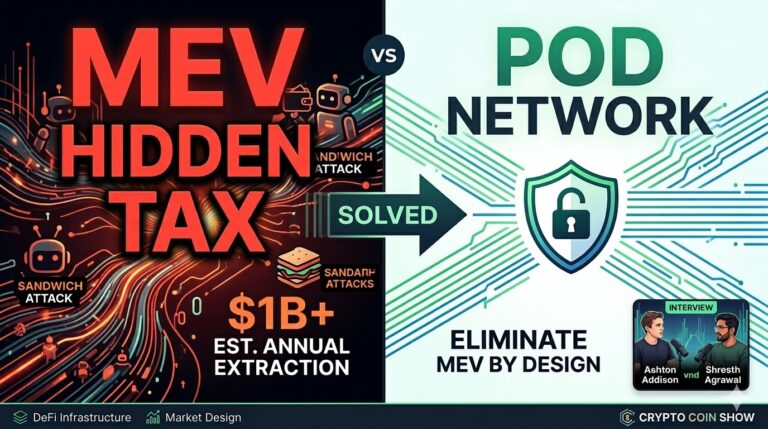
We speak with Shresth Agrawal, CEO and Co-Founder of Pod Network, about building fair, high-performance decentralized markets. Today’s prediction markets and on-chain trading systems often suffer from latency, MEV extraction, and information asymmetry that can disadvantage retail traders. Shresth explains how Pod Network is approaching market design differently to create systems that are faster, fairer, and capable of reaching NASDAQ-scale performance while remaining decentralized. We explore what’s broken in current prediction markets like Polymarket and other on-chain trading venues, why latency and finality are critical to fair trading, and how Pod’s architecture aims to eliminate structural advantages that sophisticated players exploit today. From the role of MEV in market outcomes to the technical roadmap for 200ms finality and institutional-grade infrastructure, this conversation looks at what it will take for decentralized markets to compete with traditional financial exchanges.
pod.network · @poddotnetwork on X · Watch on Refinitiv
- Centralized and decentralized exchanges both have single points of control—servers in traditional markets and sequencers in blockchain—that enable unfair order flow manipulation.
- MEV extraction and front-running are more damaging in illiquid exotic markets where sophisticated players can snipe retail orders at disadvantageous prices.
- Pod Network uses batch auction protocols to redirect excess value created by user order flow back to traders rather than extracting it as negative expected value.
- Pod functions as a matching layer that can work across multiple chains without requiring liquidity to bridge, while native markets on Pod enable composability with other protocols.
- Early liquidity challenges require selective pair launches and strategic partnerships, with execution quality advantages for smaller orders helping bootstrap network adoption over time.
Chapters
Transcript
Read the full transcript
I'm Ashton Addison from the Crypto Coin Show and today on blockchain interviews we have Shresh Agrial, co-founder and CEO of Pod Network. Here to discuss what is broken in today's prediction markets, NASDAQ scale decentralized markets and how can we get more institutional adoption into these decentralized markets and more. Shresh, welcome to the show and thanks for taking the time.
Thanks Ashen for inviting me here. Really excited to tell more.
Definitely. There's a huge convergence of prediction markets with people that are not in crypto or even tech you know a mixture of sports, gambling, politics everything now converging with the technology of decentralized markets to make it faster, more efficient, cheaper. It's really exciting
and on top of that the institutional interest in digital assets and that prediction market technology sort of moving into the financial industry tokenizing the financial market altogether. That's the next step. But that's a huge undertaking. I know you've been following this pretty closely and you and your team at Pod Network have been working on some great solutions for
the next stage of adoption. Let's kick it off by just hearing a little bit about what you and the team have built at Pod Network and how it relates to this part of the industry.
Sounds good. Sounds good. So we started pod by trying to decentralize auction protocol for flashbots and cow swap for their PBS and orderflow auctions and we came up with this protocol pod and we
realized it's kind of very it's a different way of almost building decentralized market. So whenever you have a buyer and seller and you want to match them efficiently in a fair way, we can use this protocol to do it in a globally distributed setting. So we built pod and pod is essentially a purpose-built L1 for global fair markets and I'm happy to tell more about it
later on in the talk and give more insights.
Definitely. Yeah, it's it sounds great, but on the underlying technology, it can get technical. That first sentence on, you know, what you guys set out to solve, it's like, oh my god, I'm sure there's many issues in blockchain, but I don't really understand this. Can you elaborate on
what are the main barriers to further growth in the way that centralized markets on crypto are set up right now?
Yeah. So if you look at markets today right whether it's on centralized exchanges or decentralized exchanges on centralized exchanges usually there's a server that has the trading logic that has a order book running and
then when whenever you know traders send their orders to this exchange or the server the server is responsible for matching these trades but the server basically has the full control over which trades enter the order book and how mashed and so on. Mhm.
Now we move to the decentralized version and ideally what would happen is nobody has the control but if you open the box
what you realize is there is actually a block proposer or a leader of the blockchain right so in case of a of a of an L2 there's a sequencer
and guy ends up being responsible for what gets into the block of a blockchain
and then there's the same power that is that exists in the centralized version of the exchange now in the decentralized version
Uhhuh. but other designated guy. And that is what causes the unfairness where even in markets like onchain markets today it ends up being that there is one guy who controls what goes into the block in the markets and has unfair advantage over the markets. Now you know there are markets which are quote unquote decentralized but then you know they cannot really open the box or
they're run by trusted entities. So with part essentially we have an infrastructure that can truly remove this essential point of failure this guy who controls the order flow and what gets into the order book and that allows the markets to be fair by design.
yeah, no it's really interesting comparing the centralized server to the decentralized you know still a
sequencer that has the potential to be manipulated whether it's for the market maker or some insider traders that you know if you can see transactions coming in of somebody's about to sell a giant amount or dump something and you can just sequence something in front of it that's really not a fair market is it?
Exactly. Exactly. And this gets even
worse when markets are more exotic and not as liquid, right? Where
if there is somebody who can front the markets, then they can really snipe the order at a bad price at the tax of the user order flow. Whereas you know the design that we are going towards which is with auctions and fast batch auctions. I'm happy to tell more about it.
any kind of excess value that is created by a user order flow goes back to the user.
So in on average the user actually makes a positive return on its order the negative EV which is the case in most of the exchanges today. H interesting. A and you mentioned the importance of liquidity and how in exotic markets where there's even less liquid, there's
more of an issue coming in as a layer one that has solved these issues but doesn't have the same network effect as the major decentralized exchange like unis swap or something that's high volume like Binance. There's a trade-off there where you have the right technology but it's not as liquid to start. How do you overcome that? That's a that's a very good question.
we have a very good matching engine and we have we have this batch auction layer which will provide better execution quality to the end user. But until there is enough liquidity we will not be playing in the same level playing ground and of course we are talking with several partners that will bring in liquidity on day one. we'll have to select our pairs, be more picky about
the pairs we launch and what kind of liquidity we want and then progressively build from there. Of course on day one, if you trade a million bucks on Binance versus us, Binance will definitely have more liquidity. But if you're going to trade probably small orders, you will see that our trade execution quality is much better. And then over time we hope that this will
attract more and more traders and bootstrap the flywheel of liquidity.
Definitely. You mentioned for decentralized trading depending on the blockchain network for example in L2 some of them can be more centralized or they have different entities that are running the sequencing. How does that affect pod you know pod network? Does all of the all of those L2s and
different liquidity networks they have to bridge their assets into a new chain that's more fair or can you actually run this technology in sync with other existing networks?
Yeah. So we think of part as kind of this matching layer when you have a buys and sells and you want to match it efficiently in a fair way and it doesn't require you to bridge the liquidity out
of other chains. You could have liquidity sitting on another chain and just do the matching on pod and then settle it on the chain wherever you like though we are planning to launch native markets on pod and I'm happy to tell more about later on where the liquidity will be on pod because pardon itself is a specialized L1 and has not just the matching engine but the risk
the programmability the composability with other other components that we have and then when the liquidity is actually sitting on the network you can compose it and build more complex primitives on top while when liquidity is sitting elsewhere you can still use it for matching but then you cannot easily compose it other primitives.
So that's the kind of trade-off.
Mhm. you mentioned it hinted at part of the issues with matching and how sequencing can put somebody in front and that sounds like this MEV attacks. It's one of the main issues on decentralized trading at least you trade you know you go to swap even stable coins for another stable coin and then all of a sudden like most of your position was like stolen by somebody
practically. Can you explain what's happening there and then is that one of the main problems that's being solved by pod network?
Yeah, definitely. So when we say fair actually I'm trying to hide away the word me because you know not everybody in the audience might be familiar but when we started pod we actually were trying to basically build
auction protocols to build to solve muv for flashbots which is one of the key players trying to solve or democratize muv in ethereum and what if you kind of open the box of blockchains What ends up happening is there is a there's a leader or sequencer that decides what goes into a block. So if there is let's say you're trying to trade some some pair on unis swap or any
you're trying to put on a lending bing market any any kind of decentralized exchange or a finance operation that you're doing on chain has to go through this block proposer or leader and then this leader can basically look at this transaction and say you know does it benefit me if I add my transaction before this transaction front running or add something after it
or basically just censor you your transaction. Say, you know, I don't like your transaction because, you know, I might want to you're you're trying to snatch some order, but I like it more, so I'll take it before you take it. So this power is what leads to ME and ME is basically the value captured by doing these kinds of complicated strategies and there's a whole
business around builders who are trying to come up with better and better strategies to extract these value and this value is essentially given out from the traders and the retail flow and the resting liquidity on the on the exchange on the onchain u AMM. So it's negative EV for these people.
Mhm.
And with net with the D5 primitives
built on pod essentially what happens is there is no single party that controls the order flow. The transactions are streamed directly to the validators and then transactions are batched. So similar to blocks you can think of batching but then all the transactions within the batch have the same clearing price. So it doesn't matter if you're earlier in the batch or
later in the batch, you get the same clearing price
and this creates basically any kind of surplus is given back to the user.
So if there's a batch surplus, it's democratized across the batch and the every user gets it.
Yeah, that's really nice. With that MEV issue persisting across decentralized exchanges, it seems like through multiple blockchains or at least in the
EVM ecosystem, even on layer 2s, is this something that they could solve by patching the technology or doing some kind of softwork that would enable to fix it on chains that already have a network effect? Yeah, I think a lot of work is being done at the moment to try to solve ME in different ways. Different networks have
different approaches. Some think that MU should be completely enimulated by design using you know fair ordering. Some are trying to do auctions. The most common approach is what was you know what has been done by flashbots where they do these proposer builder auctions where there are participant builders who are trying to propose this is the next block and then there's an
auction these strategies do end up democratizing the me but the it's it's still requires a lot of machinery to be built on top and users the end users don't actually end up benefiting there is some refunds but it's with part because we built this ordering is built in the protocol it allows the me to be democratized from day one and
also part of the part design is to allow other infrastructure other L1's other L2s to compose with it to provide this me freess
so if they were to build a decentralized auction protocol that would democratize the me it would look like part so they could integrate hard to do to that patch. One one thing I want to note as well is you know
even though we refer to MEV in like you know blockchain space this problem also this problem is actually much more elevated elevated in traditional finance where or centralized exchanges where you know anybody who's colloccated to the server is basically taking a cut on every order that comes in because they see the orders coming in first and they can basically snipe that
order or have a bit spread where they're taxing the law.
Yeah, I would love to see this solved. It's practically criminal when you're when unbeknown unknown traders they trade even highly liquid pairs and all of a sudden they didn't get what they were expecting. So the faster we solve this the better. Sresh, how long has your team been working on
this and at what stage is it in reaching that level of adoption that we have in major decentralized exchanges? So we've been working on this for a year and a couple of months and we have some test nets that have been out with certain components and people have been playing with it and now we are getting into a phase where we can actually release something end to end
where people can use the exchange feel the fill quality and realize what it means to be actually fair exchange. So this is going to come out very soon. We're getting close to the point where this will be in hands of the public in crypto users today. So yeah, really excited about that.
That's exciting. And in the beginning we hinted at you know prediction markets
and they have auction mechanisms as well and they've gotten so popular even more popular than decentralized exchanges like this poly market kshi. What do you think of the current mechanisms that run the trading and the betting on these major prediction markets and are they fair?
Yeah. So both Kalshi and Poly Markets are running offchain, right? They are
not running even polyarket even even though it's settled on chain the matching happens completely offchain in an offiscated server. So in market makers bunch of high frequency traders they're trying to collocate with these servers. So what ends up happening is even though they don't want it to be unfair that's the best they have today. And then anybody who what any any
retail user who's trading on these prediction markets is basically in the mercy of all the HFT firms that is colllocated with the matching engine of Kawoshi and Poly Market. There was recently an event where even poly market removed the speed bump and that created a lot of problems with retail flow and so on. But you know I think the reason why we've
seen such a huge adoption for prediction markets is it's it's a broad class any any event is a prediction like any kind of thesis is it can be can be mapped as a prediction market and I believe that you know pods matching engine again can be used and can be composed with existing systems to build pair matching for these prediction markets. markets and in fact the
first prediction markets if you look back into the Ethereum history of Gonos they were using batch auctions
and they understood that you know it was because they're illquid assets and batch auctions is a fair way to do it and now we're doing the full circle movement where you know again when the [clears throat] prediction markets are there we want to bring back the batch
auction so that they become fair for this kind of more exotic asset class. M definitely and there is some aspect of poly market as you mentioned that it's like it's on chain but really most of it's not do you think there'll be a further convergence of decentralized technology into prediction markets and things that are outside of the realm of crypto
do you do you mean that whether prediction markets are going to be more decentralized or sorry I didn't get your question
yeah decentralized or at least you utilizing blockchain technology you know ideally pod network for you guys I'm sure to match to things that are outside of crypto I think I think prediction markets should become more and more on chain
because that unlocks them composibility like today you know poly market and ki they're becoming pretty huge and I'm pretty sure there's a lot of interest of people bu wanting to build on top of it, but if they're offchain, this composibility is completely lost.
so I think this is going to happen sooner or later. Part of the reason why it has not already happened is
because the existing you know poly you know poly was in polygon I polygon probably the infrastructure does cannot support fully onchain order books
and the kind of throughput and latency numbers needed to have matching done on chain but I think this is totally possible now right I mean when they deployed this might have not been possible but today I think you know with
pard and I also believe there are other infrastructures that can do fully onchain order books and that will allow and open up much better composibility.
Talking about latency and finality, you know, for many years, you know, the blockchains were were touting, you know, well, we can do a thousand 10,000 transactions per second or 100,000 transactions per second. And that was
one of the major barriers to adoption that, you know, Bitcoin would took a long time to confirm and therefore it wouldn't re match adoption. Of course, there's many more facets to the triangle whether it's decentralized or not, but how important is that instant finality of confirming the transactions on the onchain for pod and for the matching engine?
Yeah, I think the TPS metric has been marketed in web 3 a lot, but the end user doesn't really care about transactions per second. They care about how quickly their transaction is confirmed. Mhm.
So it has to do with like we need to look at both the TPS of a system but also the latency which is like how quickly if I send a transaction how
quickly do does my transaction get confirmed.
A good way to think about it is like a pipe right the width of the pipe is the TPS and the length of the pipe is the latency.
That's nice.
You could you could have transactions being confirmed in like a minute but have a million TPS
and that's kind like counterintuitive, right? [laughter] that
the latency could be very very slow while your TPS is still very high.
In fact, there are trade-offs where you can make where you can increase the TPS to decre to increase the latency as well. With traditional blockchains, what ends up what happens is you send a transaction to the memp pool. Then the block leader picks up this transaction, builds a block, sends the
next block. This block goes through consensus. The consensus finalize it. And then it is actually considered as a confirmed transaction. With pod, you directly stream transactions to the validators. The validators locally validate. They don't have to talk among each other. They send attestations back and the moment there is enough attestations, the transaction is
finalized.
Mhm. So the latency is basically bottlenecked by the ping time of the end user. So if your ping time is 150 millisecond, your transactions are confirmed in 150 millconds. If your ping time is 100 millconds, your transactions confirmed in 100 millcond. It's like API calls, right?
While in blockchain is kind of you have to send the transaction, wait for the
next block, wait for the block to be finalized. We don't have that kind of latency part is kind of cut off. Mhm.
yeah. No, that it's important to make that distinction and I like that analogy of the pipe. You could have a really wide pipe that has a million transactions per second, but if it takes 10 minutes to confirm still, you know,
we need transactions confirmed per second. We need a new a new a new annotation for that. So with the test net you mentioned and you know you guys are working on the next stages how will it work when it goes to the production in terms of the first markets building that foundation are people able to build whatever markets they want in a decentralized nature or do you
start with you know Ethereum and stable coins and some other altcoins how's that going to look
yeah so in the start we'll be launching some of the native markets that will be launched by the team. It's going to be in US equities and some real world assets like gold and silver and then we will expand from there in the start. We will be the ones launching
new markets but the primitives are completely asset agnostic and we want builders out there to launch more complex markets and new financial primitives and it will be as simple as calling a function on a contract on chain and launching a new market which should be very easy in the start you know if there are developers that are interested they can come to us and we'll
help them launch new markets just because we want to we want the system to be stabilized and battle tested before we open it up to everybody.
and yeah, we want to launch with actually more real world assets than than crypto.
We believe it's like a superior asset with superior infra.
definitely that's exciting because there's a lack of that right now with
good options for trading precious metals or US equities.
Exactly. globally 247
and the tra and the UX has to feel like you don't have to know you're using a block you're using a web three or decentralized system. It has to feel as as if you were using a traditional very smooth UX system and everything is kind of hidden behind and you use it
because you like the product not because it's decentralized.
Definitely. Well, I'm looking forward to it. what's the best way to follow along for this transition from from the test net to a weight list and early adopters so for the people that are on top of this they can test it out early and try it on day one.
definitely we will you know we have
our socials where we keep releasing our updates and that's where I think everybody can find us on Twitter pod.network. We'll be releasing a lot of fun stuff in the next weeks. So, if you're excited about what we're building, I think that's the best place to learn more.
Sounds great. I'll leave those links in the show notes below. Appreciate your
insights on this, Shresh, and all the best in making more fair decentralized trading, tokenized real world assets, prediction markets, all of the technology needs to be uplifted and evolved to make it more fair for everybody and faster. and cheaper with the with the decentralized technology as well. So, props to you and the team so far. I would love to follow up again in
the near future.
Thanks a lot, Aston. It was amazing talking to you and thanks for bringing me on. Looking forward to talk soon.
Related coverage
More interviews
 Pawel Mastalerz on how Daski helps AI agents navigate the webOct 6, 2026
 Why banks are building for Web3 in silenceOct 5, 2026
 How TrendTrader Pro raised $1M for a token buyback fundOct 2, 2026
 Illia Polosukhin on NEAR's privacy features and AI agents in 2026Oct 1, 2026
 How Robinhood built its own blockchain to control compliance and feesSep 29, 2026
 Geo Protocol founder Yaniv Tal launches Geo Debates, its first productSep 28, 2026