
Shehram Khattak / Trust Wallet
Trust Wallet adds stocks, perps, and prediction markets
In this episode
Most crypto wallets are still just storage. Trust Wallet just added tokenized US stocks, perpetual futures, and prediction markets — all non-custodial, all on mobile. SELF-CUSTODIAL TRADING is no longer a contradiction, and Trust Wallet's General Counsel breaks down exactly what changed.
Shehram Khattak, General Counsel at Trust Wallet, joins Ashton Addison on Blockchain Interviews. Trust Wallet has surpassed 220 million downloads across 100+ blockchains, hit $1 billion in perp volume within 40 days of launching on Hyperliquid, and became the builder by volume on the network in its first weeks. Shehram explains how Trust Wallet integrated Hyperliquid's HIP-4 prediction markets as the first major wallet to do so, what bStocks means for someone who wants to trade tokenized NVDA, TSLA, and SPCXB 24/7 with dividends handled automatically onchain, and why the Trust Wallet Agent Kit — which lets AI agents execute trades on a user's behalf — is the next frontier for self-custody.
- Trust Wallet has surpassed 220 million downloads and achieved $1 billion in perpetual futures volume within 40 days of launching on Hyperliquid.
- Trust Wallet operates as a self-custody platform that does not execute orders, distinguishing it fundamentally from centralized exchanges.
- Trust Wallet integrated Hyperliquid's HIP-4 prediction markets and became the builder by volume on the network in its first weeks.
- bStocks enables 24/7 trading of tokenized US stocks like NVDA and TSLA with automatic onchain dividend handling through self-custody.
- Trust Wallet's Agent Kit allows AI agents to execute trades on behalf of users while maintaining self-custody principles.
Chapters
By the numbers
Transcript
Read the full transcript
I'm Ashton Addison from the Crypto Coin Show, and today on Blockchain Interviews, I'm joined with Sheram Catack, General Counsel at Trust Wallet, the world's leading self-custody crypto wallet with over 220 million downloads across 100 plus blockchains. There's a lot to dive into today. Sheram, welcome to the show and thanks for taking the time.
Thank you. Thank you very much. Pleasure
to be on the show.
Yeah, excited to dive in to the world of crypto right now. We're massively expanding and then at the same time in a bit of a shift in figuring out where to stick as we continue to grow. I know Trust Wallet from as far back as 2017 being one of the best self-custody wallets, but now it's expanded into spot trading, perps, prediction markets, AI
agents, I'm sure as well. From from where you sit and watching the expansion of Trust and the wallet, what's the biggest shift that's happened over the last few years?
Well, I mean, I think over the last few years, it's it's been more about the technology growing and developing and becoming something that users can can readily access and have available to
them. You know, we don't we don't as a self-custody platform, we're very different to a centralized exchange. So, we don't affect orders, we don't execute orders. The model is entirely different. We're we're self-custody and in that respect, it's more about what the user using our system as a tool to do what they want to
do in crypto. And so, you can see that kind of evolution of the users' behavior through platforms such as all the self-custody wallets, all the dapps in our system, the DEXes and so forth.
Mhm. Yeah, I love that the ethos has been self-custody since the beginning and you've continued to grow to hundreds of millions of users. I feel like it's been
an uphill battle, not that it's necessarily a direct competition between centralized exchanges with custody versus the decentralized self-custody, but it's always been harder for self-custody, it appears, to grow. Do you think there was that struggle with Trust Wallet?
Yeah, of course. You know, you have to it's not it's not always about walking a fine line. There's there's
also huge sectors, there's huge activities that you're just simply not allowed to get in get involved in and you have to be extremely careful because the stakes are high. If you get it wrong, it you know, you can get into a lot of trouble. So, you have to be very mindful of how you navigate that field.
Mhm. Definitely. And over the last few years,
alongside the legislation, we've been seeing glimpses of emerging, potentially, of, you know, TradFi and other traditional markets with self-custody and decentralized networks. I know your background was in TradFi, finance, securities, capital markets before getting into crypto. How do you think that your background shapes the way that you see where the
industry and where Trust is headed in those two industries merging?
Yeah, that's a really good question. I mean, if you'd asked me this when I first joined or got in got into crypto, I would have probably given you a completely different answer. So, I got into crypto because I saw first-hand largely because I the only lawyer in the bank that I was at who had knew
anything about crypto at the time and they were running a experiment with crypto infrastructure. And it was this large consortium of banks and they were looking at how crypto infrastructure would it impact a capital markets transaction. And that's when I realized that as an infrastructure play
this is the future. So for me it made no sense to like once you once once you kind of make that decision it makes no sense to you know not explore it. So that's kind of what brought me into crypto. I was already you know like involved in crypto in a personal capacity but that was more kind of you know speculating with Bitcoin and things like that.
Now though I think my answer might be slightly more nuanced. I think that there's you can see the industry really splitting. One is going after the infrastructure side and that's where I think you have you can see tradfi coming in. You can see the players like Robinhoods and Revoluts and the big banks like playing around with the sector in
different ways at this on the speculative edge and also on the infrastructure edge. The other part of crypto which has come which has come through is this kind of almost doubling down on the counterculture which was the founding ethos of crypto. This concept of okay well you know we want we want something slightly different. We
That's where the tenets of privacy and self-custody really become important for you to understand and uphold. And I think that's really fascinating because that's where I can see a lot of the innovation still happening.
Yeah, it is super exciting and I think a lot of experimentation is has been done on the on the privacy front. And we've
evolved from just having, you know, dark coins that were meant for criminals to having encryption, you know, fully homomorphic encryption or ZK proofs that privacy used for corporations and enterprises and good guys. I feel like that's something that has evolved and that's a benefit to in blockchain to the rest of the world.
Yeah, yeah, for sure. I mean, the
conversation's evolved so much. Like, I remember I remember the idea of trying to defend privacy as as as somehow immediately making you culpable of like, you know, some sort of criminal activity. And I forget who there was a big crypto account. I can't I can't remember who it was exactly now, but they made the analogy to drawing your curtains in your bedroom
and saying, "Well, if you draw your curtains, that doesn't mean you're immediately going and stabbing someone behind, you know, in your room." So, and it was just yeah. Now, thankfully, we have a much more mature way of thinking about privacy. And coincidentally, you know, Trap Find might might be responsible for that kind of maturity there because suddenly people realized,
"Oh, actually, I don't want all my transactions to be fully visible. I don't want my wallet to be in the same way as you don't want your bank account to be fully you know, transparent and visible."
Def- definitely. You know, I would love to dive into the exciting stuff with regards to trading volumes, the actually the action that's happening in
the market despite sort of a consolidation in Bitcoin and maybe, you know, not as high volumes as we would see in a crazy bull market, it seems like Trust Wallet has had, you know, like a billion dollars in volume in perpetuals in a short amount of time. And this hyper liquid integration, which has been super hot right now, which also follows the sort of
decentralized ethos. Maybe you can touch on the hyper liquid part and perpetuals and what you guys are seeing right now with the current market conditions.
I mean, you look like you called it that, you know, there's there's a consolidation in Bitcoin. I think I think you can say that there's a real reflection going on within the industry
as to kind of where where does the value lie, you know, we're we're not so some parts of the sector are still narrative driven and others are now becoming a little bit more fundamentals driven or something else, you know, there might be something else going on as well because I think I think one thing you need to kind of accept with crypto is you it's not
always obvious what's happening. So when when when you're mixing things that you we still don't have a full grasp on like like around the tokenomics plus narrative plus fundamentals. It's it's still it's still anyone's guess as to what's really happening with certain assets and certain sectors. The prediction markets is a really
interesting one. It's it's obviously one of those features within our sector that's proven its market fit. And so, you know, we're seeing just continued activity in the perpetual space. And yeah, I mean, it's it's it's it's interesting to see users and their behavior with respect to how they view these sorts of assets and maybe,
you know, what they're trying to do. We have the whole spectrum of users who who choose to do what they want on through the platform. Whether that be small small trades or, you signals of slightly more sophisticated hedging activity and things like that. You can see the whole spectrum.
Mhm. Yeah, it really seems like a dream
integration for Trust Wallet. Hyperliquid is making a name even more so than the centralized exchanges especially at this time in the market, but just overall it's like that's what the goal has been was to keep it self-custody and find a way to trade without having to go through the complexities and learn all this extra stuff like you would in a
centralized experience. I feel like this is as close as we're getting to it right now. I don't know if it's perfect, but it seems pretty good for you guys.
Yeah. Yeah, I think like it's it's it's I like I always I always try and like reflect on like, you know, kind of what's happening and to take taking a slightly more academic big picture in mind. Like
what I mean by that is right now Hyperliquid's in a phase of its life where it is myopically focused on one thing. It just needs to execute execute execute this one aspect of its chosen kind of field. A lot of the big DEXes, centralized exchanges, or any product that starts its life with one
focus tends to do quite well. And then as it scales, it needs to it needs to think about, you know, things like, well, okay, how do I make money? How do I pay bills? How do I retain users? How do I expand my feature set? And that's where I think you can start start to lose some of your magic. So, Hyperliquid is on a fascinating journey. You know, it's it's obviously proven
It that it can do things really really really well. I think that now the next phase of Hyperliquid's journey is going to be even more interesting to watch.
Definitely. And I feel like you could say the same with Trust Wallet. You do one thing really well, but then there's users want certain feature sets. And then, okay, perps, prediction
market, you know, where where does the team find that balance of like, let's just keep adding functions as the narrative changes, but still focused on the principles?
Yeah. Yeah. Yeah, I should have seen that coming. Yeah, so, you're right. You're right. It is So, I think I think I think Okay. So,
had you asked me this question last year, I think I would have really stumbled on this one. Because last year we were we were I think following the everything app thesis. Right? So, we wanted it to be all things to all people. And in fairness to us at the time, the thinking was, you know, you look
around and you see this great bundling. So, there was the effectively the fat app thesis, right? So, everything was getting bundled up into one application, one platform, and you could do everything you wanted to the in on that platform and you would point to players like Alibaba or WeChat and say okay look look at what they're doing then you look at maybe
what the strategy behind Google and Meta you know and Apple. Now I think you're seeing this kind of unbundling and then rebundling of certain features. So the like take a bank the different parts of a bank are getting unbundled and you're getting players coming in and nibbling at very specific niche processes.
And then they're also then saying okay well I can do this but I can actually do a few other kind of adjacent things as well and you can bundle that together. So you're getting this weird kind of like consolidation across the market and reorganization across the market and Trust Wallet's in exactly the same phase. We had we had a shift in
CEO recently so Felix joined in February and he's brought a real focus on the product. There's just this kind of singular focus on okay we need to fix the product and that's I think what you're seeing happening with Trust Wallet in the market where we are just I mean I you know can't really describe
it any other way other than just trying to fix the product.
Mhm.
And then everything else we'll we'll we'll figure out after.
Yeah. No, I think it's I think it's a great focus you know obviously product first and then the image will be portrayed through the success of the product itself.
Hopefully. Yeah.
[laughter]
Follow goes to scale.
Yeah exactly yeah.
You know as the as the council how do you
[clears throat]
see the hyperliquid integration and prediction markets, you know, at a global scale looking at the different jurisdictions? Are there any major issues or are there any golden gate areas where you need to focus on more than others?
No. I mean, look, it's
It's really difficult and you can see the you can see how painful it is just by looking at how all of us in crypto are just tiptoeing around and, you know, trying our best to navigate very uncertain waters. I mean, like perpetuals is a little bit bit that there's a bit a lot more guidance from
the perpetuals space than there is in the predictions. The predictions thing is tricky. You need to kind of, you know, borrow thinking and reasoning that we've now tested on in other aspects of crypto and then be mindful of certain things that a regulator might look at and be like, well, actually, no, this is materially different to what happened
before or what happened in, you know, perpetuals or whatever. So, for example, you it's it's untested around what the impact of the way in which you the infrastructure of a predictions market itself is untested ground. So, yeah, I mean, like the it is it is difficult and everyone's
you know, going about it in it by by exercising their best judgment and in good faith. I think that's that's kind of how how I look at these things, which is you need to you need to approach the a novel topic, a product by looking at it from the regulator's perspective in good faith and see okay, well, what would a regulator be concerned about?
And then try and approach it from that angle.
Yeah, I like that approach and when you have these gray areas of new markets completely, it's almost like when Bitcoin it became, you know, when Bitcoin started to exist and people were like, there's there's no asset classification for this and like on in the legal papers, you know, that's why the
banks had stayed away cuz it's like this is a new asset class. Prediction markets are almost like that in that we haven't been able to bet on, you know, there's there's been sports betting for a while but now it's like everything and like you got to figure out the rules, making sure there's no insider trading or manipulation and all these different stories you're hearing
about, you know, people affecting the weather while they bet on it and everything else. So, yeah, it's a trying to manage that is much beyond just managing a crypto wallet.
Yeah, yeah, I mean the thing is that like, you know, it's it's so we have a slightly lower risk profile being being a platform, a self-custodial platform.
But I think I think what's really important here is that and what I hope the regulators also, you know, see. I think I think in some in some instances the regulators don't look at things in this in this way, in the following way. And that is you need to leave some space, I believe you need to leave some space for experimentation.
You know, if you look at how DeFi has evolved where we are today, DeFi is without doubt a useful technology. Like it is something that is being incorporated into traditional finance and it would never have got there. Hyperliquid wouldn't exist if you didn't have people, you know, yoloing a thousand X on the
Dogecoin back in the day. Like, like the meme coin market, whatever you want to say about it, it did prove the technology. You know, it forced us to create a system that could handle that throughput.
Mhm.
And I think predictions is in a very similar space. You know, people are experimenting in a way which means that the technology is being
forced to adapt and being forced to self self-regulate, to evolve, and mature in a meaningful way, and it's becoming a primitive. You can see it happening. Like, you're already seeing people looking at prediction markets as LEGO blocks in terms of, you know, risk analysis and hedging your position in on your spot trades. So, like, you
know, if you have a portfolio that's like skewed towards a certain sector, you could use prediction markets to see whether or not your you should make any changes to that thinking.
Yeah, no, it's a great point and a funny omen to the meme coin trading. It sort of makes me think of, you know, I don't know if it's Elon Musk's quote, but you know, he says,
"First, just make it exist, then make it better." And in the beginning, it's probably going to be bad, but make it exist. And that's what happened with sort of meme coins, and now it's like legit.
Yeah, yeah, there's there's another one that's Felix might Felix might shout at me for saying this, but he I have heard him say, "If you if you're not ashamed
of your first of your first launch,
Mhm.
you're launching too slow.
Mhm. Yeah.
So, like like obviously, you know, for the regulators listening, you know, you have to button up at I all the legal and compliance is all all buttoned up, but you need to you need to you need to get the product out to see how the market is reacting. And then and
then you start to iterate.
Definitely. And I feel like that's there's been a bit of a different approach between the American North American markets and the European markets trying to have too many rules and regulations, and that's inhibited the innovation in why you know, the financial industry is the greatest in the world in America.
Yeah. Yeah.
Yeah, that's that's an interesting one. Like I wish So, I'm I'm, you know, from I've spent most of my life in the UK. And I would love to be able to come back to you on that and defend that region, that part of the world. But yeah, I'm I'm not I'm not sure I really understand. I mean, I understand what they're doing because, you know,
it's it's in like I'm I'm intellectually able to understand it. They have a protective positions, right? So, they're overemphasizing on we need to make sure we need to we need to regulate, we need to make sure that the people are protected, but it's it's almost taking a slightly I mean
Yeah, like I would say it's kind of all not not patronizing the public, but certainly being a bit too paternalistic.
Mhm. Yeah. Well, moving forward, there's going to be a lot more discussion on the AI front and AI agents tied into blockchain, but now that AI agents can have their own wallets and make transactions on people's behalf, it's adding in more complexities to the
legal side as well, which involved in. Can you touch on Trust Wallet's integration with regards to AI agents, payments, and where do you see that going?
So, Yeah, I mean, look, like AI agents it's it's difficult to it's difficult there's two things right
now to consider. One is obviously the there are some real issues with how you can deploy an agent
[snorts]
with the functionality that you that you may, you know, wish to have in a self-custody environment. There's some real there's some real difficult regulations that you have to kind of navigate.
So, so you're going to find the functionality more in decentralized exchanges and in the regulated entities. The other thing which I think is really interesting that's coming through is the product fit and just whether or not there is uptake. I think those two factors, once we start getting a handle on how those are panning out, you'll
really start to see, okay, well, is this something that users want? Yeah.
Yeah. No, it's a great point because it's the hot topic right now and it's the narrative, but will it will it stick or will it be sort of like NFTs that, you know, don't have as much value as in all of the different aspects as you thought they would when they first
came out. We're already seeing integrations in these regulated entities like Robinhood, you know, it's popping up on my phone. Trade your agent will trade. I haven't I haven't tried it yet. I'm like I've been busy. I don't know how many people are actually going to what percentage of people are actually going to have their AI agents trading for them versus just having a passive
portfolio that maybe it rebalances once a year like their financial advisor would. Maybe they're day trading with these AI agents. No one really knows at this point. And, you know, that's another thing as we talked about in adding more functions, you know, is this something that Trust Wallet actually sees everyone's going to be using this, we need to add
this, or should we focus on the perps and having that great experience and focusing on that integration. There's so many things to focus on.
Yeah. Yeah. So I think I think in this instance, the, you know, the AI piece is something which will eventually, once it's mature enough, feed into every feature set.
The way that I look at it is you've got different verticals. So, you can have, DeFi, you can have payments, you can have, dapps, you can have, you know, different different verticals. Right now AI is spoken about as another vertical. But actually it's a horizontal. It sits across all of them.
And I think that you kind of need to have skin in the game to understand how it would sit across all your features. Otherwise otherwise it'll be disjointed. It'll almost feel like you have two apps. And so you don't want that. So you have to you have to think about it. You have to put some resources into it. And that's kind of I think a
reflection on how Trust Wallet running it. So we have our principal lines of business. As we said, we are focusing on the product. So the principal lines are the ones that we are doubling down on and we're making sure we've we've ironed out everything and we're at the real, you know, forefront of the industry. But you can't afford to get left behind in
the AI race. So you need to have some R&D going on there, too. And that's where
different monster. It's not just integrating perps. It's like this affects every function
Exactly.
of an application.
Yeah, exactly. Exactly. So that's where you can see the agent kit and, you know, things like that. So at the minute it's it's a
little bit more developer focused. It's about externalizing the wallet APIs so that the developers can do things and make things available to our users. I think what's really fascinating and I think, you know, the AI sector is talking about this ad infinitum is how AI changes your internal processes. So, you know, we are focused on
that as well. We're looking at how AI can be embedded within our operations and infrastructure and how that changes the way that we work. And that too is a fascinating journey, right? Cuz like in the beginning, like like, you know, if we if we just like AI is like speed running every sector. It's it's it's it's astonishing and, you know, like
every day things are changing in AI to the point where like like if you look at something in the morning, you're like, "Oh, okay, cool. That sounds like a cool idea." And you start implementing it or trying to figure it out. Like literally by the end of the day it's old, and something new is happening. And so, you just take, "Okay, but I think there's also been a slight kind
of realization and wake-up call in that AI is not the answer to everything. You still need that human nexus in your internal operations. Which is also a fascinating kind of maturation in how we use AI. You know, and you I think you can see it happening with certain sec- certain companies that kind of again, over-indexed with AI, and
suddenly realized, "Actually, we got rid of too many people." now that they're have they're having to hire them back, or they were caught flat-footed because you know, like the they fired people to, you know, as a cost-cutting exercise, and realized the AI bill cost more than the people that they had, and so suddenly they're hiring them back in
because the AI subscription cost is costing them.
Definitely. Yeah, it's good for humanity at least at this at this point in the growth of AI that it's not completely replacing us. We can still have jobs while we figure out how exactly AI fits in. It exists, now let's refine it so that it works for us, you know, it we don't work for it.
Yeah, although I did see yesterday that I think I think it was yesterday a meme on X where they're like, "Yeah, you do realize in Terminator 1, Skynet reached AGI in 2029." So,
[laughter]
it's like, "Okay, okay." You know, and you know, some of the stories that you see about the experimental features of Claude and ChatGPT, yeah, it
does make you think twice.
Definitely. You know, we don't we don't have a lot of time left, Sharon, but I want to talk about one more topic because you know, as a as a swing trader, I've a lot of the traders sort of moved over to the equities market because it's been hot. When Bitcoin was going down, it seemed like SpaceX launch and the stock market just
keeps hitting new all-time highs, which is amazing and I hope that Bitcoin will follow it. But right now, that's been the focus. I believe Trust Wallet has access to tokenized equities where you can actually trade with B stocks. Maybe you can touch on that and you know, how you see the users, you know, if they're holding their crypto long-term and they but they
still want to trade in hot markets, they have access to more than just the digital assets.
Yeah, I mean so these are still digital assets. They're they're tokenized representations
Crypto assets.
Yeah. Yeah, right. Yeah, so my as in the point there was the representations of equity. It's not it's not actual equity. And regardless, it comes with a lot of
restrictions. There's a lot of, you know, guardrails in place with RWAs include and in particular B stocks. But yeah, I mean like it's it's it's another one of those fascinating areas. I, you know, there's an angle there which is users need exposure to these assets to either balance or
Well, yeah, balance or hedge their position somewhere else. It means you can use those assets to do things. Like there you can deploy them in DeFi, you can you have them available in perps. So there's that whole kind of world that is accessible through crypto.
Or crypto technology that's kind of layered on top of the equities market. What I think is going to be really interesting though is how the crypto sector starts to balance the users' appetite as the equities themselves start to become more and more available. You know, you've got players in the market that are
Experimenting with exactly that. They're they're they're they're they're taking a bet that actually uses want the equity itself, not not the out of the way.
Mhm.
Okay.
And I think that's going to be really interesting because the thesis with the out of the way is the composability that comes with it being a crypto asset
or token, right? So yeah, that's that's one of those kind of experiments that I'd like you know, can't wait to kind of see pan out.
Definitely. I think it's we've made it exist and now we just need the volume, liquidity, and tokenization of the entire stock market to move that technology, upgrade it, and get make it faster and cheaper. We're on the way,
but it's it's something that's been you know, many years in the works.
Yeah. Yeah. Yes, it has. I mean, I think I've been looking at RWAs yeah, for I'd say like almost 2 years. It's been a while.
Yeah, definitely. Well, we're running out [clears throat] of time, but I would love to give your closing thoughts on you know, I've learned so much about
Trust Wallet that I didn't even know. I knew it's one of the top great wallets, but there's so many functions that are new, especially these new integrations. And as you said, the AI moves so fast, and keeping up is it's a lot of work. But what would you say to the users that you know, they're like they already have their crypto stored in
a wallet, or you know, they don't realize the potential of everything that you can actually do in Trust Wallet, and why you think it's such a great product.
I think I would I would encourage people to just play around with crypto. I mean, that's that's kind of how how I got involved with it. And I think that still remains the case, you know, it's
it's a sector unlike traditional finance, you can't really play around with traditional finance. And I And you know, I don't mean to I don't mean to kind of minimize things, but there is something just in you know, staking something and unstaking it, and you know, just playing around with the infrastructure, you start to understand why there's so
much noise around crypto. And why people are evangelical about it. So yeah, I would I would I would encourage people to use it to just use crypto. And I think Trust Wallet is a fantastic venue to do that, because our engineers are the best the best of the best. You know, I've I've had the privilege of working in a few places now,
and Trust Wallet engineers are amazing. And the things that they ship are top-notch quality, quality first. And so, yeah, I would say that it's a it's a pretty solid environment for you to, you know, play around in.
Definitely. Well, I'm going to retake a look at it. I've I've had it on there and but there's so many new integrations. I'm excited to try out the
the hyper liquid integration and take a look at the predictions and all of this stuff. I appreciate your insights into everything going on internally and globally and where the industry is shifting. And your perspective [clears throat] really wishing Trust Wallet all the best in integrating AI as it AI and blockchain converge and add more value to each other.
And would love to have you back on in the near future, Shera.
Thank you. Thank you. I'd love to be back on. Thank you.
Related coverage
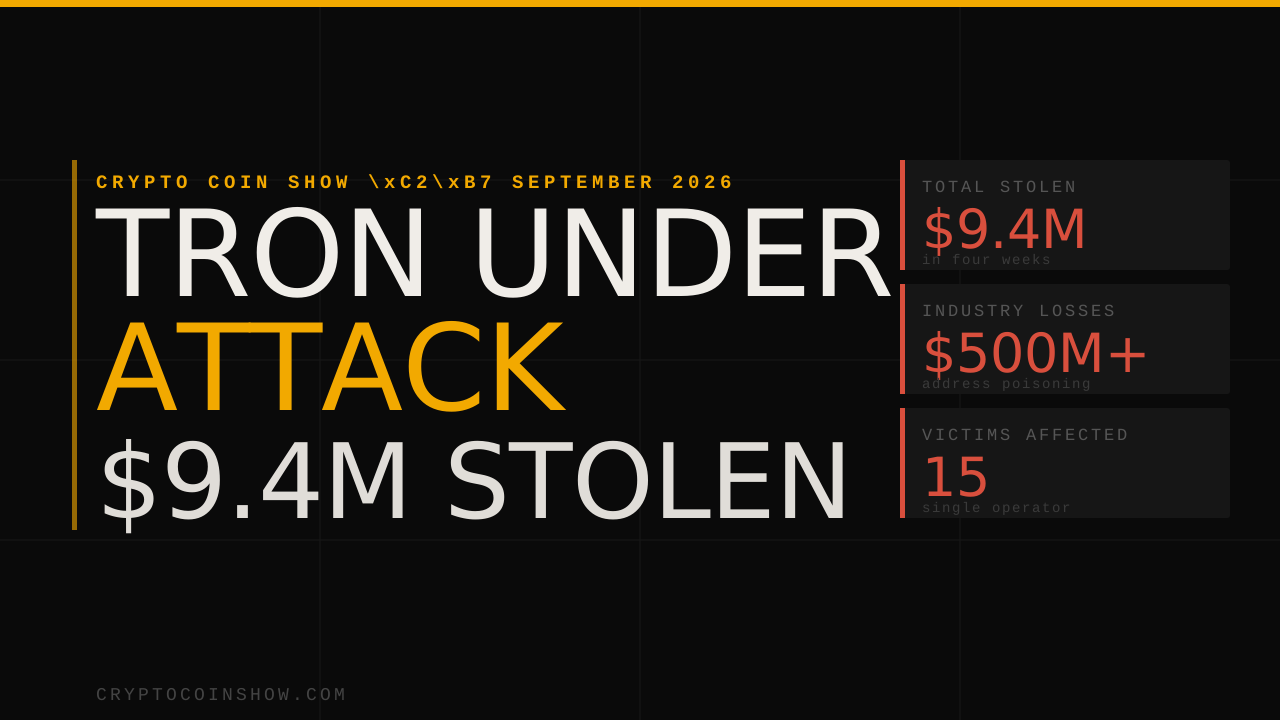 Tron wallet providers get called out as address poisoning attacks spreadAug 27, 2026
 CZ Says Software Wallets Avoid Risks Seen in Trezor LeakAug 14, 2026
 CZ goes after Etherscan for displaying address poisoning scams, offers up Trust Wallet solutionsMar 14, 2026
 Trust Wallet to verify wallet addresses for reimbursement Dec 30, 2025
More interviews
 Why banks are building for Web3 in silenceOct 5, 2026
 How TrendTrader Pro raised $1M for a token buyback fundOct 2, 2026
 Illia Polosukhin on NEAR's privacy features and AI agents in 2026Oct 1, 2026
 How Robinhood built its own blockchain to control compliance and feesSep 29, 2026
 Geo Protocol founder Yaniv Tal launches Geo Debates, its first productSep 28, 2026
 How Brave is expanding beyond ad blocking with Drew PotterSep 27, 2026