
Mike Weeks / SAGINT
Mike Weeks on tokenizing critical minerals for trade
In this episode
Global commodity trade runs on slow settlement and trust gaps — and most teams have no way to prove provenance without adding friction. Mike Weeks, Executive Chairman & Co-Founder of SAGINT, breaks down how SAGINT is building a compliant commodity exchange and settlement stack designed to digitize the lifecycle of critical minerals. Learn how tokenization can reduce fraud, improve auditability, and make mine-to-market traceability usable in the real world, plus how SAGINT thinks about OECD due diligence, Dodd-Frank 1502, and multi-jurisdiction compliance from day one.
sagint.com · @sagintinc on X · Watch on Refinitiv
- SAGINT addresses critical gaps in commodity trade by combining traceability, trust, and efficient digital trading processes for minerals.
- Team resilience is essential for startups facing financial pressure, as founders must prepare teams for worst-case scenarios rather than expecting smooth growth.
- High-performance teams require training in stress management and decision-making under pressure, which most tech startups neglect entirely.
- SAGINT emerged from studying carbon markets and discovering widespread documentation and traceability failures across traded commodities.
- Startup environments differ fundamentally from structured institutions like military or government, offering no safety net or guaranteed support systems.
Chapters
Transcript
Read the full transcript
0:00I'm Ashton Addison from the Crypto Coin Show and today on Blockchain interviews with Mike Weeks, executive chairman of Sagent, here to talk about resilience in high performance startups, working under pressure, and your long history working in some high pressure scenarios. How can we apply that to some of these innovative industries, especially these
0:22these founders that feel like they can't keep up with using AI and crypto and you know, the work never ends here. So, there definitely needs to be some resilience in there. I appreciate you taking the time, Mike, and welcome to the show. Thank you, Ashton. A pleasure to be here. Yeah, I'm excited to dive into your insights. I understand you've been working for over 20 years advising
0:43governments and elite teams in high pressure scenarios. Could you start off by giving a little bit of insight into that and sort of the resilience and the teachings that you've built through those experiences? Yeah, so let's go in reverse because this is a Crypto Coin Show and I am no expert in crypto coins and in fact I've only really been in tech for
1:10the last four or five years. And I got to the current position here of actually being a co-founder and a executive chairman of a of a tech company through my work as you rightly put it, working in high performance teams. I dropped out of school at 16, became a professional rock climber back long before social media which basically meant you were a dirt bike climber
1:32traveling the world. I went to about 50 countries. And I climbed a lot without ropes, did a lot of dangerous climbing. You to succeed in that domain, you have to learn how to manage your state. You have to manage your ability to handle high pressure situations, especially when climbing without ropes, especially when holds fall off in you know, in your
1:54hand. I've been hit by peregrine falcons 300 ft off the ground because I got too close to a nest that I didn't didn't know was there. I've seen friends die, of course. So I had a 9-year period where I was traveling the world as a rock climber. Then I went back into business as a coach. I made a TV series. It was really successful called Jack Osbourne:
2:14Adrenaline Junkie. I lived with Ozzy and Sharon for a couple of years in Los Angeles transforming their son. And on the back of that, I got so many interested parties wanting me to coach I went back to school, studied performance psychology, neurolinguistic programming, even clinical hypnosis. And for the best part 15 years, I have worked in business with high well, essentially
2:42coming in and looking at teams that were underperforming and turning it into high-performance teams. So, I've worked with every bank that you can that you can name, but I've also worked with US Marine Corps, lots of members of UK special forces. I've worked in the with the Indonesian and where I am now, and the Filipino military. And so, my focus up until working in
3:04tech was really around resilience and high performance. And those two go hand in hand cuz you can't have high performance without resilience. If you're falling apart at the seams because of the high-pressure environment you're in, then it doesn't matter how well-skilled you are, you're you're still not going to be opera- going to going to be able to
3:21operate. And we see this with some of the best and brightest minds who burn out over a period of time, and especially in tech these days, and especially with the pace and rate of change. And my god, if I was in the crypto markets heavily invested with the ride that people have been going on the last few months, you know, you need resilience because you need to also from
3:42resilience, you need the ability to actually be able to make let's say resourceful, clever decisions. When people panic, they make terrible decisions, typically. So, we my work with the US Marine Corps led me to meeting my co-founder, who was a lieutenant lieutenant colonel at the time at School of Infantry West. In our work there, we had various conversations
4:06about potential tech by opportunities that could be modeled from the military world and brought into the civilian world. And about 5 years ago, when COVID hit, my co-founder, Jacob CEO of Sagent, he retired, stepped out, and we set a business up that we built and sold in 8 months. And in that, we had a 2-year working with the company that bought us, and
4:31that was mostly focused on carbon credits and looking at the carbon markets. And from studying the carbon markets here in Indonesia and in Brazil and in other parts of the green belt, at the end of our 2 years, when we stepped out of that, what we realized was that there was a huge gap in the market it or traceability and compliance systems. And
4:53we didn't work on carbon market after that, we didn't want to. We chose critical minerals. But, the obvious gap in the market was literally looking at these huge volumes of carbon credits that were being traded and seeing that most of the documentation or the traceability was all junk. And so, that's why we created Sagent to step into the into that
5:18gap, where traceability, trust, and the ability also to trade efficiently, you know, with the new digital processes that we have, all of that combined in one. So, that's where we're at right now. That's what we do. Yeah. Very interesting backstory, and I'd love to dive into to Sagent and the crypto side a little bit more. But, I want to touch first on that translation
5:44of resilience and high-performance teams, looking at something like like governments or military training or rock climbing with no ropes and comparing that to you know running an AI or a crypto startup you may not be in a life or death situation maybe economically you are but how how what are some of the lessons you can take away from that to put into
6:07this new scenario? Yeah so it often feels like life or death scenarios when you're when you're a startup because I guess the number one problem for most companies is that they start running out of runway they start running out of money. And when people actually ask me you know what is the number one thing that you should be focusing on in the company
6:35it's the it's the from a team resilience perspective it's the ability to deal with those real lows the ability to deal with those dips because one minute you raise money and everyone's behind you and you're on a high and six months later you burn through it and you know the CEO or management is saying we've got no money you'll need to work for free or go on to half half pay for
7:02the next couple of months and we don't know if this is going to work and if you don't have solid team cohesion and I've seen this in I've seen this in special forces teams I've worked with dozens of police teams firefighters ambulance teams etc. In most of those frontline workers they're prepared Now they get burned out and they get
7:29PTSD and a lot goes on but typically they're much more prepared than startups or companies in tech through training. Nobody trains people in startups to be prepared for the worst that's coming, right? And then when the worst comes, everyone's expected to be their best. When in fact, what actually happens is it when people start going to let's call it a self a low-level or
7:56even a high-level self-induced play state of stress. Mhm. When that happens, that's the fight or flight or freeze response. And people will always fall back to the patterning, the routines, the habits of what they've they're used to. Right. So, people will always go back to their default. Very rarely will you will somebody say, "Okay, we need to take a step back here
8:22literal and figuratively and really understand the situation and let's take a deep breath and let's, you know, approach this from a problem-solving perspec perspective rather than, "Oh we're all going to end up being out of jobs and we've lost all of our investors' money." And I've seen that, way. I worked in Silicon in Santa Monica with a
8:47a startup academy called the Expert Dojo. And maybe over my 2 years there, 250 plus startups, many of them in tech. And so many of the investors who Sorry, so many of the founders who had who had raised investment from their friends, their family, people who'd mortgaged their houses, they live in a fantasy world expecting everything to be a smooth ride. And
9:12startup really isn't a smooth ride. I mean, there are plenty of frontline workers, special forces guys who would never last in a startup for 2 or 3 years. Right. Because if you're a firefighter, yeah, you're putting out fires and you're dealing with their bodies and you're rescuing people and you and but you're your wages are are always there. Your pension is always there. The
9:31system supports you and holds you. Mhm. In startup, no one's supporting you. Mhm. Right. There's there it is it is from the moment you dive into it, it's typically high risk. And the probability of it actually working out is very, very low. Mhm. So, what you can learn from high-performing teams across, you know, across different domains is training.
9:56You know, if you're if you're in if you have a team working in crypto mining, if you have a team working in AI, if you have a team working in tech, I guarantee they haven't been trained to deal with the worst-case scenarios. And that's essential if you want long-term sustainability. Mhm. Yeah, well said. And I feel like with the volatility of the crypto markets
10:19and the price of Bitcoin, you know, and not just for miners that are mining at which that's their revenue source, but for you know, it ripples to all all the different companies in the in the digital asset services and infrastructure, you know, if Bitcoin goes down, no one's hoping it does, but it sort of ripples out and affects people that even
10:45you wouldn't think you know, we're not using Bitcoin to pay or, you know, it's not really related, but it is related. Yeah, and I have an observation on that. And I think from hundreds of conversations over the last couple of years, when we tell investors or we tell customers or we tell decision-makers in governments that we work in tokenization, Mhm.
11:10immediately, as soon as you talk about tokenization, everyone assumes that you're a crypto a crypto bro, right? Or you're or you're attached to crypto. And so, we have to multiple times in a week Mhm. explain to counterparties the difference between what we do, which is we create tokens for real-world assets,
Mhm. and provide traceability and it has
11:34nothing to do with the crypto market. However, the current transition that we're in where people like Larry Fink are saying everything will be tokenized. Mhm. Those report those narratives are being reported next to and Bitcoin has just dropped another $20,000 today, right? And so there's a in the in the in the person who's uneducated about this
11:59stuff, there's an association. It's like a bit anything that's that's being tokenized, anything that's mentioned about on blockchain, anything that's mentioned on the current transition in the way that we are doing economic value chain, it's people link it to the crypto markets. Mhm. So if the crypto markets suffer, trust across
12:26these domains suffer unless you understand that there's Mhm. there is an absolute distinct difference. Yeah, I think we definitely still see that. You're seeing the conversation still, but I feel like over the last 2 years with the increase in awareness in Bitcoin, that there more people are waking up to the fact that there's the currency and
12:52then there's the blockchain and they are separate and you can use the ledger technology for transparency transparency and traceability and the fact that stable coins now have legislation and you can have assets that aren't crazy volatile. I think that's woken up a lot of big and small businesses to the fact that they can do tokenization without
13:16having the volatility like Bitcoin. Yeah, there should be no volatility. I mean, it should be the opposite actually because what with we're creating sequence of traceability that can actually tell you more about the underlying assets than you would get if you had a bunch of PDFs. Mhm. Right. And you And it's immutable. So, the level of trust should be should be in the
13:40opposite direction. The problem is, of course, is that for now so many people have have have not, let's say, updated their knowledge between the difference between tokenization of certain types of assets and crypto coins. Mhm. With the notion that Larry Fink has says everything will be tokenized. Of course, some things are going to come first.
14:06We're starting to see certain financial products, money markets, we're getting to, you know, private equity, and then public equity and real estate and all of this stuff down the road. Where is Sage Does Sage Act lie in that spectrum? Yeah, well, first of all, if Larry Fink's listening to this, please give me a call cuz we're happy to tokenize
14:27everything for you, of course. So, a year and a half ago, maybe almost 2 years now, we started opening up business channels in Central Africa. And the reason we did that is because those are some of the most opaque and least trustable markets. And so, our business model for business
14:57development has actually been to go into marketplaces that other people, certainly other people in the West and in the in the US, would try and avoid and they would shun a little bit because traceability just isn't there. There's a lot of corruption in these countries. There's a lot of misreporting if reporting at all. And so, we've gone into these highly
15:19volatile, dynamic marketplaces because they need it most. And originally when we went into the Congo it was that we wanted to look at agricultural tokenization for their exports what we term eco assets. So, any kind of function or service other than carbon credits, which is something we avoid, but any kind of function or service to the environment is beneficial that can
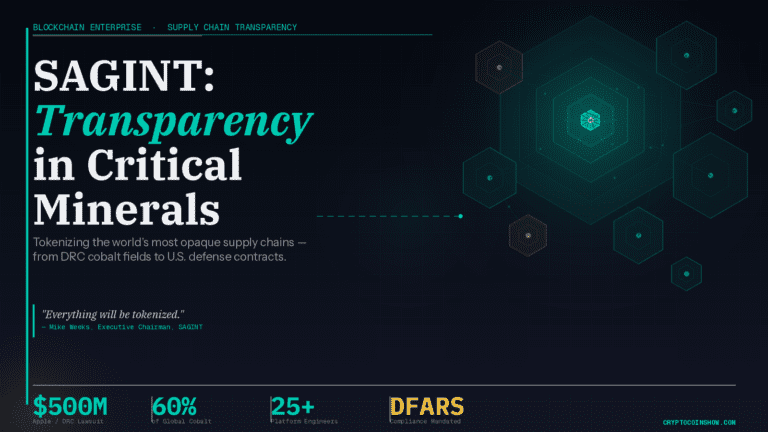
15:42be tokenized. But, what we what we saw when we were there and what we were actually asked to focus on and this has been the case now across other African countries is mineral tokenization. And of course the DRC Democratic Republic of Congo, they're responsible for I believe something like 60% of the world's cobalt. And most of it can't be bought by the
16:06US, it can't be bought by Apple because there are children in the mines, there's forced labor. Right? There's massive environmental degradation from their mining operations. And so on and so forth, you know, there are people who allegedly allegedly are being paid, but then they're working 18-hour days and they're getting emphysema and there's no health
16:25and safety, etc. etc. They're not They're not OECD compliant in any shape or form. And the problem with that is that some of these minerals end up leaking into supply chains that are OECD compliant and then Apple ends up getting sued as they are right now by said government for buying non-compliant minerals. Mhm. Makes Apple an easy target, but Apple doesn't have
16:49doesn't have the traceability in place. So, we saw that as a massive opportunity because one it feels very rewarding to be a part of prevention of child labor and forced labor in mining operations. Right? There are mines in the DRC that are typically American mines that are run exceptionally well with high standards of health and safety and
17:16Consideration for the actual miners. People take breaks, they get paid, their families are looked after, etc. etc. That's what we want to be a part of. Now, there's a massive demand of course in the US as we move forward with more microprocessors and robotics and defense, etc. There's a massive demand for more minerals coming out of these countries like here in Indonesia
17:40and coming out of mostly African countries. And so, we've positioned ourselves right now to be probably one of the leading companies for traceability of critical minerals coming out of these countries. That's a great use case and whether you can add to the prosperity of those in the mine and their well-being or just the opportunity for these large enter
18:07enterprises and conglomerates or Apple to get the lawsuits off their back, you know, if they if that's something that's you know, they are in a lawsuit for 100 million and you know, this technology is
I think. 500 million, okay.
I think the DLC is suing them for 500 million for Yeah, for non-compliant mineral acquisition. Yeah. E- Exactly.
18:28And if you can use tokenization to solve that, that's a great use case to prove. You know, with the it sounds good on the surface that tokenization and transparency on the blockchain or the supply chain can solve all the problems, but I feel like there still can be pockets of whether it's manipulation or error-prone, whether it's
18:57human input of some sort or the oracles getting price feeds or information feed onto the chain. What are the things that Sagen has to consider in when moving to a tokenization mechanism to make sure that there's no faults in it. Yeah. Well, I have that conversation regularly with Rajiv, head of tech, who's you know, who's led a team of 25 engineers to put
19:25this get the platform to where it is at the moment. And that's mostly because we're using AI, right? Of course, to let's say 2x optimize our output. Now, we could use AI to 2x sorry, to 5x or even 10x. But let's say one of our one of our engineers is generating without typing a single line of code themselves, is generating 10,000 lines
19:53of code in a day. Are we at a point with AI that we can trust that code? And the answer is no, we cannot. And so we still have a the problem that a human can be 2x, 3x, 4x. And this is why we're not doing 5x of code, because there's a limitation on what that human can check line to line running through the system. Because if we get a couple of lines of
20:20of error, that can affect second, third order further down the line. And then coming back and trying to find that. So the number one issue that we have right now is it's like giving a child a loaded gun almost. Right? Is it we have this technology that we know can absolutely trans the technology being AI, that can absolutely transform the way we do business. We
20:49utilize AI across pretty much every aspect of our internal operations in some shape or form. But with internal operations, there's a direct there's a direct recipient. Right? So when a document is help is generated and then it's edited, you've got a person looking at it. But with coding, that it's so prolific. We're creating so much code moving forward
21:14that it there's so much opportunity for error. Now, I'm pretty sure that and I'm told by people who are much smarter at understanding AI and coding. I've never written a line of code in my life, but I'm told that within a reasonable period, maybe 2 years, we will be able to use AI to check AI to check AI. And I personally, when I use if I if I
21:41write something Grok, I always throw it into one of the other major platforms and get it to write and I always say, "Hey, Grok wrote this." Or Claude wrote this. Or ChatGPT wrote this and then it creates some kind of competitive response to make it better and to check for errors. So, yeah, the number one challenge we face is that we have this tool that
22:01is so effective, but it still isn't there yet. Enough that we can trust it. And so, we absolutely every single line of code has to be read by a human. Yeah. No, that makes sense and it is making it, you know, 5 10 times more efficient, but can you trust it at the moment? Myself using it as well, I do have to check in Gemini or Grok. If I'm using Claude
22:25or like there's an error and it's wasting all this money and time trying to fix something and you ask somebody else and they have a different perspective. It's like, "Okay, this technology is not perfect yet." but it's definitely
of one of one of the big consulting companies last year very embarrassed, they charged 500 I won't mention any case I get the wrong one. But they
22:45they charged 5 or 600,000 dollars for a research project and it was all AI generated and it was wrong. Mhm.
Right? So, like there is a there and that reputation damage is worth more worth you know, it cost them more than the 600,000 that they probably had to refund. Yeah. So, we just we absolutely embrace AI, but we don't we don't rely upon it and trust it yet.
23:13And when we can say that we do, then I think the efficiencies can be 10x, 20x cuz you'll get AI managing AI. And then you get exponential output. Definitely. So, with the production ramped up and you know, the platform there and ready to be onboarded from Apple or these mineral mines, you know, and with you having explained all of the difference of this
23:41is not Bitcoin volatility, this is going to solve all these problems. What's the trajectory for, you know, the next year or so on actually getting this implemented and you know, adopted by somebody like Apple? Yeah, so we have customers in the in the mining industry right now. So, we work and you can read about this online if you put in Sagent ReElement. So,
24:06ReElement is one of the cutting-edge tech companies. I say tech, they're a refining company for minerals and they're using new state-of-the-art refining processes that are both environmentally more sound, more energy efficient, and just more able to extract the mineral the target mineral from the general ore. So, ReElement is an incredible company.
24:31They have huge backing from the US government, which again you can read about in the news. And so we have a contract with them to tokenize essentially all of the minerals that they're producing. Now, they are working very much within the US ecosystem. They have a defense contract and they're going to be providing minerals to the defense industry.
24:55For us right now, our main focus is working with companies like ReElement, and there are others that are on boarding right now. Because in January of next year, there will be a requirement for what's called DFARS compliance. And, DFARS is the, it's the defense federal, agency registration, something or
25:23other. But it's essentially ensuring that in the same way that I was talking about compliant minerals for, you know, lack of not forced labor, etc. It's the same thing but for the defense industry. It's making sure that they're ethically sourced. It's making sure that they're, because it's the defense industry, that they're ex-China. It's making
25:43it's ensuring that these are fully compliant for the US. There are thousands upon thousands of companies that by next January have to have that traceability in place for their what they're currently trading. Most of them don't even know it's coming. It's going to be a tsunami of administration for these companies. The Boeings of the world, the, you know, the Lockheeds,
26:06the, you name it. And so, our main focus right now, and what we've been putting millions of dollars and time and effort into is preparing to provide traceability and tokenization for, the defense industry in the US. So, we're going to be, obviously, one of the biggest buyers. I think by by association to those industries which have the highest standards
26:31imaginable, other companies in more in tech, in hardware, will be, you know, will be jumping on board as well. Hm. That's really exciting. I've talked I've talked to some other projects that were working on mineral tokenization for the sake of being able to buy and sell minerals while they were still in the ground or other, you know, derivatives of it. Is
26:56that Is that something that Sajen is involved in as well in that aspect or is it purely the traceability side? No, we have been we were asked by a Saudi group. We've worked extensively in Saudi Arabia. We were asked by a Saudi group if we could provide tokenization for based on assets. Like they have X amount of
27:23assumed gold in the ground or silver or tungsten or nickel. And when we looked at it, it's for us that's it's too speculative. And because we're working right now with the defense industry, the US government, and other sovereign governments, we don't want to risk any of our current reputation by going off the speculative projects. Now, you know, some of the
27:47I don't I don't know enough about the quality of those assets, and I'm told that many of them are absolutely or that, you know, they're essentially large-scale scams, but many of them are very accurate. I do see a massive gap in the market, of course, because how do you raise capital for these types of projects? Typically, you would go to
28:11large-scale investors, and you either get a yes or a no, and then you're off to another large investor. But to be able to actually do fractional investing, I mean, would I put a couple of grand into buying some tokens for a new mining project that says, you know, if I look at all the paperwork, that there's a potential 5x or 7x? Yeah, you know, and if I can do that on
28:31my own on my iPhone, and I can do it seamlessly, then why not? But it's not something that we're willing to risk going into yet just yet, you know, it's too speculative. Yeah, I agree. There is a market for it, and it seems, you know, a lot of the prediction markets and the crypto derivative decentralized finance that was based on speculation and that's why
28:55I have seen that around in the industry. But, having something legit, stable, and transparent that has defense contracts is also important and it's probably a good idea not to be mixing those two. Well, and it's and it's really important to distinguish distinguish the fact that what companies like Sage and there are other companies, of course,
29:15tokenize. They're tokenizing real-world assets. Mhm. So, yeah, your token is this let's call it somewhat it's it's an it's an objective reflection on what exists. I can go, if I want to travel across the world to go and actually touch and pick up the item that it represents, then I can. Mhm. Right? In the crypto markets, I it's it's so opaque, there's nothing
29:45there's nothing there under underneath apart from trust. And, of course, and a lot of let's say future hope. Right? My understanding would and you're the expert in this, my God, but you buy crypto coins because of a sense of trust and because you're somebody who actually wants decentralization in the financial markets. But at when it's all said and done,
30:11you know, when the tide goes out, you see who's been swimming naked. Right? With us, if the tide goes out, you can see that everyone's got, you know, their swimsuits on.
[laughter]
Definitely. And yeah, it you know, especially going back to the beginning of our conversation, when the runway runs out or when, you know, the price of Bitcoin goes down and investors
30:34Shy away from these startups, you're back treading water trying to stay alive. Exactly. Yeah.
Yeah. Yeah. Exactly that. Well, it sounds like you guys have a great thing going on. I would love to follow along with this. I think it's a great way for major companies to and defense contracts and you know, governments to implement tokenization and blockchain
31:01technology one way or another to get it solving problems and whether it's fraud or opaqueness bring transparency and trust into the real world and I think it's a great use case for blockchain. Yeah, couldn't agree more and whether you like it or not it's coming. Definitely. Is there a way to follow along to see you know, I you mentioned about the real element
31:27I can put a link to that in the show notes below and follow along with Sage and anything else that you might be putting out online. Yeah, we have a we have an X account with Sage and Inc on X. We're not very prolific on it in all truth because I as a as a small company you know, 30 plus people most of folks are working on in the same way we're tokenizing real
31:53world assets we're working on real world requirements right now. So we're not prolific on media. We will be at some point in the future I'm sure but Sage and Inc is where you get your information. Sounds great Mike. I appreciate your insights into the resilience and the high performance teams how we can apply that to crypto and then using tokenization to solve
32:14some real world issues with real world assets. So I'm wishing you and the Sage and team all the best. I would love to follow up again in the near future and thank you for the time. Thank you for having me on the show and I'll just say one thing to all of your crypto traders out there. I think probably resilience is as important as understanding the markets right now.
32:33Good luck.
Mhm.
Related coverage
 Bitcoin Holds $68K While the Whole World Burns.Apr 1, 2026
 SAGINT: Bringing Transparency to Critical Mineral Supply Chains Through TokenizationMar 18, 2026
More interviews
 Quantum computers could crack Bitcoin keys by 2028, says Postquant Labs CEONov 24, 2026
 0G Labs' Michael Heinrich on cheaper open AI modelsNov 19, 2026
 Why Wall Street is moving toward 24/7 trading in 2026Nov 13, 2026
 How Wallet V is letting AI agents trade while keeping your keysNov 10, 2026
 How Silent Payments Keep Your Bitcoin PrivateNov 9, 2026
 How XYO is building proof in a world of AI fakesNov 5, 2026


