Key takeaways
- Matrixport offers over 10 crypto financial products including trading, lending, yield earning, and collateralized borrowing on a single platform.
- The company's early clients were Bitcoin miners needing collateralized loans and yield products, followed by retail investors and non-mining institutions.
- Market cycles significantly impact user behavior, with bearish markets driving conservative yield-seeking and position-building, while bullish markets increase risk appetite and leverage usage.
- Institutional adoption has accelerated, with family offices, hedge funds, asset managers, and traditional brokerages becoming increasingly interested in crypto services.
- Matrixport was founded in early 2019 during a bear market by Jihan Wu from Bitmain, along with Zhong and Daniel, to provide comprehensive crypto financial services.
Building a one-stop crypto shop
Ashton Addison: What is Matrixport, and what problem were you trying to solve?▶ 00:22
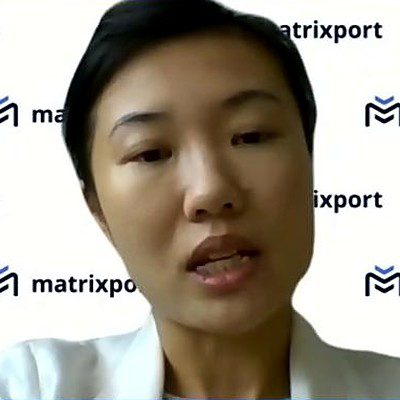
Cynthia Wu: I started Matrixport with Jihan, Zhong and Daniel about three years ago. It's Jihan's second venture after Bitmain. We were determined to build crypto financial services because the market was getting more mature, and more people, both institutions and retail, were holding crypto assets. What they needed was one platform that fulfilled most of their needs, if not all of them: trading, lending, earning yield and more. We now have more than 10 products on the platform. People can trade, lend, earn, and use crypto as collateral to borrow money. There are also asset management products for different yield expectations and risk appetites. Our slogan is "make crypto easy for everyone." It sounds easy, but it's harder than it seems, because customer needs are always evolving. We have to stay ahead of the trend to identify unfulfilled demand and make it available on the platform.
Ashton: How much did Jihan's name help when you launched in the middle of a bear market?▶ 02:52
Cynthia: Having Jihan's name there was definitely helpful. He built his first empire, Bitmain, and it's a successful business. When we started, at the beginning of 2019, the market was gloomy. Bitcoin was only around $3,000, which is far from where we see it today. It was the bottom of the bear market. But because of Jihan's name and conviction, a lot of investors gave us critical backing even in that very bearish environment.
In a bullish market, everything goes up, including the appetite for risk taking and the level of activity.
Miners, retail and institutions: who uses it
Ashton: Which kinds of customers have responded most to Matrixport?▶ 03:40
Cynthia: Today we have a good mix of both institutions and retail, but it took time to evolve. In the first year, our first clients were mainly miners. They needed to pledge their bitcoin to borrow as working capital, so we became a major lender to the mining industry. They also needed to trade and sell, and they wanted yield products on bitcoin so they could earn a bit more bitcoin. It's like virtual mining. The second batch was retail and non-mining institutions. Retail users want to earn interest on stablecoins and yield on the coins they hold, and they also want leveraged trading and staking. Institutional clients have also become more engaged. They are not crypto natives. They are family offices, hedge funds, crypto funds, funds with DeFi strategies and smaller asset managers, and we even see brokerages and corporates getting interested. That has grown a lot, especially in the last year, given the pandemic and the macroeconomic background.
Ashton: How does client behavior differ between bull and bear markets?▶ 07:12
Cynthia: In a bullish market, everything goes up, including the appetite for risk taking and the level of activity. It's multiple times that of a bear market. In bear markets, people look for safer yield and are more realistic about it, or they want to preserve their bitcoin and accrue more. People who have been here long enough realize this is a very cyclical market. For long-term believers, a bear market is a good time to build their position again, so there is more demand for collateralized loans. They use their bitcoin to borrow crypto and make more investments so they're better positioned when the bull market comes. But because the price outlook isn't clear, they don't do it very aggressively. When the market bottoms out and the outlook brightens, people accelerate. They take leverage through leveraged trading and by borrowing more aggressively and investing more aggressively. At a tipping point, when the market starts to look a bit overheated, the more vigilant institutions start to lower their leverage.
How Matrixport picks DeFi yield
Ashton: How do you decide which DeFi protocols and products to offer, given the range of risk and reward?▶ 10:08
Cynthia: We've offered DeFi yield products since last summer, and we've seen strong traction from both retail and institutions. They streamline the process, so people get the benefit without the hassle. We look at three things. First is liquidity. We are not purely yield-driven, because very high yields may not be sustainable, and a shallow pool's yield drops immediately once you deposit a sizable amount. That means we may skip very early-stage protocols even when the yield is crazy. Second is security. Security first is always our culture across all of Matrixport's products. Before we offer a protocol, our security team audits the code. Most protocols we work with are already audited. For the few that aren't, we act as the auditor, looking at the code one by one and grading it. Third is yield, which has to be both attractive and sustainable. We keep a watch list of 20 to 30 protocols and move funds across 15 to 20 of them at any one time to capture relatively high yield. It works like a smart pool, moving quickly on behalf of our clients. As an individual, that would be basically impossible to follow and carry out, or to bear the cost of.
Security first is always our culture across all of Matrixport's products.
Series C and the road beyond Asia
Ashton: You recently closed a Series C. What can you tell us about it?▶ 14:33
Cynthia: We closed our Series C last month, and it's an important milestone for the team. The valuation was above $1 billion, which makes us one of the newest unicorns in the space. The round was led by DST Global, a leading growth fund, with some of the most influential and largest Asian family offices in Hong Kong and Singapore. That's strategic, because those are two very important markets for us at this stage, and having those families behind us matters for our growth and credibility. We're also still backed by our early Series A and Series B investors, which shows their confidence in us.
Ashton: Where will the new capital go?▶ 15:54
Cynthia: First, we'll continue our R&D. We've recently added a lot of hires in our development and product teams, because the core capability behind our fast growth over the past two and a half years is product innovation, a robust product experience and good UI and UX. Second is security. Our AUM is currently $10 billion, which is not small by any measure, so we'll keep investing and build an even bigger security team. Third is our global footprint. We're primarily in Asia, with 70 percent of our user base there, but we plan to expand into the UK and the US. We recently made hires in London and Australia, and we're planning to apply for relevant licenses in the US, so hopefully we can become a truly global crypto platform.
This interview has been edited for length and clarity. Recorded September 2021.