
Kha Nguyen / Birdeye
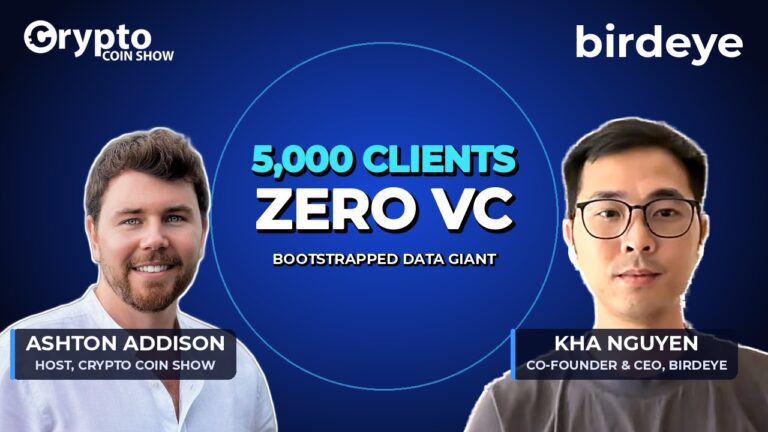
How Birdeye bootstrapped to 5,000 enterprise clients
In this episode
Crypto data is only useful if it is complete, fast and right, and Birdeye covers thousands of data sources across the world's chains with no venture funding behind it. The company started as a website for tracking token price, volume and trading venues, then grew into data infrastructure that now serves over 5,000 enterprise clients, including wallets, decentralized exchanges and analysts.
birdeye.so · @birdeye_so on X · @birdeye_data on X
- Birdeye aggregates data from 4,500 sources across 20+ blockchain chains to power over 5,000 enterprise clients including wallets and decentralized exchanges.
- The company bootstrapped without venture funding after failed fundraising attempts during market downturns like FTX and Luna collapses forced monetization.
- Data synchronization across hundreds of exchanges presents the core technical challenge, requiring anomaly detection to filter manipulated prices from smaller venues.
- Birdeye delivers market data with 2-3 second latency from trade execution to client display, with engineering efforts underway to achieve subsecond speeds.
- The company prioritizes building infrastructure independent of market trends rather than chasing short-term narratives like memecoins or tokenization waves.
Chapters
By the numbers
Transcript
Read the full transcript
when your data coming from 4 500 sources, they're going to disagree with the data coming from the other source. And not to mention in many small exchanges, many of the time the price going to be manipulated by by some items. So it may cost like a very very weird data points like a meme coin with a price of $1 million and things like that does happen.
[music] Ashton Addison from the Crypto Coin Show and today on blockchain interviews we have ha co-founder and CEO of bird eyee. You've probably been using bird eyee for years without knowing it. It's the data behind a lot of prices you see today across 4 to 500 of the top exchanges and price feeds and much more. And we're excited to dive into the back end of
that as RWA and tokenization and institutional adoption are growing blockchain and making it more mainstream. Ha, welcome to the show and thanks for taking the time.
Thanks Ash for having me.
Yeah, very very welcome. I would love to start out with a high level on what you and the team have built at Bird Eyee. Many people have never heard of
it, but you're sort of powering the back end of crypto going mainstream right now. So, could you explain a little bit more on what you actually do and the problems that you were solving when you started out?
Sure. So Buddha has been around for about more than 5 years. We started off with just a website for people to tracking token performance
like price, volume, where the tokens be what venues are the token being traded on. But then we evolved into one of the data infrastructures. We currently power like over 5,000 enterprise clients around the world like thinking about all the wallets, decentral exchange analysts like all the tools like that. They using our data to improve on the user
experience or also to do to make up on the analyst about the crypto market. And yeah currently we started off with the Solana ecosystem but now we cover multi chains we are supporting over 20 chains right now.
Nice and at one point there was thousands of chains and a lot of them have have sort of died off. But we are seeing pretty strong adoption with
you know some some some of these major chains. How how has that evolved in starting with Salana and Ethereum and then deciding, you know, is this chain big enough to start including? Is this wallet big enough? Is the is there extra load on the system or can you just start partnering with everything? Well yes you're going to need to observe the markets right. So we
we started off on Solana because Solana was such a good chance for the retail traders, retail investors. And there are a lot of retail traders over there. But then those investors, they don't really stick to one chains. They also park their assets somewhere else, right? Whenever there's new chains, there's something new coming up, the new layer one, new layer
two. The most recent one is obviously Robin Hood and there's a lot of users moving over there. So we observe that the market data and we see that okay the money is we follow that money flow right so when we see that okay there's a lot of assets moving here there's a lot of asset being allocated into that blockchain then then then we going to just
follow that one and we support that and you can see that now there are probably hundreds of thousands of chains but the asset is actually concentrated into only like less than 20 chains on the other hands don't really have that type of you know trading activities at all.
Mhm. Definitely. And when you started 5 years ago, I understand that the company
was fully bootstrapped and decided they didn't need to raise from VCs who you said they keep switching, you know, to the next chain and the next chain at trying to capture opportunities. Can you talk about that decision of bootstrapping and has it paid off? Well yes that is a interesting story is that is not that we don't need to raise but whenever we try
to raise there's something happen right like as as you know in the in the crypto market like things happen and whenever we try to raise we think that okay this is the time to involve more experienced investors we need some more capital we need some more advice we need some more you know knowledge and then something happens like you know FTX
Luna and you know like a lot of things can happen that affect the way that the investor deploying their capital and then there are some that's some point in time we couldn't raise the fund that we need and then we actually have to force ourself to monetize on what we already have and then that turns out to be pretty good decisions because we
survive like all of those downturns of the market and here we are I mean in the future I don't know maybe we there will be some more times that we might need to raise fund but then yeah it is not that we choose to not raise fund but then the whole market forc us to be who we are today and I'm pretty happy about
it I don't really complain and that's good
yeah it's nice when you know you are your own boss and it's great to have partner ers that can add capital. But the way that the situation works out and going through the turmoil, 95% of crypto companies died through those bare markets. So, finding a will in a way to make it through and bootstrap and
build and be forced to find that product market fit and get the revenue streams going. You know, it sounds like it's worked out for you guys.
Yeah. And I think one of the thing that we do a little bit different from many other projects is that well many projects when when they start to building products right they want to follow the trends right
it is like the wave is going up the market is going up so they want to build something to follow that trends whether it is memecoin whether it is tokenizations and everything but for me I really want to build something that is more independent from from the trends so that means whether it is like there's this trend or the other trends we don't really
being affected that much. Somehow we can have our own timeline we can have our own agenda and we don't really being affected by it and that's how we try to build our business around. I mean I don't I cannot say that we are success on that yet but then it's still working for us so far. Yeah. No, I agree. If you try to jump on a trend that only lasts one month,
then, you know, and you're trying to build a long-term stable business around it, you don't know how long the trend will last, but often these narratives keep shifting like the VCs are looking for the next big thing, but is this something that will be around in 5 years, you know, and or should they be focusing on NFTTS, which ended up dying? Or they may come back
in a different way. But I think that's a good way to look at it. With Bird Eye having so many partners in hundreds of exchanges, thousands of wallets, the 20 chains, what's the hardest part to manage of all of that? Cuz I can imagine I have a portfolio of 100 different coins. I'm going insane trying to manage all these different areas. So when you have thousands of different
partners, what's what's hard about that? Well the hard part is obviously synchronizations. It's like when your data coming from four 500 sources it's going to be very difficult to have them agree with the with each other right like the data point from this source going to be they're going to disagree with the data coming from the
other source. And not to mention in many small exchanges many of the time the price going to be manipulated by some by by some items. So it may cost like a very very weird data points like a meme coin with a price of $1 million and things like that does happen. So how can we getting data from everywhere but then we have them to agree with each others.
we had to remove all the all the anomaly and then we shift to our clients servers in under a few seconds. So the so the coverage and the freshness of the data make it really really difficult. And it is what we have been trying to solve in the last five years. We have a pretty good system running right now. We are delivering under I think like now
it's like two three seconds from the moment when a trade happen anywhere in the world to the moment that our clients can actually display that information into their front end. So that's a is a pretty hard difficult problem that we solve but we want to push it even further. We want to have a subsecond latency and yeah it is an incredible engineering problem
that we are trying to solve. Definitely I'd love to learn a little bit more on the positioning and understanding bird eye. You know, I'm familiar with chain link and that they use oracles to grab price data and bring it into DeFi and without that you know the blockchain would not be able to it doesn't have a price. The price is set from the markets and that's how it
goes into into there. So is Birdy competing with them in that sense or is this different? It is different because to be honest we are solving two different use cases. I mean we are good friends with chain link and pizza as well. And what they are solving is that they're going to provide a very accurate timely price
point for a very selective number of assets. We are talking about bitcoin, soul, ether, ether and you know like on the top tokens right and their data can be used for trade executions so on the exchange so lending protocol they can rely on that kind of data to do the trade executions but they do not support like small meme coins on the fresh tokens that just
being added liquidities somewhere right so they have their very specific use case and what we are trying to solve is that we want to provide to the market the most the most fresh new data and in the shortest time possible. [gasps and sighs] so let's say there in the market right now there's like over like a few million
tokens being issued and then there's like thousand of tokens being issues and new nearly every day right so we want to spot at the moment when that tokens being issued and then being and the liquidity being added in on radium or on any small exchange somewhere we want to know about that one and we want to send that information to
our clients so that [clears throat] on the our clients like the wallets, the taxes they can use our data to display that one into to you as a users right you can see that for example if you get adopted some new tokens right you can know instantly that okay it is on my wallet and this is the price of it and this is the value
of that amount of tokens so we are solving like totally different use use case Definitely. No, thank you for explaining that. And you talked earlier about verifiability and getting the information fast, but making sure it's accurate and the potential for manipulation, especially on newer coins or lower liquidity exchanges, small exchanges. If two sites show potentially
different 24-hour volumes for the same token, which one is right? And how do you determine we actually have a have a very sophisticated system to detect like which one is accurate and which one is actually there are like two cases right when you see something different like for example token price being double right there could be
it could be manipulation or it could be something real just happening right how [clears throat and snorts] can we know that it is like the fake one or the real one. Then we're going to base on the different different parameters. We're going to look at okay where that trade actually happened. Is that in a very high liquidity venue or is that just a
very new a very small liquidity exchange? And then it's like how what is the trade volumes? Is that like a 0.1 volume or is that like $1 million traits? And that going to tell us a very different stories. So we do look at all of those and we have to make that decision just in a
fractions of a second. And then yeah I mean that is something that we do constantly because that kind of noise is actually happen more often than than you think. Definitely. And there can be a big difference between a lot of volume and a lot of liquidity. And especially on some of the sketchier exchanges and the large exchanges, they're using market makers
to make the market. and some of the smaller exchanges, they're probably pushing up the volume a lot and maybe wash trading. How do you determine the quality of the that volume on and to you know it might show $100,000 volume but if you try to buy 10,000 of some small token it might have huge slippage.
Yeah, there could be some other set of
parameters right. There's something that we call the capital efficiency. It is like we're considering the volume and the liquidity of the market. And then we can also take a look at the how many you know wallet address actually participate in that market with us count on the unique wallet address. So that can that can be a parameter as well
for us to determine okay this is like they have 100 millions volume but then if I don't know if 40% 50% of that is just being generated by 10 wallets then then that then we going to rate it differently from you know we have that decentralizations of a volume generated in another markets
Mhm. M
so yeah all of that had to have had to be thought through and we have been you know like do it and then revise it and refine it in the last 5 years there's a lot of cases definitely and you and the team at Bird Eye had presented at Salana Breakpoint the top Salana conference a few years ago as an insider on the knowledge of Salana network growth do you still
think it's you know the right choice in how you started bird eye starting on Salana and do you have are you optimistic about that network moving forward? Yeah when talking about Salona I feel so lucky because I choose to build on Solona since five years five years ago. Well before but before but I was actually the head of product
at Soulcan which is the default explorer for Solana. And I'm still being surprised by the ecosystem every day even even now because Solana the interesting about that ecosystem is that it does have a directions right the founders of the Solana foundations they does have have a general directions of you know building the fastest decentralized machine
In the world but then how they did that actually change u based on the market right like you remember like back then when the meme core happens and now we have the internet capital market and then we have the you know all the asset tokenizations so the whole ecosystem actually swift based on what the market wants but then the general direction is still
there and that's what I like about it is you know the best system is a systems that change right because otherwise if they just stick to one method, one way of doing things, then it's going to be very very fast. They be they're obsolate. So yeah I think Solana is an incredible ecosystem, incredible network. There
are so many people active and there's so many talented engineers and talented people like doing both business and community in development. Yeah have it has been like five six year and I still very enjoy it. Mhm. I appreciate the insider insights and because it's a lot to follow all of these chains and I think Salana still is a top contender for helping
tokenize the financial system as well and of course Ethereum and I want to dive into that next because recently and over the past year or two we've seen a lot more institutional adoption and real world asset tokenization and tokenization of other financial products. and merging them into decentralized trading and blockchain networks. And that's probably opening up
more avenues for bird eye. You're not just tracking the data for digital assets and the top bitcoin and these altcoins. There's traditional financial products now that are on chain. So how has that evolved with bird eye? Well firstly well there are much more assets on there are much more valuable assets on China now especially with the tokenizations of all
the reward assets for all the stocks and you know gold and treasuries and the data now we actually have to be much more standardized you know like with the crypto data we it is very noisy and normally does there aren't any you know common standards among all the data providers but now with all the access coming
from the traditional finance they are very standardized right like when talking about all the SEC regulations like all those stocks they are in the same format there are some certain standards that we actually have to follow there are some concepts that we actually have to learn and adopt from the chart file to defy. So yeah, we actually
have to change quite quite a bit in the way that we do business because in the crypto world, we can defy some some some concept, right? We can put up with the new names and everything. But when we work with on the chart five assets we actually have to adopt all the on the concept that is already being defined for 100 years like
stocks like treasuries like bonds and everything we have to use all those words so that we keep it familiar to all the investors. So yeah there's a lot of thing we learn we adopt it. And then technically we also have to include a lot of offchain data as well. So we have the onchain data but now we also need to include all the offchain data like
coming from on the exchange like NASDAQ NYC and SEC as well. So from from all those places we have to merge it with the onchain data that we already have to bring the better pictures to the traders and investors. So that is a challenge, but it is something quite fun to solve as well.
How quickly do you see RWA tokenization
growing as a business sector inside of Bird Eye and when do you expect that the market cap of that sector might outpace crypto? Well, that is a very good questions because currently it is already in our business. So we do have some APIs that expose the information about those RWAS through BA API pack. And there are
already some some some projects some clients already use that one to display reward assets on their tools on their wallets on their website. But then it is it is just the beginning right. And also the number of asset being tokenized is actually not that much. Well I mean there are thousand of them but it is still like not that
many. there will be much more when you know currently we mostly about the US stocks right but then when it's when it's expand and being accepted in Europe in Japan in Singapore in Hong Kong then in China then there will be a lot more accepts so I'm quite positive about the about the trend because the you know the
benefit is quite obvious now everybody in the world can trade own those regulated assets 24/7. And you know if you are in the US you can actually buy some stocks like being issued in Japan or even in Vietnam and vice versa like for us here we can buy some assets like being issued in the US. That is that is something very exciting right so I believe like all
the good things will have the time and then whole trend going to going up. But then from from our side of view like with that belief we are building our data products to fit to that futures. We are we will have more RWA APIs so that our clients can consume. We're also building more institutional
tools as well some dashboards so that people can go and go over there and to track for the trends and maybe spot their new opportunities and to track their portfolio for example. So you know the possibilities are limitless for us. Yeah, it's an exciting time in digital assets and you guys are going to be busy with the amount of tokenization
and institutional partners coming in. [laughter]
So I hope so.
Yeah, I know. So thank you H for all the insights into this. I'm wishing you and the team all the best at Bird Eye and keep bringing us fast reliable data so that people can make decisions in decentralized finance and regular finance as they move move into the web 3 world. So I appreciate you
taking the time.
Thank you Ashton for having me. Enjoyed a lot. [music]
[music] [music]
Related coverage
More interviews
 How Anvil lets you use crypto as collateral without sellingOct 6, 2026
 Pawel Mastalerz on how Daski helps AI agents navigate the webOct 6, 2026
 Why banks are building for Web3 in silenceOct 5, 2026
 How TrendTrader Pro raised $1M for a token buyback fundOct 2, 2026
 Illia Polosukhin on NEAR's privacy features and AI agents in 2026Oct 1, 2026
 How Robinhood built its own blockchain to control compliance and feesSep 29, 2026