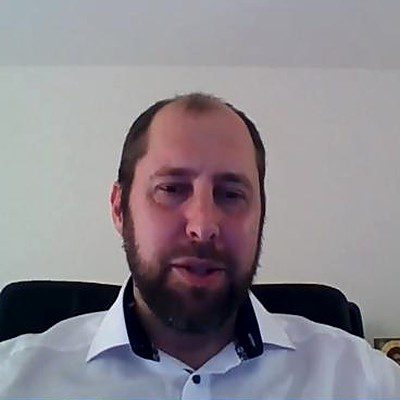
Key takeaways
- Zenotta developed a data formatting technology that creates scarce, ownable digital files independent of access, solving the problem that data doesn't behave like traditional property.
- The company uses identity-based ownership rather than access-based ownership, allowing files to be recognized as property by institutions like banks.
- Zenotta's peer-to-peer trading system combines asset ownership transfer and payment in a single blockchain transaction, providing full cryptographic protection.
- Andrew Kessler's background in chemistry and computer science led him to recognize blockchain as a state transition system after reading the Ethereum white paper.
- The Zenotta network was scheduled to launch in Q1 2021 after years of self-funded development focused on solving data ownership problems.
From skeptical chemist to blockchain founder
Ashton Addison: You've been an entrepreneur for a long time. How did that journey lead you into blockchain and to founding Zenotta?▶ 00:21
Andrew Kessler: I started in academia, studying as a biochemist and ultimately an organic chemist, which tends to make me more conservative and more skeptical. One of the differentiating points about Bitcoin is that it didn't come from a university, a military lab or a government. In 2009 I was still quite skeptical about Bitcoin and even blockchain. I'd heard that's how drug dealers get paid, and that was the extent of my thinking. I met my co-founder and CEO around 2013 or 2014. He had just come back from Switzerland, where he'd been involved in meeting the founders of Ethereum, and over coffee one day he encouraged me to read the Ethereum white paper. I come from a very old computer science background, and I realized from my chemistry training that there are chemistry descriptions of how computers work. Some classes of computer are called state transition systems. When the white paper described the ledger as a state transition system, a light bulb went off. I'd been working with biometrics and hardware-level cryptographic security protocols, so this was an opportunity to come into a very young and vibrant space. I told my co-founder this was going to be big, and that we had to do it right and do it slowly.
Data doesn't behave the way property does.
Making data behave like property
Ashton: What is Zenotta's exact focus, and what problem is your team solving?▶ 03:08
Andrew: I'm more excited to talk about the why than the how. Data doesn't behave the way property does. If a bank issued a ten-thousand-dollar bearer bond and I photographed it and presented the photograph, the bank wouldn't accept it, because of functions like copy and edit. We can't apply the legal framework of property to files. We have a well-understood framing of what assets mean in the real world, but what is a digital asset? So we created a data formatting technology that takes a PDF or a JPEG and turns it into something scarce, a singular copy of ownership that doesn't require access as the basis for ownership. The problem with the incumbents' use of hash functions as pointers to assets is that a fingerprint only shows the asset hasn't changed. If you have a JPEG of a bearer bond on your phone and it hashes correctly, that doesn't give you the right to own it. What we built is identity-based ownership rather than access-based ownership. Imagine I have a special pen that writes green binary and you have one that writes red. Every file in my system is green and every file in yours is red. Access has nothing to do with ownership. That was our first patent, developed back in 2016. It lets you own your copy of a file independently of my copy. Your application layer renders it identically to mine, but on disk it's written in a different color of binary. So you can take your JPEG to the bank, and they will recognize it as property.
Ashton: How does this work in Zenotta's peer-to-peer trading system, and what makes it unique?▶ 07:48
Andrew: We created a double entry on our ledger. Say Alice is the client and Bob is a merchant. Alice pays Bob in the first line of the double entry, and in the same transaction Bob signs his uniquely provable, ownable file over to Alice. So we can carry out an in-game item trade and the payment for that item as a single entry in our ledger. That moves away from a coin ledger that can look like a ledger of gifting, where you wonder why Alice just gave somebody Bitcoin. The other problem is that if you try to move ownership off chain, through a VM or some other construction, it doesn't have the same cryptographic protection from the blockchain. We're literally giving you the rights to that unique, privately scarce file in exchange for the payment. So the distribution of the product and the distribution of the token are fully distributed.
A proof-of-work network built for scale
Ashton: Where are you right now, and what's coming with the network launch?▶ 09:43
Andrew: We realized that not all value in the universe is well described by tokenization. A vote, or my right to be the author of some work, doesn't fundamentally require a token. So we've tried to capture the value of data socially, legally and economically, beyond a narrow token understanding. Scalability is a unique problem for us, especially at the rates data gets transferred and updated. We spent a lot of time building a proof-of-work network. We're very strict on old-school fundamentals, and we like UTXO thinking and stack frameworks. We've developed a proof-of-work blockchain that reaches about 800 transactions a second in testing, and when we go live we expect it to handle up to about 25,000. It maintains the security level of something like Bitcoin. We're big fans of Satoshi's original insights, and we're not particularly fond of proof of stake for providing the security level you need for something as valuable as data. Within the next six months we'll launch the commercial version of the data formatting technology. In the first six months it will be a token-heavy network, mostly sharing the payments alternative. We want people to become comfortable with how we've extended proof of work and to understand our consensus mechanism. Next we'll release the data protocol, and then a suite of languages for integration into applications. It's going to be a very busy next year.
We're literally giving you the rights to that unique, privately scarce file in exchange for the payment.
Token economics and the road to adoption
Ashton: What does the token do, and how does it create a sustainable ecosystem?▶ 13:16
Andrew: You can start with the utility a token offers, and that scales roughly with the square of the number of users. A network with 10,000 wallets is far less valuable than one with 100,000 or a million. On volatility, it's a simple observation in economics that if something is scarce and finite in supply, its price must be volatile against supply and demand. What stabilizes the dollar in the long run is that it's backed by goods and services. That's one of our real strong suits: we have a GDP of data. Initially the token could be priced at its raw production cost, the electricity consumed to produce one token, and then according to token supply and speculation. Bitcoin is not a perfect analogy, but it's like the old gold standard. The U.S. had to move off the gold standard because the economy outgrew the gold supply. We'll reach a point where the value of the smart data assets, goods and services created on our network outstrips the value of the tokens. Then we'll have to move away from the gold standard towards a token backed by the goods and services under management. We expect good growth in the token price over the first couple of years. Once the economy moves from exponential to more marginal growth, we expect the price not to crash but to level off and stabilize.
Ashton: What challenges do you anticipate in getting mainstream adoption?▶ 16:51
Andrew: Unlike a one-sided ledger that only has to worry about building token supply, we also have to build out smart data supply. In the early days, our economic growth strategies will centre on building up that supply. It's a tight walk, because we don't want the token supply to grow too rapidly and hurt the token price during the speculative phase. The trick is not to focus on one data asset type but to build a topology of different data asset classes, just as a traditional bank has asset classes with different risk profiles. We'd like to partner with several banks to help build a data asset risk topology. One difficulty will be forming those partnerships. Like all tech companies, we're a relatively small, lean startup going fast, and that can create challenges when integrating with very large organizations at scale.
Ashton: How can the community follow Zenotta's progress toward the network launch?▶ 18:29
Andrew: You can go to our website, contact us and register your interest. We have staff managing that site, and we'll be posting a lot of media milestones as we roll out. We're looking for feedback and integration from the development community, not just the usual stakeholders. I'd prefer to see more engagement within the development community and get our fundamentals correct, because if our fundamentals are good, we'll win. That will be our focus over the next couple of months.
This interview has been edited for length and clarity. Recorded February 2021.