Key takeaways
- TON Labs developed an operating system and developer tools on top of the TON blockchain protocol originally created by Telegram's team.
- The project launched as FreeTON in May 2023 with a decentralized governance model and no token sale to avoid regulatory risks.
- TON Labs uses a meritocratic token distribution model rather than traditional ICO or token sale mechanisms.
- The ecosystem provides developer tools including C/C++ and Solidity compilers, SDKs, and bindings to simplify blockchain development similar to Firebase.
- The network has grown to include thousands of active developers and teams participating in governance and development contests across various use cases.
From Silicon Valley to Free TON
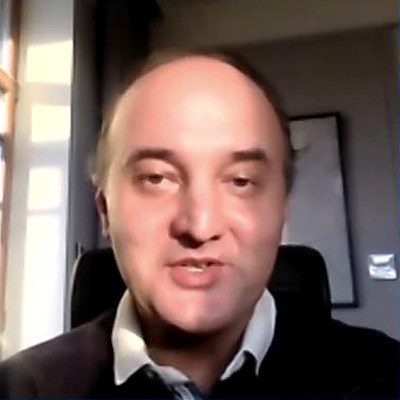
Ashton Addison: How did your background in finance lead you to blockchain and to co-founding TON Labs?▶ 00:21
Alexander Filatov: My career splits into three phases. I spent nine years with a multinational corporation, running a few large industrial companies in Europe. In 2015 I went to Silicon Valley, spent some time at Stanford and Singularity University, and got carried away with exponential technologies. Blockchain was on top of that list, though it wasn't yet the most obvious one back then. I co-founded a fund called Industry Zero to invest in those technologies, and in 2017 I focused completely on blockchain.
Ashton: What is TON Labs, and how did the project come about?▶ 01:11
Alexander: The project was conceived and originally developed by the Telegram team. They wanted to build a backend, the Open Network, integrated into the Telegram messenger so its users would have direct access to a blockchain platform and cryptocurrency. We co-founded TON Labs to complement that effort by developing an operating system on top of the blockchain. If the blockchain is a decentralized microprocessor, real adoption also needs something like Linux on top of it, with developer tools, bindings and parsing databases. Telegram raised $1.7 billion, which drew the attention of the SEC. They lost in court and had to disengage. By then there was a community of about 1,000 developers and ours was the most prominent team. We knew the protocol intimately and had developed more than three million lines of code on top of it. So we teamed up with 22 other teams, picked up the open-source code and launched in May last year. We made a few changes to the business model. We went for serious decentralization of governance, and we decided not to do any token sale, to stay immune to regulatory risk. We also rebranded to Free TON. Free means free software, and it also stands for freedom: governance open for everybody to join. We've just finished what we call the foundational year, in which we proved the technology works. Now we're moving into a growth phase focused on adoption and use cases.
There was no token sale, so people have to do something for the ecosystem in order to get tokens.
Attracting developers and rewarding contributors
Ashton: What are you doing to attract developers to build on TON rather than other blockchains?▶ 07:07
Alexander: That's what I mean by the TON operating system. A large part of it is a set of developer tools. We have two compilers, one for C and C++ and one for Solidity, which helps developers coming from the Ethereum ecosystem. We also have a comprehensive software development kit and bindings such as Kafka and GraphQL, which help you parse the blockchain. Think of the Firebase experience, which simplified mobile development about 15 years ago. You spend much less time developing for the blockchain than you used to. It's all live. We're seeing about 3,000 teams or people active in the ecosystem chats. Even for complex contests, like decentralized exchanges, we had four submissions, and for NFT marketplaces six quality ones. That suggests teams find the ecosystem robust to build on.
Ashton: How does the token fit into the ecosystem, and how is it distributed?▶ 09:29
Alexander: There was no initial token sale of any shape, which matters because you don't attract people who come to make quick money, as sometimes happens in other networks. There was no token sale, so people have to do something for the ecosystem in order to get tokens. Ten percent of tokens, 500 million, is allocated to developer adoption. A large chunk is allocated for partnerships. Say an existing blockchain use case can't work on other networks because of high fees or not enough throughput. It could migrate to Free TON, and we would have tokens to cover significant integration costs and to power its use case, for example with TON Crystal as the token in a loyalty program. Think of Wikipedia: someone challenged the world to build the largest library of knowledge, and it happened. We want to build the largest ecosystem, going beyond knowledge into real use cases and adoption. It isn't free, though. Those who contribute are rewarded with tokens, become stakeholders and become even more passionate contributors. That creates a snowball effect.
Governance by contest
Ashton: How does governance work on the network?▶ 12:35
Alexander: The network was launched by 23 independent teams a year ago. TON Labs does less than 0.1 percent of what happens in the community. We stimulate what we call sub-governances, which are essentially DAOs: groups of passionate people united around a language or geography, or around a functional area. We have eight geographical or language ones, including Korean, Indian, Chinese, French, Japanese and Vietnamese, and 27 functional ones, such as NFT, DeFi, esports, developer experience and DevOps. Each group gets a token allocation and works on its own domain. What differentiates us from other networks is that others typically hand out grants. That's quick and easy, but you get no competition, and typically when folks get grants, they tend to relax a little bit. In our case it's always contests. Multiple teams compete against a short deadline, and you get a diversity of solutions. In NFTs, for example, we got six quality submissions and each took a different stance on the future of NFTs. Some focused on the programmability of smart contracts and some on gaming dynamics. The downsides are that it takes a bit longer and we spend more tokens than we would on a grant. All of this is part of what we call a meritocratic token distribution model, which rewards people in proportion to their contribution. We're about to release the final version of the white paper, a comprehensive 50-page document covering the governance and technical innovations.
Typically when folks get grants, they tend to relax a little bit.
Scalability and new protocol features
Ashton: What should developers and users expect next on the core protocol?▶ 16:24
Alexander: The biggest thing the Telegram team invented, and we brought to full production, is scalability. They called it dynamic sharding in their white paper. We call it multi-threading, which is a more precise term. The network scales when there is a load of parallel smart contract execution, not just simple transactions. When people talk about scalability they usually quote transaction numbers achieved in a single data center, which isn't a decentralized, internet-based network. Ours splits under load, and we can have a significant number of workchains. Last week we ran a real-life, internet-based test on a decentralized network of 200 developers and reached speeds of about 50,000 transactions, with smart contracts executing in parallel. That was with a limited number of validators and shards. Architecturally it scales linearly, so with more validators we can go to half a million or a million transactions, and we think tens of millions if needed. You could put Twitter or Reddit on it, or a lot of fintech solutions. That isn't today's reality, but it's coming, and we believe it's the only working architecture for ultimate scalability.
Ashton: Which other innovations are you most excited about?▶ 19:13
Alexander: One is engineering decentralization, delivered through what we call DeBots. They let you open decentralized applications straight from the browser front end, with nothing in between. That's something Web3 folks still have to come up with. The other is True NFT. Most NFTs on the market don't include the interface or the media as part of the NFT. The media sits somewhere else, with problems like vulnerability, and you don't actually own it as part of the smart contract. We're promoting a True NFT concept where the interface and media are part of the NFT itself. For that we have a special workchain for storage, optimized for significant pieces of media.
This interview has been edited for length and clarity. Recorded September 2021.