How Hyperliquid Managed to Lead 3 DeFi Apps That Paid Holders $96 Million In 4 Weeks
Three emerging DeFi protocols distributed $96.3 million to token holders over 30 days in 2026, marking a structural shift away from inflationary token emissions toward sustainable fee-based returns. For institutional investors, this cohort demonstrates which platforms can generate real revenue and defend token supply, a critical metric for assessing long-term token value versus speculative yield farming.

- Hyperliquid generated $50.95 million in protocol revenue and returned all of it to HYPE holders with zero user incentive spending in 30 days.
- Pump.fun switched from 100% buybacks to a 50/50 revenue split on April 28, 2026, after nine months of returning all fees to token holders.
- edgeX paid $23.26 million to EDGE holders despite earning only $8.26 million in protocol revenue, indicating reliance on reserves rather than trading fees.
- $96.3M Total distributed by three DeFi protocols to holders in 30 days versus sector-wide flat fee growth.
- 97% Percentage of Hyperliquid trading fees captured by its Assistance Fund for HYPE buybacks and burns.
- 50/50 Pump.fun’s new revenue split between buybacks and operations, effective April 28, 2026.
Three young DeFi applications, Hyperliquid, Pump.fun, and edgeX, returned $96.3 million to token holders within a single 30-day period, according to DefiLlama’s holder revenue rankings. The concentration of payouts represents one of the largest clustered distributions from any comparable DeFi cohort tracked during 2026.
What distinguishes this moment is not the size of the payout alone but its composition: each protocol reached the figure through a fundamentally different revenue model and payout mechanism, yet all three rejected the token-emission playbook that defined DeFi in prior cycles.
Hyperliquid Funds Full $50.95 Million Payout From Trading Fees Alone
Hyperliquid led the group by absolute payout volume, channeling $50.95 million in protocol revenue directly to HYPE holders over 30 days. The platform spent zero on user incentives, an unusually austere ratio for a perpetual exchange managing significant trading volume.
That capital came through the Assistance Fund, a mechanism launched in January 2025 that captures 97% of all trading fees generated on the protocol.
The fund operates a continuous buyback program executed through automated Layer 1 transactions. Rather than distributing tokens or cash directly, the Assistance Fund repurchases HYPE on the open market, tightening circulating supply while simultaneously rewarding holders through token appreciation and burn pressure.
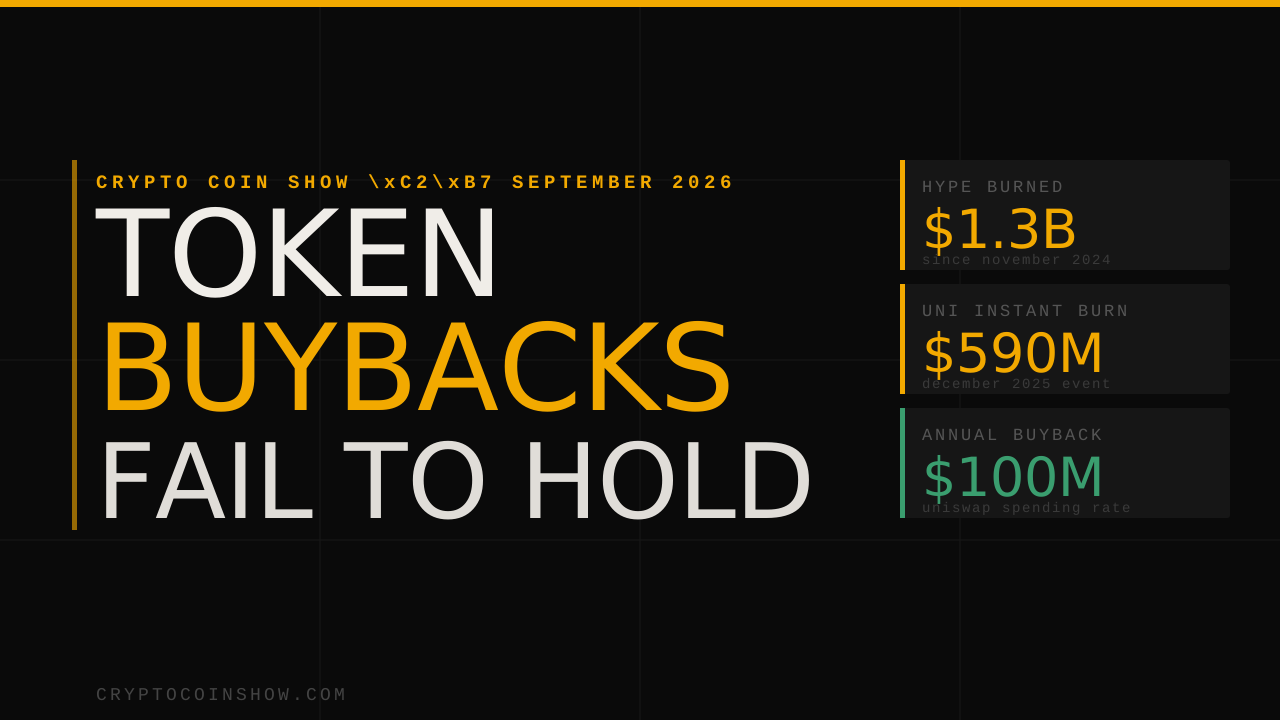
In December 2025, a validator proposal sought to retire roughly $920 million in HYPE held by the fund permanently, marking the first structural test of whether the protocol would commit to supply destruction at scale.
The model inverts the traditional DeFi incentive structure: instead of diluting holders to subsidize new users, Hyperliquid extracts trading revenue and uses it to reduce supply.
Pump.fun Cuts Buyback Ratio to 50% After Nine-Month Full-Return Experiment
Pump.fun returned $22.09 million of $38.81 million in protocol revenue to PUMP holders, but the mechanics reveal a strategic inflection point. For nine months prior to April 28, 2026, the Solana token launchpad ran a 100% buyback policy, routing every dollar of net fees into automated buy-and-burn contracts.
That approach was unusually aggressive for the category and received explicit acknowledgment from the team as without peer in crypto at comparable scale.
On April 28, 2026, Pump.fun shifted to a 50/50 split: half of protocol revenue now funds buybacks through an irreversible smart contract, while the other half flows to operations. The timing of the pivot coincides with what the team described as the strongest user-side data the platform had ever produced.
The split preserves significant token defense while freeing operational budget to fund growth, user acquisition, or product development without cannibalizing holder returns.
Over the past ~9 months, 100% of revenue went into buybacks. Basically no other platform in crypto has done that at this scale.
alon, Pump.fun founder
The transition signals confidence in underlying demand and unit economics. A protocol shifts away from full buybacks only when it believes the fee base is stable enough to fund operations independently while maintaining meaningful holder distributions.
edgeX Distributes Three Times Its Monthly Revenue, Signaling Reserve Depletion Risk
edgeX represents the outlier case within the cohort. The perpetual exchange paid $23.26 million to EDGE holders against only $8.26 million in protocol revenue, a 2.8x ratio indicating the team is drawing on pre-launch incentive budgets or reserve capital rather than current trading fees.
While Hyperliquid and Pump.fun both defend token supply through operating economics, edgeX is subsidizing payouts artificially.
The mechanism is not inherently unsustainable; early-stage exchanges routinely allocate launch reserves to reward early adopters and bootstrap liquidity. However, the math exposes a hard deadline.
If edgeX continues paying holders three times what the protocol earns, existing reserves will deplete within a defined window, forcing either a restructuring of the payout policy, a material increase in trading volume, or both.
For institutional investors evaluating EDGE, the sustainability question becomes concrete: how long does the reserve runway extend, and what happens to holder returns upon depletion?
DeFi Pivot From Endless Token Emissions to Fee-Based Revenue Models
The $96.3 million payout encapsulates a broader structural shift in DeFi incentive design. Throughout prior cycles, protocols rewarded users by minting new tokens at accelerating rates and distributing them through liquidity mining programs. The model treated token supply as an infinite resource, creating a dynamic in which supply inflation far exceeded demand growth.
Holders absorbed relentless dilution, often losing 70-90% of early gains within 12-18 months as emissions exceeded user acquisition and organic fee generation.
Hyperliquid, Pump.fun, and edgeX sit at the front of an emerging cohort treating token supply as a resource to defend rather than expand. They generate fees from active products, perpetual trading, meme coin issuance, or other activities, and route portions of those fees directly back to holders through buybacks or burns.
Supply becomes a function of trading volume and protocol economics, not a marketing tool for user acquisition.
DefiLlama’s holder revenue rankings show the three accounted for the majority of monthly holder cash flow across tracked DeFi categories during the 30-day window, even as the broader DeFi sector experienced flat fee growth.
The shift carries material implications for token valuation frameworks. A token backed by real, auditable fee revenue and declining supply is fundamentally different from one backed by inflationary emissions and liquidity mining subsidies.
Institutional investors have historically discounted DeFi tokens on duration grounds: the assumption that emissions would outpace organic demand, forcing price discovery downward. Tokens with fee-backed buyback mechanisms and declining supply profiles introduce a cash-yield component absent from emission-heavy models, creating bridge-to-value narratives that institutional capital responds to.
Structural Sustainability Tests Emerge as Payouts Continue
The 30-day payout window occurred during a period of flat broader DeFi fee growth, meaning the three protocols’ performance was not driven by sector tailwinds.
Hyperliquid and Pump.fun both demonstrated the ability to maintain holder distributions during neutral market conditions, suggesting the model can weather volatility. edgeX’s reserve-dependent payouts, by contrast, lack that proof point and carry visible depletion risk.
The next phase of validation will test whether these protocols can sustain fee-based returns through a bear market or a period of reduced on-chain activity. Hyperliquid’s 97% fee-capture
Original reporting: beincrypto.com