
 MM
Guest profile
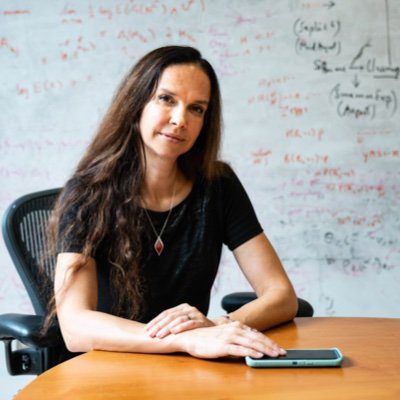
Muriel Médard
Co-Founder & CEO, Optimum
Who is Muriel Médard?
Muriel Médard is Co-Founder and CEO of Optimum, a blockchain data propagation company, and the NEC Professor of Software Science and Engineering at MIT.
She is a co-inventor of Random Linear Network Coding (RLNC), the technology behind Optimum, which grew out of more than two decades of research in her MIT lab. She leads the Network Coding and Reliable Communications Group at MIT's Research Laboratory of Electronics. Her work on an algebraic approach to network coding, known as the Médard/Koetter framework, helped make network codes practical.
She is a member of the US National Academy of Engineering and the German National Academy of Sciences Leopoldina. She is also a member of the American Academy of Arts and Sciences and a Fellow of the US National Academy of Inventors and the IEEE. She served as president of the IEEE Information Theory Society in 2012.
Before Optimum she co-founded the network coding companies CodeOn, Steinwurf and Chocolate Cloud. At Optimum she is focused on bringing RLNC into production for blockchain networks, starting with faster and more reliable data propagation.
 38:42
Latest interview · Mar 6, 2026Optimum CEO on why data propagation is blockchain's real scaling limitWatch the episode →
Key points
- Data propagation is a fundamental scaling bottleneck in blockchain that limits performance of consensus and execution layers above it.
- Decentralized systems can achieve equal or better efficiency than centralized systems for data propagation without requiring centralized state management.
- Random Linear Network Coding enables more efficient data representation and transmission by leveraging mathematical flexibility of numbers versus physical constraints.
- Validators depend critically on propagation networks to communicate and reach consensus, making propagation infrastructure foundational to blockchain functionality.
- Optimizing propagation through better traffic engineering of data flows may be more practical than building entirely new infrastructure capacity.
In their own words
“We take a Hippocratic approach to networking: first, do no harm.”
“Why not start by doing the traffic engineering correctly?”

