Ethereum Price Prepares for Upside Move—Is the Rally About to Return?
Ethereum is testing critical price levels after a recent pullback, with the cryptocurrency consolidating above $3,150 and positioning itself for a potential breakout. Technical analysis suggests ETH could face decisive resistance near $3,350, a level that would need to be cleared for a sustained rally back toward $3,450 and beyond.
Current Price Action and Support Zones
After climbing above $3,150 earlier in the session, Ethereum encountered selling pressure in the $3,400 range. The pullback saw the asset retreat below $3,250, testing the 50% Fibonacci retracement level of the recent upward move from the $2,914 low to the $3,448 peak.
At current levels, Ethereum is holding above the $3,200 mark and remains positioned above the 100-hourly moving average. This technical setup suggests some underlying buying interest, preventing a more severe decline.
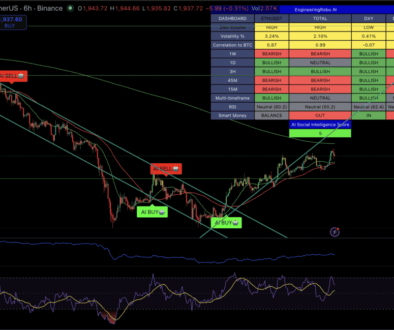
A bullish trend line is now forming on the hourly chart with support positioned at $3,180. This level will be critical to monitor for traders tracking the near-term direction.
The importance of maintaining support cannot be overstated in cryptocurrency markets. A break below $3,150 would shift the technical bias materially lower, potentially triggering weakness toward $3,040 and the psychological $3,000 level.
Market Context and Ethereum’s Position in Crypto Markets
Ethereum’s price action must be understood within the broader cryptocurrency market landscape. As the leading smart contract platform by market capitalization and daily transaction volume, ETH movements often signal broader sentiment shifts across decentralized finance (DeFi) and blockchain ecosystems. The consolidation between $3,150 and $3,350 reflects institutional and retail participants weighing the risks of holding exposure against macro uncertainty and competing asset classes.
The second-largest cryptocurrency by market cap commands approximately 15-18% of total crypto market value, making it a barometer for overall sector health. When Ethereum demonstrates strength above round-number support levels like $3,200, it typically provides confidence to investors holding positions in layer-2 scaling solutions, DeFi tokens, and other Ethereum-native assets that derive value from network activity and usage.
Conversely, Ethereum weakness below key support zones can trigger liquidation cascades across leveraged positions, particularly in derivatives markets where open interest on centralized exchanges has reached elevated levels. Understanding these interconnections between spot price action and derivatives positioning provides crucial context for anticipating volatility spikes or unexpected reversals.
Resistance Levels and Upside Targets
For buyers looking to regain control, Ethereum must overcome a series of resistance barriers. The $3,290 level represents the first near-term resistance, followed by $3,320, where previous selling pressure has been documented.
A clear move above the $3,350 resistance might send the price toward the $3,400 resistance and potentially unlock further upside.
— Technical Analysis
Breaking above $3,350 would be significant from a technical perspective. Such a move could validate the emerging bullish structure and encourage momentum traders to target $3,400 and $3,450. A sustained break above $3,400 would open the door to testing $3,500 in the near term.
The implications of Ethereum reaching these elevated price levels extend beyond technical chart patterns. Higher ETH prices reduce transaction costs on the network (measured in gwei), potentially increasing demand for smart contract execution and user adoption. This creates a virtuous cycle where price strength can attract fresh participants to the Ethereum ecosystem, particularly for DeFi applications, NFT trading, and decentralized exchanges.
For context on Ethereum’s broader market performance, check our Ethereum analysis section for detailed coverage of longer-term trends and fundamental developments affecting the network.
Downside Risks and Failure Scenarios
The bullish narrative is conditional on price holding above key support levels. If Ethereum fails to overcome the $3,320 resistance zone, momentum could shift back toward sellers, creating fresh downside pressure.
Below $3,150, the next support zone sits at $3,040. A breakdown below this area would target the $3,020 region, with $3,000 representing a significant psychological level for long-term traders.
Market structure suggests that a failure at $3,320 would likely trigger a retest of the $3,200 support. This is a critical juncture—how the market reacts to that level will determine whether the correction is merely consolidation or the beginning of a more serious pullback.
A sustained breakdown below $3,000 would carry significant implications for the broader Ethereum narrative. Such a move would coincide with weakening fundamentals in network metrics, potentially including reduced daily active addresses, declining transaction volume, and deteriorating sentiment among long-term holders. Market participants would likely reassess valuations for Ethereum-dependent projects, potentially triggering a broader repricing across layer-2 solutions and DeFi protocols that depend on Ethereum’s security and liquidity.
For broader context on cryptocurrency price movements and their relationship to market conditions, visit our crypto prices section to track multiple assets in real time.
The hourly MACD for the ETH/USD pair is gaining momentum within bullish territory, a sign that selling pressure may be easing. This indicator is often used to confirm the strength of directional moves and the persistence of trending conditions.
The Relative Strength Index (RSI) has moved above the 50 midpoint on the hourly timeframe. While this suggests some bullish momentum, traders should note that RSI readings above 70 are often associated with overbought conditions, which can precede corrective moves.
Technical indicators provide useful context but should never be used in isolation. Price action, support and resistance levels, and market structure should be weighted equally when forming a trading thesis.
Industry Implications and Market Positioning
The consolidation Ethereum is experiencing reflects deeper structural shifts within cryptocurrency markets. Institutional investment vehicles, including spot and futures ETFs, have increased demand for large ETH holdings, reducing volatility at the extremes while creating support at psychologically important levels. This represents a fundamental change from earlier market cycles, where retail speculation dominated price discovery.
Major staking platforms and liquid staking derivative protocols now control meaningful portions of Ethereum’s circulating supply, creating long-term holders less prone to panic selling during sharp corrections. This structural change has altered the risk profile for investors while potentially reducing the severity of sell-offs that previously characterized bear markets.
Mining and validator economics also influence Ethereum’s price support levels. At $3,000 and below, operating margins for network participants narrow considerably, potentially reducing hash rate and validator participation—factors that could undermine network security assumptions priced into current valuations.
What Traders Should Monitor
The $3,180 trend line support and $3,150 round number represent the floor for bullish momentum. A violation of either level would warrant a reassessment of the near-term outlook.
On the upside, the $3,350 level is the line in the sand for confirming a resumption of the rally. A daily close above this level would carry more weight than an intraday touch, given the recent volatility.
Volume is another consideration that technical traders examine closely. An upside breakout accompanied by increasing volume would provide stronger confirmation than a move on light trading activity. Conversely, a breakdown on high volume would be more concerning to bulls.
The next major resistance is near the $3,320 level, with the first major resistance at $3,350 representing a critical inflection point for determining the next leg of the move.
— Technical Analysis
For updates on market-moving events and regulatory developments affecting Ethereum and other digital assets, subscribe to our news section for timely coverage.
The cryptocurrency market moves quickly, and price levels that appear stable can shift rapidly on new information or changes in market sentiment. Position management and risk controls should always be prioritized over aggressive directional bets.
Conclusion and Forward Outlook
Ethereum’s technical setup at this moment suggests neither buyers nor sellers have decisively won control. The next 24 to 48 hours will likely prove illuminating, particularly if the asset approaches either the $3,350 resistance or the $3,150 support zone with meaningful volume.
The broader implications extend beyond technical chart reading. Ethereum’s price discovery process determines network health perceptions, validator economics, and confidence in smart contract platforms generally. A successful breakout above $3,350 would validate the emerging uptrend while attracting fresh capital to DeFi and broader Ethereum applications. Conversely, a failure to maintain $3,150 support would signal deteriorating market sentiment and potentially trigger a reassessment of cryptocurrency valuations across multiple asset classes.
For investors and traders, the current consolidation represents a genuine inflection point worthy of close monitoring. Position sizing appropriately for volatility, maintaining clear stop-loss levels, and avoiding overleveraged exposure remain essential risk management principles. The technical setup favors patience—allowing price to reach critical levels before committing substantial capital to either side of the trade. Market participants should remain flexible, prepared to adjust theses as new information emerges and price action reveals the intentions of major market participants.
Get weekly blockchain insights via the CCS Insider newsletter.