
Bitcoin retreats below $80,000 after 20% August rally as traders lock in profits
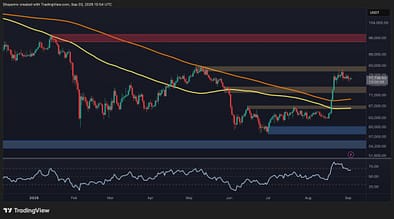
Bitcoin has retreated below $80,000 after a strong August rally, signaling profit-taking ahead of key technical resistance levels as oil prices surge amid Middle East tensions. For institutional investors, the divergence between crypto’s pullback and traditional markets’ resilience suggests a tactical rebalancing rather than a broader risk-off event.
- Bitcoin fell approximately 1% below $80,000 after gaining more than 20% during August
- $82,000 and the 50-week moving average near $81,000 present near-term resistance to further upside
- Oil rallied to six-week highs on US-Iran tensions, with Brent crude at $97.73 and WTI at $93.10
- $80,000 Bitcoin’s current level after 20% August gains, down 1% from recent moves
- $97.73 Brent crude price at six-week highs amid geopolitical escalation
- 20% Bitcoin’s August rally ahead of this week’s pullback and consolidation
Bitcoin retreated below $80,000 this week in what traders characterized as profit-taking following a robust August that saw the asset gain more than 20%, according to market data. The pullback came as two layers of technical resistance emerged: $82,000 acting as an immediate ceiling and the 50-week moving average hovering near $81,000 providing overhead pressure. The move reflects typical consolidation behavior after sustained rallies rather than capitulation, with institutional players likely locking in gains ahead of the approaching quarter end.
August’s 20% Gain Triggers Tactical Profit-Taking Ahead of Technical Resistance
The magnitude of Bitcoin’s August performance, gaining more than a fifth of its value in a single month, set conditions for a natural pause. Rallies of that speed typically attract profit-taking from both retail and institutional holders, particularly when they encounter well-defined technical barriers.
The $82,000 level and the 50-week moving average represent neither capitulation points nor support zones; they function as decision points where algorithmic traders and momentum strategies often execute exits.
This week’s retreat does not suggest a reversal of the longer-term uptrend that characterized August.
Oil Surge and Geopolitical Risk Add Macro Uncertainty Without Derailing Equities
Meanwhile, oil markets rallied to six-week highs as US and Iranian strikes escalated Middle East tensions, with Brent crude reaching $97.73 per barrel and West Texas Intermediate climbing to $93.10. The geopolitical escalation created a classic bifurcated response: energy markets sold off in the traditional safe-haven trade, while equity markets proved remarkably resilient.
European stocks finished mostly flat, with France and Italy posting modest gains while the UK, Germany, and Spain retreated slightly.
The muted equity response to oil’s jump suggests institutional investors view the current geopolitical risk as contained rather than systemic. Bitcoin’s pullback therefore appears disconnected from broader macro stress, indicating that the retreat reflects technical consolidation within a bull phase rather than a flight to safety across asset classes.
Institutional portfolio managers appear comfortable holding both long crypto and equity positions despite near-term headline risk.
The next test for Bitcoin comes at $82,000 resistance and the 50-week moving average near $81,000; a breakdown below $80,000 support would signal deeper consolidation, while a break above $82,000 would open the path to fresh highs and confirm August’s momentum remains intact.