Ethereum Foundation opens pq-cl devnet to test hash-based validator keys
The Ethereum Foundation has opened a devnet called pq-cl, short for post-quantum consensus layer, where client teams are testing validator signatures built on hash functions instead of elliptic curves. The move, laid out in a blog post, is the Foundation’s answer to a dual threat: quantum computers that could eventually break elliptic-curve math, and AI models the EF says are already finding bugs faster than humans can review them.
- The EF has doubled the size of its protocol security team to support the migration
- Justin Drake proposed December 2028 as a target at Devcon; 2029 remains the EF’s internal deadline
- A timeline review is planned for January, and node operators face larger signature sizes that could affect home-staking hardware
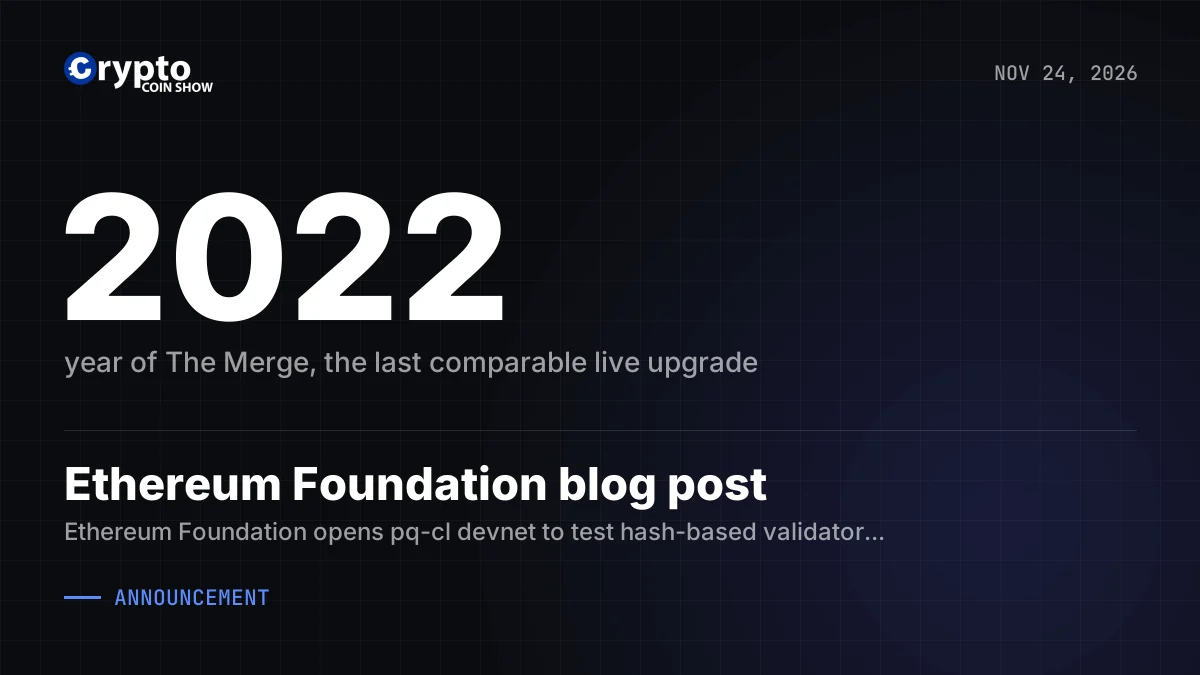
- 2022 year of The Merge, the last comparable live upgrade
- 2028 Drake’s proposed target date at Devcon
- 2029 EF’s current internal deadline, under review
Ethereum’s consensus layer currently relies on BLS signatures built on elliptic curves to let validators attest to blocks. The Foundation’s post argues that assumption needs to go, not because a quantum computer exists today, but because “we do not expect the maths that cryptography relies on to be any different” as AI improves at breaking decades-old algorithms. The plan: move validators to hash-based signatures, which the protocol already depends on for other purposes, so the change “does not add a new assumption,” per the post.
Pq-cl Devnet Swaps BLS for Hash-Based Keys
The pq-cl devnet is where the rubber meets the road. It is a test network, separate from mainnet, where client teams can try out validator signing with hash-based keys instead of BLS.
Staking pools and home stakers are asked to run validators on these devnets and report what breaks. Wallet teams are told to build the migration path for ordinary users moving from elliptic-curve to hash-based accounts, and rollup teams are asked to test against new blob commitments.
Ethlabs Pulls Quick Slots, Publishes Pqai27
Ethlabs, a research group working alongside EF on the effort, published a document called pqai27 and withdrew its own Quick Slots proposal from a fork called Hegotá specifically to free up engineering time for the quantum work. The Foundation frames this as evidence that other features are being deprioritized in favor of the cryptography swap.
The remaining All Core Devs calls this year will reportedly decide which other features get cut from the fork for the same reason.
What Changes for Stakers, Wallets and Node Operators
For validators, the practical change is a new signing key type: hash-based rather than elliptic-curve. Stakers and staking pools will need to generate and manage new keys, and existing tooling built around BLS “will need to be reworked,” the post says.
Wallet providers and multisig operators face a parallel migration, moving user accounts off elliptic-curve signatures. The post also flags that hash-based signatures are larger than today’s, which means node operators should watch hardware and bandwidth requirements to keep home staking viable.
This is a heavier lift than the September 15, 2022 Merge, which swapped Ethereum’s consensus engine with no downtime and no lost funds. The EF says explicitly that “this upgrade is harder than the Merge, and we have less time,” though it argues better tooling should offset that.
The CCS Read
“This upgrade is harder than the Merge, and we have less time. But we now have more powerful tools that allow us to move faster than we’ve ever moved before.”
Ethereum Foundation, PQAI #0 blog post
The CCS read. A protocol-wide key swap touching validators, wallets and multisigs is a bigger operational event than the Merge, which only changed consensus internals invisibly to most users. If the EF can’t recruit client teams, wallet vendors and staking pools fast, the 2028-2029 window slips, and every contract assuming elliptic-curve signatures becomes a migration liability later rather than sooner.
The post does not name which hash-based signature scheme will replace BLS, nor does it specify an activation block, fork name or exact mainnet date. It also leaves open how existing accounts and contracts built on elliptic-curve assumptions will be migrated or whether old keys remain valid during a transition period.
The EF has flagged a timeline review for January, when the 2028-versus-2029 target gets reconciled, alongside the remaining All Core Devs calls this year that will decide which other features get cut to free engineering resources for the migration.
Lead image: Crypto Coin Show. Source: Ethereum Foundation blog post