
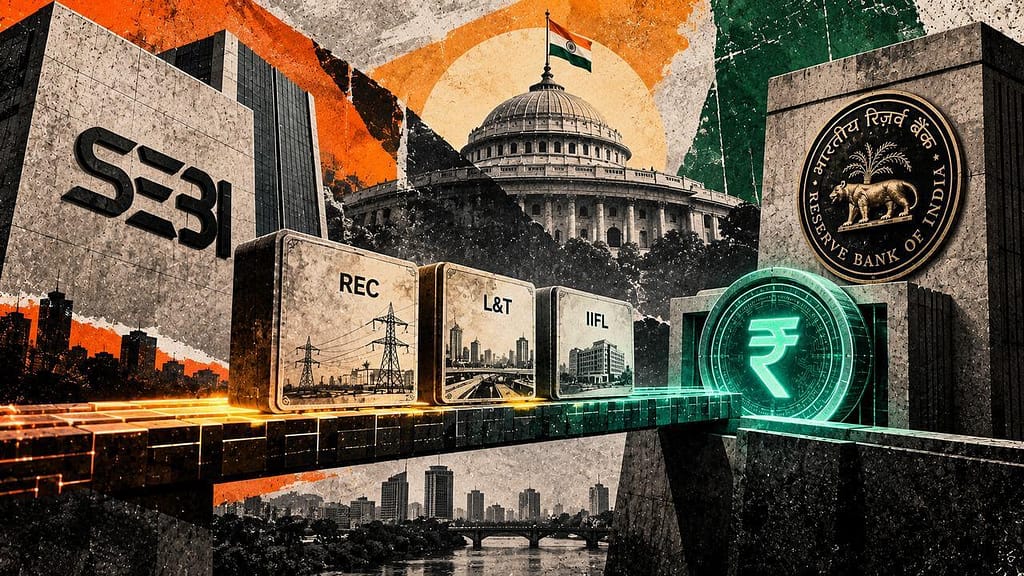
India tokenizes ₹1,025 crore in corporate bonds with atomic settlement on RBI wholesale digital rupee
India’s securities regulator has successfully tokenized ₹1,025 crore in corporate bonds on a private blockchain using the Reserve Bank’s wholesale digital rupee, with atomic settlement eliminating counterparty risk at issuance. Stage II will open secondary trading and retail access, testing whether the infrastructure can sustain liquidity beyond the institutional launch.
- ₹1,025 crore moved through first three tokenized bond issuances by REC Limited, L&T Limited and IIFL in September 2026
- Atomic delivery-versus-payment synchronizes bond and cash settlement simultaneously, removing settlement risk during the transaction
- Stage II will introduce secondary trading and retail participation; interim period allows peer-to-peer transfers outside atomic framework
- ₹1,025 Cr Total value of bonds tokenized in pilot’s first three issuances
- Sept. 7-9 Dates REC, L&T and IIFL completed initial tokenized offerings
- Stage II Next phase, when secondary markets and retail investors gain access to platform
The Securities and Exchange Board of India announced Demat 2.0 on September 10 after three major corporates completed tokenized bond issues on September 7 and 9. The pilot places corporate bonds as native digital tokens on a private, permissioned distributed ledger while using the Reserve Bank of India’s wholesale digital rupee for payment settlement. The core innovation is atomic settlement: the bond and cash either both settle instantaneously or neither does, eliminating the window in which a buyer could send funds before receiving the security or a seller could deliver the bond before payment cleared.
REC, L&T and IIFL move ₹1,025 crore through first tokenized issuances
REC Limited issued ₹500 crore, L&T Limited issued ₹500 crore and IIFL completed a ₹25 crore offering, establishing proof of concept across three distinct issuers and bond structures. The transactions retained all existing legal and economic terms: each token carries the same ISIN identifier, coupon, maturity date, covenants and credit rating as a conventional dematerialized bond.
Issuer obligations and investor rights remained unchanged, with regulatory treatment identical to off-chain securities.
The network itself is private and institutionally controlled, not a public blockchain.
India’s depositories own and operate the infrastructure, preserving the statutory record of beneficial ownership. Depositories and stock exchanges run the ledger’s validating computers, and depositories manage investors’ private keys, maintaining the intermediated custody model familiar to institutional markets.
Investors gain ledger access without managing bond token keys or replacing the depository record that establishes legal ownership, keeping the established custody chain intact.
Atomic settlement removes counterparty risk at issuance through synchronized payment rails
In conventional bond settlement, a gap exists between when funds leave the buyer’s account and when the seller receives the security, or vice versa. SEBI’s technical FAQ confirms that the Demat 2.0 system eliminates this interval through linked digital rails: the bond token and the digital rupee payment are synchronized for simultaneous settlement. Either both settle or the transaction fails, removing the credit risk exposure in either party during settlement completion.
Issuer credit risk, the risk that the corporate borrower fails to repay, remains unchanged. The tokenized bond carries the same rating and covenants as its conventional counterpart. The technical innovation addresses settlement infrastructure, not the underlying credit quality or maturity risk embedded in the debt itself.
This distinction is material for institutional investors: the pilot solves a plumbing problem without changing the economics of the securities themselves.
Stage II to test secondary liquidity and retail participation after institutional foundation
The live pilot currently covers institutional issuance and ledger-based asset servicing only.
Secondary trading and retail participation are reserved for Stage II. During the interim period, an investor may exit through peer-to-peer or depository-to-depository transfers handled outside the atomic settlement framework; payment for those transfers may occur through the digital rupee or conventional banking channels.
This interim design preserves institutional control of Stage I while the regulator tests whether the same atomic architecture can support routine liquidity and a broader investor base after issuance.
The critical test for institutional adoption comes in Stage II: whether a private, permissioned tokenized bond market can sustain secondary trading volume and liquidity comparable to conventional dematerialized markets, and whether retail participation can be integrated without degrading settlement speed or compromising custody standards. SEBI’s announcement did not specify a timeline for Stage II launch or the number of additional institutional issuers expected during the current phase.