TaoWeave, formerly known as Oblong, says its long-term strategy is to accumulate Bittensor’s TAO token. Its latest filing shows the treasury flow moving the other way during the first half of 2026.
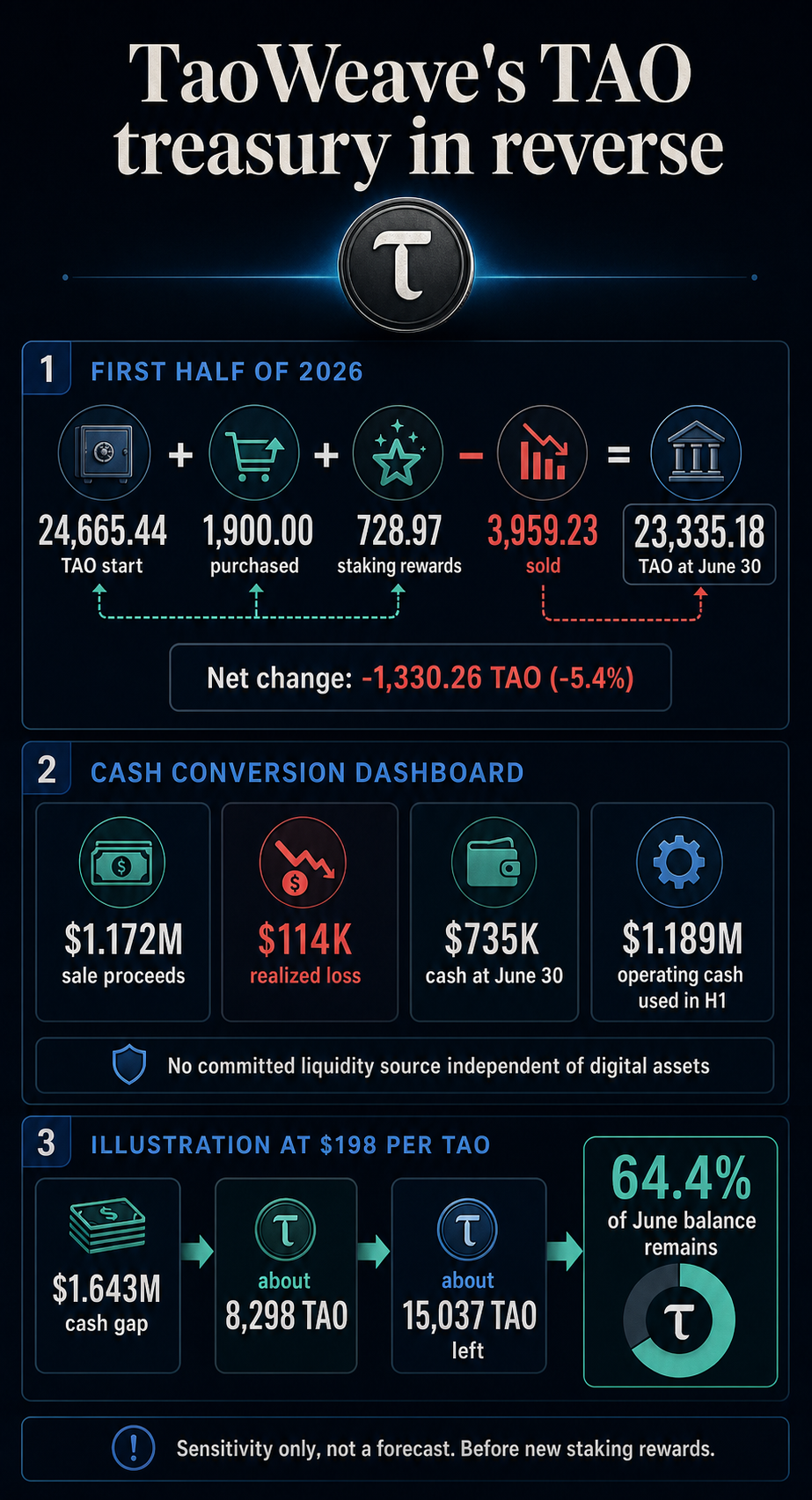
The company sold 3,959.23 TAO to fund operating expenses and manage liquidity. The sales raised $1.172 million and produced a $114,000 net realized loss. They occurred during the six months ended June 30 and were newly reported in the company’s Aug. 7 quarterly filing, rather than taking place on the filing date.
The disclosure marks a turn from the plan CryptoSlate reported in June 2025, when predecessor Oblong intended to direct most of a $7.5 million private placement toward acquiring TAO and supporting Bittensor.
TaoWeave held 23,335.18 TAO worth $4.709 million at June 30, about 69.5% of its $6.776 million in total assets. All of the holdings were staked through custodians BitGo and Kraken. The company did not hedge its TAO exposure and held no other digital assets, leaving its balance sheet concentrated in one volatile token.
Staking earned 728.97 TAO and generated $191,000 of revenue during the first half. TaoWeave also bought 1,900 TAO, but the 3,959.23-token sale still left its balance down 1,330.26 TAO, or 5.4%, from year-end.
Cash needs put the token balance at risk
TAO traded near $198 on Aug. 8, according to spot quotes from Coinbase and Kraken. Applying that price to the unchanged June 30 count would value the treasury at about $4.62 million, although TaoWeave has not confirmed its current token balance.
At June 30, TaoWeave held $735,000 in cash; it used $1.189 million in net operating cash during the first half. The company said it expects to sell more TAO from time to time as operating needs require, with the amount and timing depending on cash needs, market prices, and liquidity. It disclosed no scheduled sale.
TaoWeave also said it had no committed credit facility or other arrangement providing liquidity independent of its digital assets. That makes the number of tokens required for a given cash need sensitive to TAO’s market price.
If the first-half operating-cash-use pace persisted for the next 12 months, with no new financing or other cash inflows and TAO fixed at a rounded $198, the resulting $1.643 million gap after using June cash would require about 8,298 TAO. That would leave roughly 15,037 TAO, or 64.4% of the June balance, before new staking rewards.
This is a sensitivity, not a forecast. Revenue, working-capital changes, financing, purchases, future staking, and a different TAO price could all change the result.
Management said cash plus TAO converted to cash should fund operations and working capital for at least 12 months, while also acknowledging that more capital will be needed over the long term. That assessment tempers the liquidity risk but does not remove the conflict between funding the business and preserving the token balance its accumulation strategy is meant to grow.
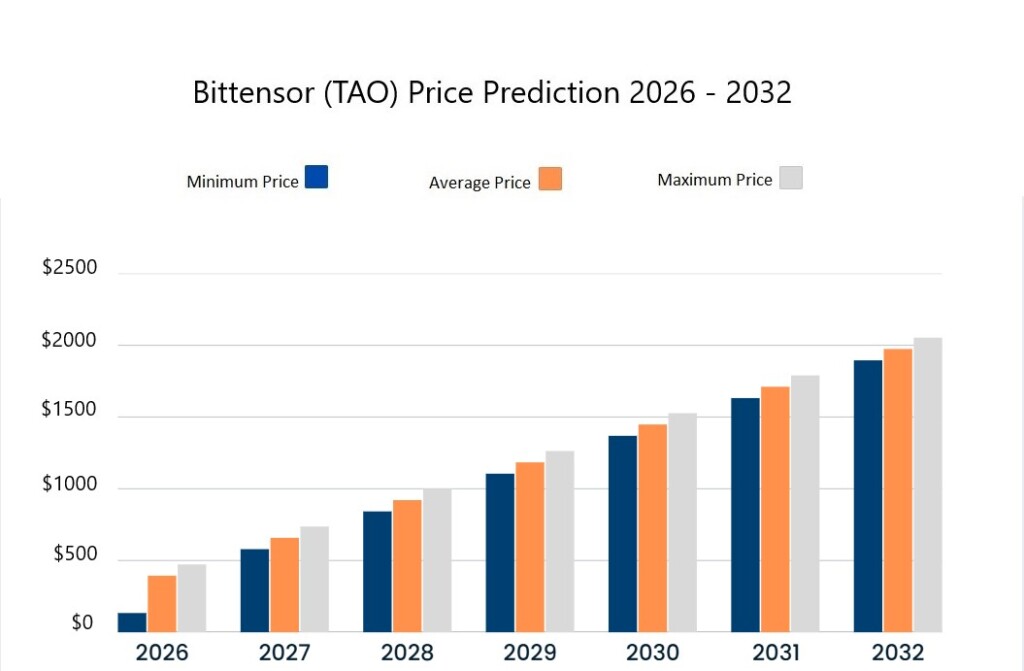
Bittensor price predictions anticipate a high of $473.94 by the end of 2026.
In 2028, TAO will range between $842.56 and $1,000.54, with an average price of $921.55.
In 2032, TAO will range between $1,895.75 and $2,053.73, with an average price of $1,974.74.
Bittensor is one of the most renowned AI-facilitated decentralized networks that promotes blockchain and artificial intelligence infusion. By leveraging Proof of Learning (POL) technology, Bittensor supports user privacy while minimizing errors. The AI models within the network are reliable, flexible, and up-to-date with modern technological advancements. The AI-based Bittensor network prioritizes cross-chain integration and native token expansions to promote collaboration among various decentralized AI networks.
TAO uses reliable authentication methods to ensure a successful transfer of nodes through its AI knowledge to correct models. The process is made possible through the PoL consensus method, which secures this process. Moreover, this technology helps to develop different stages of more advanced AI technology within the blockchain. Bittensor also uses its TAO token to incentivize node operators and AI developers.
What’s next for Bittensor and TAO in 2026 and beyond? Let’s get into the TAO price prediction and technical analysis.
Overview
Cryptocurrency
Bittensor
Ticker
TAO
Current price
$277.96 (+0.71%)
Market cap
$3.04B
Trading volume (24-hour)
$171.08M
Circulating supply
10.93M TAO
All-time low
$30.40 on May 14, 2023
All-time high
$767.68 on Apr 11, 2024
24-hour low
$280.10
24-hour high
$269.05
TAO price prediction: Technical analysis
Metric
Value
Price Volatility (30-day variation)
8.04% (Very High)
14-day RSI
48.47
50-day SMA
$275.59
200-day SMA
$258.86
Market Sentiment
Neutral
Fear and greed index
30 (Fear)
Green days
13/30 (43%)
Bittensor price analysis
TL;DR Breakdown:
TAO price analysis confirms a bullish trend at $277.96.
The altcoin has gained 0.71% over the day.
TAO token has support at $265.
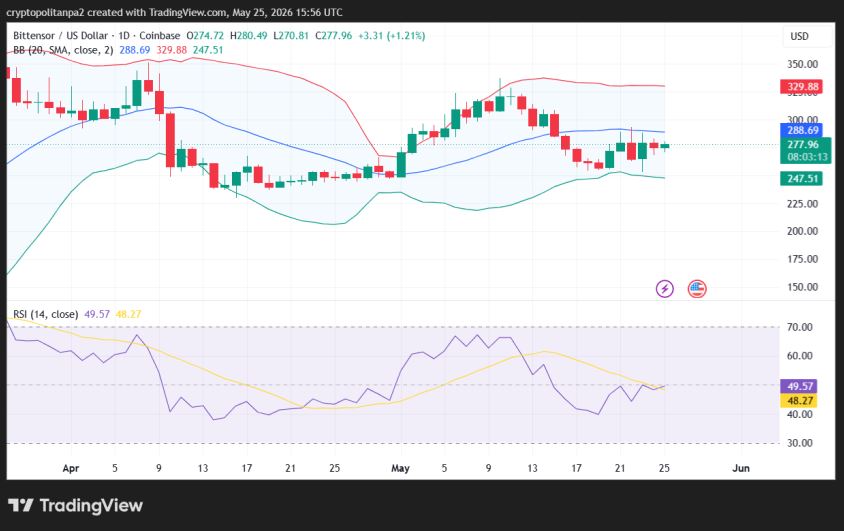
On May 25, 2026, TAO price analysis indicates a mild bullish daily trend, with Bittensor currently trading at $277.96. The altcoin has shown a 0.71% increase in value over the last 24 hours, primarily due to the swift recovery observed over the day, as the token is slipping from sellers’ grip. Buyers remain in control as the TAO price has the nearest support at the $274 level, and it may continue to maintain above the aforementioned level for the coming days.
TAO/USD 1-day chart analysis
The one-day price chart of Bittensor confirmed a bullish trend for the altcoin. The TAO/USD pair value has slightly recovered to $277.96 following a bearish spell. The comparatively high volatility suggests a higher chance of a reversal in the trend or further price appreciation.
The distance between the Bollinger Bands determines the market volatility. Currently, this distance is wide, leading to high volatility levels. Moreover, the upper limit of the Bollinger Bands indicator, indicating resistance, has shifted to $329. Whereby its lower limit, indicating support, has moved to a low of $247.
The Relative Strength Index (RSI) indicator is in the neutral region, in contrast to the other technical factors, which also seem to be bearish. Its curve also increased to 54 during the day. This slowly increasing price movement today reflects a relatively balanced trading setup in the market under the larger bearish trend. However, if the bullish momentum accelerates, the RSI value will move further up into the neutral region.
TAO/USD 4-hour chart analysis
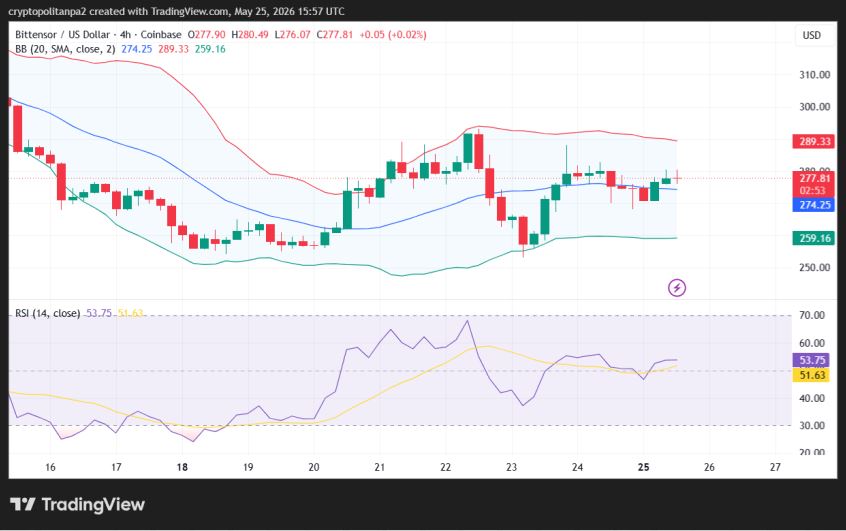
The four-hour price chart for the Bittensor coin signifies a weak bearish trend, as the token’s price movements are again in a downward direction, with sellers trying to control the market. In the past few hours, the cryptocurrency’s value has slightly decreased to $277.81. Red candlesticks on the price chart signal a returning selling pressure.
The Bollinger Bands are expanding, as the volatility level is high on the 4-hour chart. The high volatility suggests higher market unpredictability. The upper Bollinger Band has shifted to a $289 high, indicating the resistance level. Conversely, the lower Bollinger Band is at $259, indicating the support level.
Multiple technical quantitative indicators are still bearish, but the RSI indicator is in the neutral region. However, the current score of 53 and decreasing numbers confirm selling pressure. The declining curve on the indicator’s graph shows rising selling activity and bearish progress as the market conditions turn unfavorable on an hourly basis.
Bittensor technical indicators: Levels and actions
Daily simple moving average (SMA)
Period
Value ($)
Action
SMA 3
273.13
BUY
SMA 5
274.28
BUY
SMA 10
271.05
BUY
SMA 21
289.05
SELL
SMA 50
275.59
BUY
SMA 100
255.45
BUY
SMA 200
258.86
BUY
Daily exponential moving average (EMA)
Period
Value ($)
Action
EMA 3
274.73
BUY
EMA 5
273.97
BUY
EMA 10
276.07
BUY
EMA 21
279.09
SELL
EMA 50
275.26
BUY
EMA 100
267.74
BUY
EMA 200
274.04
BUY
What can we expect from Bittensor price analysis next?
Bittensor (TAO) fundamental analysis indicates a bullish outlook for current market trends. The TAO/USD price has slightly recovered to $277.96, but the bearish momentum has not faded yet. Most technical indicators signal bearishness, but the price charts lean in favor of the buyers, suggesting a potential move toward the $294 level, due to today’s recovery.
Is Bittensor TAO a good investment?
TAO coin continues to trade higher, indicating growing adoption among crypto investors as AI development and machine learning progress. Despite this, the coin faces uncertainties and volatility like all other cryptocurrencies. Our Cryptopolitan price prediction explores its potential profit and expected movements from 2026 to 2032 while considering the past performance. However, this is not investment advice, and one must conduct their own research before taking any investment decision according to their risk tolerance.
Why is TAO up?
TAO is up primarily due to buying pressure from traders after some degree of bullish price action, mainly due to strong market sentiment surrounding speculative AI tokens and the AI industry at large. Recent stability near key support levels also played a role in the resurrection of the bullish trend as traders started buying following a bull rally, and the token’s price has also increased during the past 24 hours.
How much is the Bittensor stock worth?
Bittensor (TAO) powers the Bittensor Network and is not a stock. Stocks are usually traded on stock exchanges, and stock ownership represents a stake in a company. Buying TAO tokens gives the buyer certain rights within the Bittensor Network, for example, governance participation but not ownership in a company. However, Bittensor (TAO) tokens can be purchased and traded on different exchanges, including Binance, Bitget, Coinbase, KuCoin, and Kraken. See our price analysis part for day-to-day price changes of the TAO token.
What is the price prediction for TAO 2026?
The highest Bittensor (TAO) price prediction for 2026 is around $570.20, but it is not easy to predict Bittensor price movements due to its volatile nature.
Will Bittensor reach $1000?
Yes, Bittensor should surpass $1000 by 2028. Its price will range between $842.56 and $1,000.54 during that period, which makes it a viable option to buy Bittensor tokens, considering the future performance and long-term trends, as decentralized AI development is expected to scale exponentially.
What is the total supply of Bittensor?
The total supply of Bittensor (TAO) tokens is 21 million TAO.
Does Bittensor have a good long-term future?
According to most market observers, Bittensor TAO will trade higher in the coming years. However, factors like market crashes or difficult regulations could invalidate this bullish theory.
Recent news/ opinions on Bittensor
ORO just went live on Bittensor, a specialized marketplace focused on AI agents for real-world e-commerce. It is important to remember that ORO (subnet 15) outperformed OpenAI’s GPT-5.4 on some complex online shopping evaluations.
ORO is now live on Bittensor, an open arena for AI agents.
A decentralized evaluation platform where miners submit AI shopping agents and validators assess them independently, with top performers earning emissions.
— xTAO – a Bittensor company (@xtaohq) May 1, 2026
Bittensor price prediction May 2026
A break of resistance will result in a mini bull run, with the next target at $352 during the month. The average price is expected to be $263, according to the current forecast. In a bearish scenario, TAO could drop to $197 at its lowest.
Month
Potential low
Potential average
Potential high
May 2026
$197
$263
$352
Bittensor price prediction 2026
The technical indicators are bullish on TAO for the end of 2026. It is anticipated to trade between $134 and $473.94, with an average price of $394.95, according to the Bittensor price prediction.
Year
Potential low
Potential average
Potential high
2026
$134
$394.95
$473.94
Bittensor price predictions 2027-2032
Year
Minimum Price
Average Price
Maximum Price
2027
$579.26
$658.25
$737.24
2028
$842.56
$921.55
$1,000.54
2029
$1,105.86
$1,184.84
$1,263.83
2030
$1,369.15
$1,448.14
$1,527.13
2031
$1,632.45
$1,711.44
$1,790.43
2032
$1,895.75
$1,974.74
$2,053.73
Bittensor’s price forecast 2027
TAO is expected to gain bullish momentum in 2027. According to the updated Bittensor forecast, the token will range between $579.26 and $737.24, with an average price of $658.25.
Bittensor price prediction 2028
The Bittensor outlook strengthens further in 2028. Analysts expect TAO to trade between $842.56 and $1,000.54, with an average yearly price of $921.55.
Bittensor TAO price prediction 2029
The 2029 Bittensor price prediction suggests TAO will move between a minimum of $1,105.86 and a maximum of $1,263.83, settling at an average price of $1,184.84 for the year.
Bittensor price prediction 2030
For 2030, Bittensor price predictions indicate a trading range from $1,369.15 to $1,527.13, with an average expected price of $1,448.14.
Bittensor crypto price prediction 2031
In 2031, Bittensor price prediction, TAO is projected to range between $1,632.45 and $1,790.43, with an average price of $1,711.44, which is quite higher than its current value.
Bittensor price prediction 2032
The Bittensor price prediction for 2032 places TAO between $1,895.75 and $2,053.73, with an average price of $1,974.74.
TAO market price prediction: Analysts’ TAO price forecast
Platform
2026
2027
Digitalcoinprice
$202.28
$224.87
Coincodex
$245.77
$245.77
Cryptopolitan’s Bittensor (TAO) price prediction
According to our predictions, TAO could recover to $473.94 by the end of December 2026. We expect TAO to maintain a trading range of $579.26-$737.24, with an average of $658.25 in 2027. Note that the predictions are not investment advice. Seek independent professional consultation or do your research.
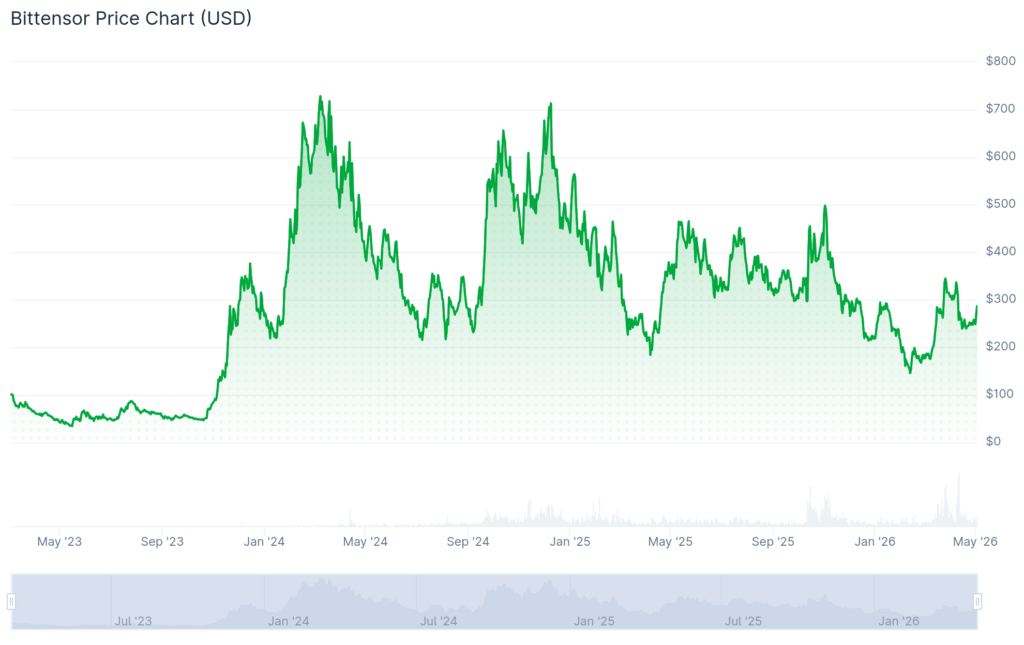
TAO launched on March 6, 2023, at $93.4, but fell below its opening price within a week, sliding into the $76 range.
By early April, it had lost half its value, dropping to $47, and continued downward to its $30.83 low in May before slowly recovering to $63 by the end of the month.
The token climbed to $86.18 in July, just under its launch price, then pulled back again and traded near $54 through October.
Momentum returned in November, pushing TAO into the $95 range, showing continuous improvement, and then sharply to a peak of $379 on December 15, 2023.
TAO trended downward into early 2024 but surged to its all-time high of $757.60 in March. It quickly corrected to $522 in April and continued weakening through mid-year, reaching $216 in July.
A brief rebound to $357 faded again as the token slipped back toward the mid-$200s by late summer, as per the crypto market price history records.
Momentum returned in October, pushing TAO into the $660 range before cooling to $468, according to the historical price data. It climbed once more to $679 in November but ultimately closed 2024 at $440.69, as the broader crypto market turned bearish again.
TAO opened in 2025 at $439.73, peaked at $565 in January, and its price decreased to the $324 level in February, taking down the token’s market capitalization as the technical indicators turned bearish due to some fundamental factors.
In March, TAO dipped to the $259 mark and descended further to $228 in April; however, in May, it recovered to $467 as the Bittensor market revived.
In October, TAO observed its year’s lowest prices extending toward $200.44.
TAO opened trading in November at $506, lost 46% of its value, and closed the month at $269.11, while at the start of December, the coin was trading between $256.29 and $298.90.
At the start of January 2026, TAO was trading near the $223 range, as the market shifted towards the bearish side.
In March, TAO traded below the psychological level of $200, but it surged past $300 in the month of April. At the start of May, TAO is trending above the $260 range, as current market sentiment turned decidedly bullish once again.