
South Korea’s LG Chem bets $9.7 billion as it pivots to AI, robotics, others
South Korea’s LG Chem, the nation’s largest chemical company, is committing $9.74 billion to research and development focused on semiconductors, AI, robotics, and advanced materials, a structural pivot away from its traditional petrochemical business facing chronic margin pressure. The move signals how institutional capital is flowing out of legacy chemical sectors toward AI-enabled manufacturing infrastructure, a shift institutional crypto investors should monitor as it reshapes supply chains for the hardware underpinning blockchain and digital asset infrastructure.
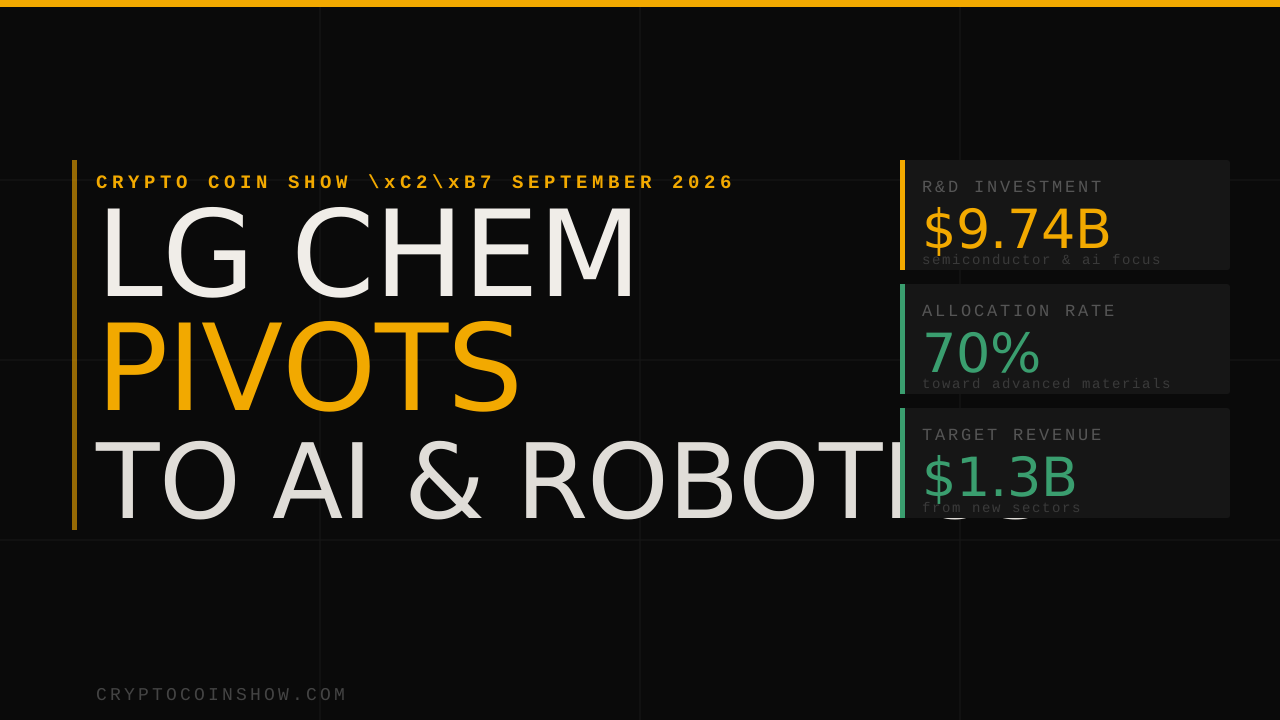
- LG Chem allocates 15 trillion won ($9.74 billion) in R&D, with 70% targeting semiconductor, mobility, and robotics materials
- Company targets 2 trillion won ($1.3 billion) revenue from electronic materials division by 2030, up from undisclosed baseline
- LG Chem aims for double-digit operating margin by 2030 across new business units, versus current single-digit petrochemical margins
- $9.74B Total R&D allocation by LG Chem through 2030 strategy
- 70% Portion of budget targeting semiconductors, mobility and robotics
- 2030 Target year for achieving double-digit operating margins across new divisions
LG Chem’s strategic reorientation, announced during a Monday town hall meeting, represents one of Asia’s largest chemical conglomerates explicitly abandoning its historical revenue base in favor of materials science for AI and advanced computing.
The $9.74 billion commitment over the coming years will fund development across semiconductor packaging materials, electric vehicle and robotics components, high-precision adhesives, and anticancer pharmaceutical compounds. The company also plans to acquire external technologies and build AI-driven applications internally, signaling that organic R&D alone will not suffice for the transition.
For institutional investors tracking the infrastructure buildout around artificial intelligence and semiconductor manufacturing, LG Chem’s pivot matters because materials science is a constrained input in the AI supply chain.
Semiconductor packaging, adhesives, low-dielectric materials, and thermal management compounds are not commodities, they require specialized chemistries and are produced by a limited number of suppliers globally.
When a company the size of LG Chem reallocates capital this dramatically, it signals both the scarcity of these inputs and the investment thesis that drives capital allocation at the institutional level.
Petrochemical Margins Collapsed, Forcing LG Chem to Abandon Core Business
LG Chem’s decision does not reflect newfound enthusiasm for AI so much as desperation to escape a petrochemical sector facing structural decline. Global petrochemical margins have compressed sharply over the past five years, eroded by oversupply, geopolitical disruption, and the slowdown in traditional end markets like automotive and construction.
For a company whose revenue historically centered on these commodity-like businesses, sustained low single-digit operating margins have become unacceptable to shareholders and unsustainable for reinvestment.
CEO Kim Dong-chun framed the shift explicitly in terms of portfolio upgrading rather than innovation for its own sake.
“We will upgrade our business portfolio by fostering semiconductor, mobility, and robotics materials, as well as anticancer drugs, as our core future growth businesses,” he said, emphasizing that each target sector offers higher margins and more defensible competitive positions than legacy petrochemicals.
We will upgrade our business portfolio by fostering semiconductor, mobility, and robotics materials, as well as anticancer drugs, as our core future growth businesses.
Kim Dong-chun, CEO, LG Chem
The company established a CEO-led new business development unit earlier this month specifically to accelerate this portfolio shift, signaling top-level commitment and removing the transition from routine business unit oversight. This structure change matters because it suggests LG Chem views the pivot as existential rather than experimental.
Semiconductor Materials Target: $1.3 Billion in Revenue by 2030
Within the semiconductor division, LG Chem will concentrate on advanced packaging materials, a critical bottleneck in chip production as foundries scale to sub-3-nanometer nodes. Packaging technology, which involves the materials and methods used to house and interconnect silicon dies, is now a primary cost and complexity driver for advanced chips.
By focusing here rather than on commodity resins or commodity plastics, LG Chem is targeting a higher-value segment with longer customer lock-in.
The company also plans to expand development of adhesives and low-dielectric materials, compounds essential for signal integrity and thermal management in advanced processors. These are not commodity chemicals but engineered solutions that require continuous R&D and close collaboration with chipmakers.
LG Chem’s revenue target for its electronic materials division is 2 trillion won ($1.3 billion) by 2030, a figure that presupposes significant market share gains in a sector where incumbents like Dow, Henkel, and Shin-Etsu already have deep customer relationships.
The $1.3 billion target implies either aggressive acquisition strategy or a bet that AI chip demand will expand the total addressable market faster than existing suppliers can scale to meet it.
Robotics and Mobility Materials Expand Beyond Battery Supply Chains
LG Chem’s pivot in robotics and mobility signals a recognition that the electric vehicle supply chain, which has been a growth engine for Korean material suppliers, is maturing and consolidating.
Rather than remain dependent on battery material demand, which is now dominated by a handful of producers in China, Korea, and Japan, LG Chem is moving into structural components for robots and high-precision motion materials used in automation equipment.
This segment includes materials for robotic joints, actuators, and bonding compounds that enable precision assembly in manufacturing. As factory automation accelerates globally, driven partly by labor cost dynamics and partly by AI-enhanced robotics efficiency, these materials will see consistent demand.
The company views this as a hedge against the cyclical nature of EV battery material demand while positioning itself upstream in the robotics supply chain.
The diversification across semiconductors, robotics, and pharmaceuticals is designed to hedge against concentration risk in any single end market while targeting sectors with higher gross margins than petrochemicals.
South Korea’s Semiconductor Export Surge Creates Market Tailwind for LG Chem
LG Chem’s timing aligns with a sharp acceleration in South Korean semiconductor exports, which soared 44% year-over-year in February, reaching $21.4 billion, a record driven almost entirely by AI chip demand.
This export surge reflects the fact that Korean foundries and chipmakers are at the center of the global rush to build AI inference and training capacity, a position that should sustain material demand for the next 3 to 5 years at minimum.
Korea’s semiconductor export momentum is not cyclical noise but structural: both Samsung and SK Hynix have signaled massive capital expenditure commitments for advanced node production, and foundries like Samsung Foundry are competing aggressively for AI chip design wins.
Each of these facilities requires materials that LG Chem aims to supply, meaning the company has visibility into demand that should sustain its 2030 revenue targets even if broader economic growth stalls.
For institutional investors, this context matters because LG Chem’s capital allocation is not speculative. The company is betting on demand that is already visible in export data and corporate capex guidance from its eventual customers. The $9.74 billion commitment should be read as a down payment on market share in a supply chain segment that is already demonstrably growing.
Operating Margin Expansion Target Tests Execution Credibility
LG Chem’s goal of achieving double-digit operating margins across its new business divisions by 2030 is an ambitious metric that will determine whether the capital allocation succeeds or becomes a write-down.
Petrochemical businesses typically operate at single-digit margins; semiconductor materials, robotics components, and advanced adhesives can command 15% to 25% margins if a supplier achieves scale and technology leadership.
The company is essentially projecting that within six years, it will transform from a low-margin commodity chemical business into a higher-margin specialty materials supplier. This requires not just capital investment but successful technology development