
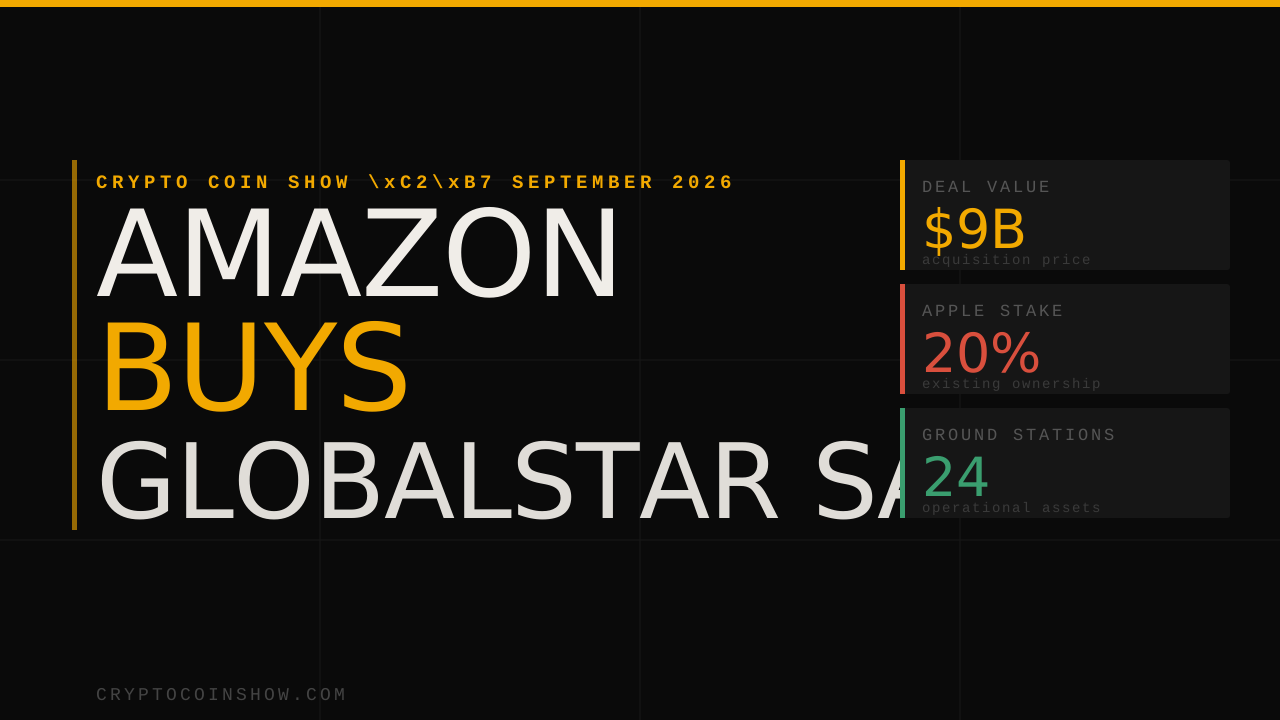
Amazon wants to buy satellite company Globalstar for $9 billion
Amazon is in advanced talks to acquire satellite operator Globalstar for approximately $9 billion, a move that would instantly grant the e-commerce giant licensed spectrum across 120+ countries and 24 operational ground stations, critical assets needed to meet FCC deployment deadlines for its Amazon Leo constellation. The deal presents an unprecedented regulatory and competitive puzzle: Apple owns 20 percent of Globalstar and reserves 85 percent of its satellite capacity for iPhone emergency services, meaning Amazon would effectively control the infrastructure underpinning a rival’s mission-critical consumer feature.
- Amazon in talks to acquire Globalstar for approximately $9 billion to accelerate satellite network deployment.
- Apple owns 20 percent of Globalstar and reserves 85 percent of satellite capacity for iPhone Emergency SOS.
- Amazon must have 1,600 satellites in orbit by July 2026 FCC deadline but has only deployed 212 production units.
- $9 billion Estimated acquisition price for Globalstar versus Amazon’s $9 billion investment in first 200 satellites
- 1,600 Satellites Amazon must orbit by July 2026 under FCC mandate versus 212 currently deployed
- 85% Of Globalstar capacity reserved for Apple Emergency SOS feature on 500+ million iPhone models
Amazon’s pursuit of Globalstar marks a direct confrontation with the challenge of catching up in satellite internet deployment. The e-commerce giant launched its Amazon Leo constellation (formerly Project Kuiper) in April 2024 and has placed roughly 200 satellites in orbit as of December, but faces a punishing regulatory timeline.
The Federal Communications Commission mandates that Amazon achieve 3,200 satellites in orbit with at least 1,600 deployed by July 2026, a threshold that at current pace appears unachievable through organic launches alone. Amazon requested additional time from the FCC in January, signaling the company’s recognition that its manufacturing and launch cadence cannot meet the original schedule.
Acquiring Globalstar would instantly inject operational capability that would otherwise take years to build. The target company operates 24 active satellites, maintains 24 ground gateways across the globe, and holds licensed spectrum access in over 120 countries, frequencies in the L-band and S-band that are heavily restricted and typically distributed through multi-year FCC auction processes.
For Amazon, purchasing these assets represents far faster progress toward regulatory compliance than organic deployment or waiting for spectrum auctions to conclude.
Apple’s 20 Percent Stake and $1.1 Billion Prepayment Complicate Rival Infrastructure Control
The structural complexity emerges from Apple’s strategic position inside Globalstar. In November 2023, Apple purchased a 20 percent equity stake in Globalstar for approximately $400 million and simultaneously committed $1.1 billion in prepayments to fund satellite network expansion.
This dual investment, equity plus infrastructure financing, transformed Globalstar into a critical component of Apple’s hardware ecosystem, specifically powering the Emergency SOS feature available on iPhone 14 and newer models and the Apple Watch Ultra 3.
When cellular networks fail, these devices route emergency messages through Globalstar’s ground stations to first responders, creating a direct dependency on infrastructure reliability.
With Globalstar’s stock price climbing 15 percent on news of Amazon’s interest (and a further 24 percent in after-hours trading), Apple’s stake has appreciated to approximately $1.1 billion in market value, matching its prepaid infrastructure commitment in value but not yet in realized returns.
This appreciation incentivizes Apple to support a transaction that increases Globalstar’s valuation, yet simultaneously creates a conflict: the same acquisition would place Apple’s emergency communications infrastructure under the operational control of a direct retail and cloud computing rival.
No precedent exists in technology for two competing giants to share mission-critical infrastructure in this manner.
85 Percent Capacity Reserved for iPhone Emergency SOS Creates Unresolved Control Question
The core tension lies in capacity allocation. Globalstar currently dedicates 85 percent of its satellite bandwidth to Apple’s Emergency SOS feature, with only a small portion available for commercial or other uses. An Amazon acquisition would place the operator of this capacity, and thus the ability to modify, repriotize, or reallocate bandwidth, under Amazon’s corporate governance.
While Globalstar would likely remain operationally independent as a subsidiary, Amazon would control board appointments, capital allocation, and strategic network planning decisions.
For institutional investors evaluating the deal, the regulatory and contractual framework governing this arrangement remains unclear. Amazon and Apple would need to negotiate explicit agreements governing service levels, capacity guarantees, pricing, and dispute resolution.
The FCC may impose conditions on any acquisition approval, potentially requiring contractual safeguards or spectrum-use restrictions that would limit Amazon’s operational flexibility. The precedent-setting nature of this arrangement, where a company owning critical safety infrastructure for hundreds of millions of devices operates under a competitor’s control, invites intense regulatory scrutiny.
Apple’s prepayment structure further complicates exit scenarios. If Apple perceives Amazon as threatening the reliability or priority of Emergency SOS service, Apple could theoretically demand accelerated returns on its prepayment or seek alternative satellite operators. The $1.1 billion represents contingent leverage Apple holds over Amazon’s operational decisions regarding Globalstar.
Amazon’s FCC Deployment Deadline and Spectrum Access Drive Deal Urgency
Amazon’s satellite ambitions depend on licensed spectrum access and rapid orbital deployment. The company designed Amazon Leo and its AWS cloud services to integrate at the infrastructure level, with satellite connectivity serving as a backbone for edge computing, disaster recovery, and rural broadband markets.
Owning Globalstar’s spectrum portfolio, L-band and S-band frequencies held across 120+ countries, would bypass the multi-year FCC auction process and grant Amazon immediate regulatory authority to deploy additional satellites using already-licensed bands.
The July 2026 FCC deadline functions as the hard constraint on deal timing. Amazon must demonstrate either 1,600 deployed satellites by that date or face potential license revocation and spectrum reassignment. At current deployment rates, organic launches cannot meet this threshold.
A Globalstar acquisition would partially satisfy the requirement by adding 24 operational satellites immediately, while the spectrum access would enable Amazon to launch additional capacity under already-licensed frequencies without awaiting new FCC approvals.
Amazon has already invested approximately $9 billion in manufacturing and launching its first 200+ satellites. The company’s cost structure for organic deployment appears expensive relative to acquiring an existing operator with heritage infrastructure, ground stations, and spectrum.
This economic calculation, $9 billion spent to deploy 200 satellites organically versus $9 billion to acquire a company with 24 satellites, 24 ground stations, and global spectrum licenses, reveals why acquisition may represent faster and more efficient progress toward Amazon Leo’s full constellation deployment.
Regulatory Approval Hinges on Apple Coordination and Spectrum Control Conditions
The FCC and potentially the Department of Justice will scrutinize this acquisition for competitive and national security implications. Globalstar operates under FCC licenses that restrict foreign ownership and require approval for any material change of control.
Amazon’s acquisition would require explicit FCC blessing, which the agency may condition on contractual obligations protecting Apple’s Emergency SOS service, preventing Amazon from discriminating against Apple traffic, or maintaining capacity guarantees.
Amazon and Apple will likely negotiate a comprehensive service agreement governing Globalstar’s operations post-acquisition. This agreement would establish minimum service levels, capacity allocations, pricing mechanisms, and dispute resolution procedures.
The existence of such an agreement itself becomes a regulatory filing requirement, the FCC may demand to review Apple-Amazon agreements as a condition of license transfer approval.
The deal remains subject to FCC approval and Apple-Amazon negotiation of service terms.
Institutional investors should monitor three specific developments: first, whether Amazon publicly announces a definitive acquisition agreement and timeline within the next 60 days; second, whether Apple signals acceptance through a statement or public transaction support; and third, whether the FCC issues a public notice or comment period on the license transfer, which would clarify the agency’s competitive and national security stance on the deal. The absence of FCC approval by mid-2026 would force Amazon to meet its satellite deployment deadline through alternative means, potentially requiring emergency spectrum waivers or deadline extensions from regulators.