
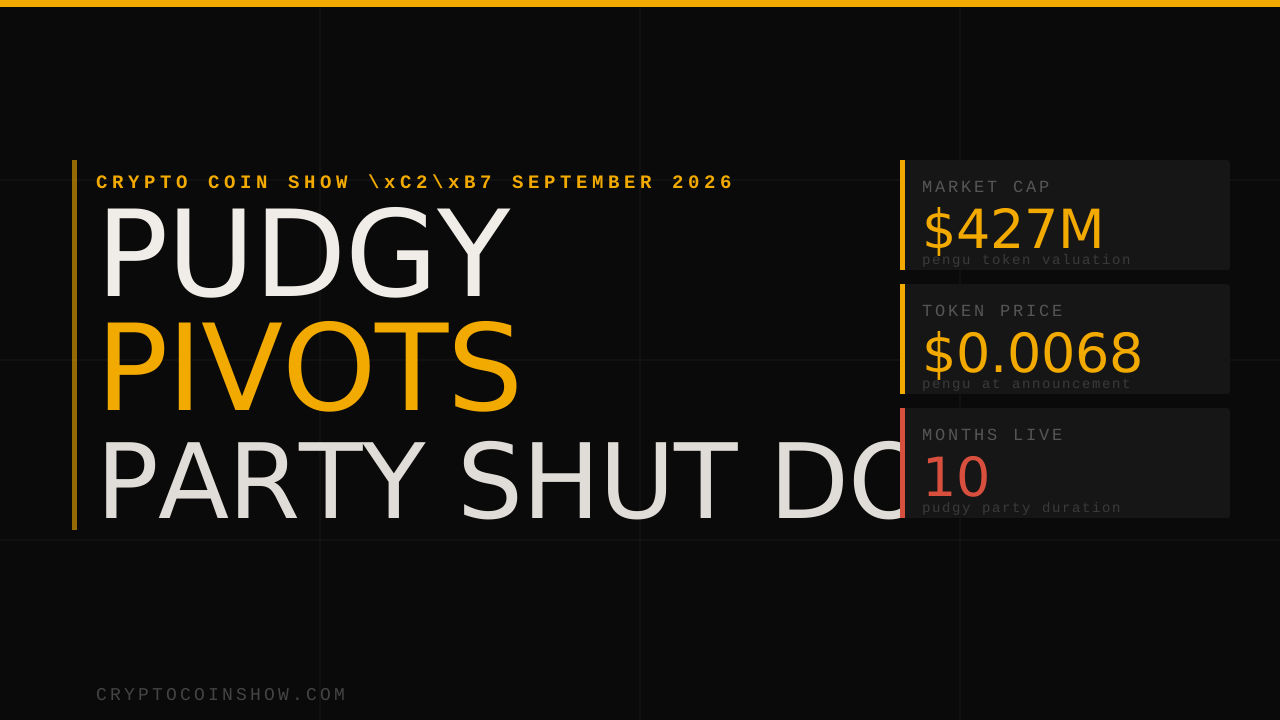
Pudgy Penguins halts Pudgy Party development, redirects resources to Pudgy World
Pudgy Penguins has discontinued its mobile game Pudgy Party, consolidating development resources into its web-based competitor Pudgy World, leaving investors and players uncertain about asset recovery and refund eligibility. The move signals a shift in strategy for the NFT project as it pivots toward mainstream consumer products over blockchain-native gaming.
- Pudgy Party shut down June 12 after launching August 2025, following Times Square promotion campaign
- PENGU token trades at $0.006793 with $427 million market cap as of announcement date
- No official guidance provided on refunds or asset migration for Pudgy Party players and purchasers
- June 12 Official shutdown announcement date for Pudgy Party mobile game
- $427M PENGU token market cap at time of Pudgy World resource consolidation
- 98,200 Pudgy Party X account followers at time of discontinuation
Pudgy Penguins officially halted development of Pudgy Party, its mobile gaming title created in partnership with Mythical Games, to redirect engineering and operational resources toward Pudgy World, a free-to-play browser-based gaming platform launched in March 2026.
The company announced the discontinuation on June 12 through the official Pudgy Party X account, triggering immediate community backlash from players who had invested time and capital into the mobile game since its August 2025 launch.
The decision marks a significant recalibration of the project’s gaming strategy, though the announcement notably omitted details on refund policies or mechanisms for migrating in-game assets purchased by Pudgy Party users.
Pudgy Party’s 10-Month Arc: From Times Square to Closure
Pudgy Party launched in August 2025 as a fast-paced mobile gaming experience featuring mini-games, customizable avatars, and blockchain-backed collectible items. The project received substantial promotional investment, including a Times Square marketing campaign in September 2025 that positioned it as a mainstream gaming entry point rather than a cryptocurrency-specific product.
Despite the aggressive go-to-market approach, the game accumulated 98,200 followers on X but ultimately failed to achieve the engagement metrics or monetization targets that would justify continued parallel development alongside Pudgy World.
Community members who engaged with the announcement expressed frustration over perceived wasted investment. The Pudgy Party X post generated hundreds of replies and quote tweets within hours of publication, with users questioning what would happen to digital items they had purchased and earned within the mobile ecosystem.
The absence of clarification around asset preservation or refund procedures amplified concerns about the irreversibility of the decision and the fate of sunk player investment.
Pudgy World’s Browser-First Architecture and Hidden Blockchain Design
Pudgy World launched in March 2026 as a browser-based alternative with explicit design choices to mask its blockchain foundations from casual players.
The game features 12 towns, plot-driven quests, and mini-games hosted within a virtual environment called “The Berg,” deliberately abstracting cryptocurrency mechanics to appeal to mainstream gaming audiences unfamiliar with or skeptical of Web3 gaming.
Co-founder @chefgoyardi highlighted custom physics and world-building tools specifically optimized to run on lower-end devices, removing technical barriers to participation.
The token market responded positively to Pudgy World’s debut. PENGU rose 9% on launch day in March 2026 and currently trades at $0.006793, reflecting a market capitalization of approximately $427 million according to CoinMarketCap.
This valuation provides context for Pudgy Penguins’ resource allocation decision: consolidating development allows the team to maximize velocity on its more successful gaming vertical while the token maintains mid-tier market standing in the gaming-focused NFT sector.
The deliberate de-emphasis of blockchain elements in Pudgy World’s user experience aligns with broader industry trends toward mainstream onboarding. By positioning gameplay as a conventional browser experience rather than a crypto product, Pudgy Penguins targets players who may not hold cryptocurrency or NFTs, potentially expanding the addressable market beyond existing Web3 communities.
This strategy contrasts sharply with Pudgy Party’s more traditional mobile gaming approach, which did not emphasize similar mainstream abstraction.
Asset Recovery and Refund Policy Remain Unaddressed
The official discontinuation announcement contained no explicit guidance on how Pudgy Party players would recover or migrate digital assets acquired during the game’s 10-month operating window.
Players purchased in-game items and collectibles using either fiat payment methods or blockchain-native mechanisms, creating potential liability around restitution or asset portability to Pudgy World’s ecosystem. The lack of clarity represents a critical gap that may trigger regulatory scrutiny or legal challenges from affected players.
As of the announcement date, no formal migration pathway or refund mechanism had been communicated to the Pudgy Party community.
This silence distinguishes the Pudgy Penguins decision from industry precedent. When other blockchain gaming projects have wound down titles, operators typically provided explicit timelines for asset recovery, conversion mechanisms to alternative tokens or NFTs, or direct cash refunds to users who had spent money in-game.
The absence of such guidance here suggests either incomplete internal communication with affected users or a deliberate choice to avoid commitment on a complex logistical problem. Either interpretation raises questions about the company’s operational maturity and its prioritization of community trust versus engineering efficiency.
Pudgy Penguins’ Broader Pivot Toward Physical Retail and Consumer Goods
The Pudgy Party shutdown must be understood within Pudgy Penguins’ wider business transformation over the past 12 months. The project has successfully moved substantial volume into physical merchandise, generating over $10 million in sales through major U.S. retailers including Walmart and Target.
This diversification away from pure digital/blockchain offerings reflects a strategic bet that Pudgy Penguins’ brand value resides in consumer affinity rather than crypto-specific mechanics or token utility.
Consolidating gaming development under a single title aligns with this retail-forward strategy. Rather than splitting resources between two gaming properties, Pudgy Penguins can focus engineering investment on Pudgy World while allocating business development and marketing capacity toward physical product expansion.
The NFT collection itself remains active, with 8,888 total pieces held by 5,100 unique addresses and a floor price of 4.54 ETH on OpenSea, providing a secondary revenue and user retention mechanism independent of gaming performance.
The consolidation suggests Pudgy Penguins views gaming as one lever among several, rather than the primary value driver for the brand.
Institutional Implications: Token Stability and Developer Credibility Risk
For institutional investors holding PENGU or considering positions in the token, the Pudgy Party discontinuation creates both clarity and risk. On one hand, the decision to focus resources on Pudgy World eliminates operational drag from supporting two divergent gaming platforms, potentially improving the quality and velocity of Pudgy World updates and new features.
On the other hand, the lack of formal communication regarding refunds and asset migration exposes the project to reputational damage and potential regulatory complaints that could affect broader market perception of the team’s competence and commitment to user protection.
The PENGU token’s $427 million market cap places it in the mid-tier of gaming-focused cryptocurrencies, a valuation that depends substantially on confidence in Pudgy Penguins’ execution and brand strength.
Community backlash over the Pudgy Party shutdown, particularly if amplified by user complaints about unresolved asset claims, could trigger token selling pressure and reduce confidence among institutions evaluating the project as a long-term investment or partnership opportunity.
Token holders should monitor whether Pudgy Penguins issues a subsequent clarification addressing refund and migration policies within the coming weeks.
The critical watch point is Pudgy Penguins’ response to community demands for a formal asset recovery and refund policy within the next 30 days. If the team establishes a clear, auditable mechanism for protecting player investments, the shutdown may be understood as a disciplined resource optimization. If no such policy emerges, the discontinuation could become a case study in how not to sunset a blockchain-connected product