
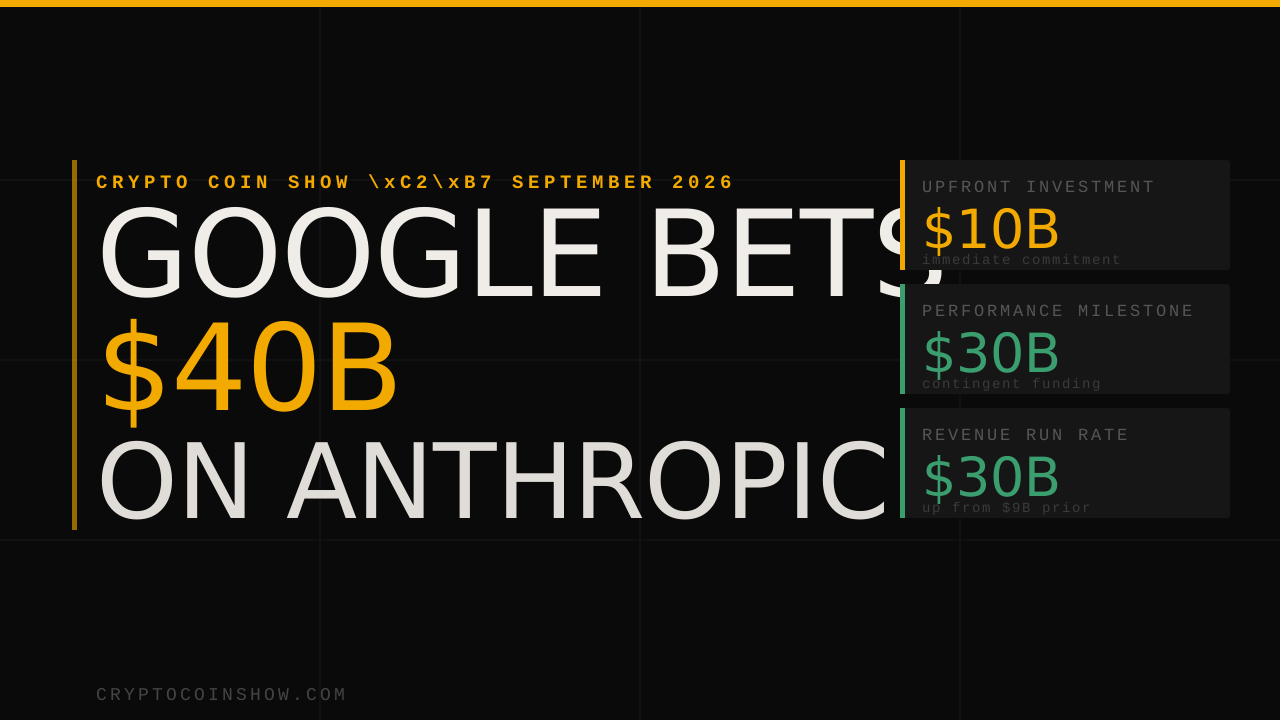
Google invests up to $40B in Anthropic
Alphabet is committing up to $40 billion to Anthropic, $10 billion immediately and $30 billion contingent on performance milestones, marking one of the largest single corporate investments in an AI company and signaling intense competition among tech giants for frontier AI capability. The deal arrives as Anthropic’s valuation has surged to $800 billion to $1 trillion on secondary markets, and as the startup accelerates product releases to compete with rivals across software engineering, vision, and design tools.
- Alphabet will invest $10 billion upfront with $30 billion more tied to performance goals, valuing Anthropic at substantially higher levels than prior rounds.
- Anthropic’s revenue run rate has reached $30 billion, up from $9 billion at end of 2025, a more than threefold increase in annualized earnings.
- Secondary market transactions now price Anthropic between $800 billion and $1 trillion, with some shareholder listings valuing the company at $1.15 trillion before the Google deal.
- $40B Total committed capital from Alphabet to Anthropic over investment period
- $30B Annual revenue run rate for Anthropic as of April 2026
- $1T+ Implied valuation range on secondary markets prior to Google announcement
Alphabet announced on April 24, 2026 that it will funnel up to $40 billion into Anthropic, one of the most prominent AI research companies and creator of the Claude family of large language models. The commitment consists of $10 billion in immediate capital followed by $30 billion in follow-on funding conditional on achieving specified performance and capability milestones.
Anthropic, which remains privately held, has emerged as a key player in the race for advanced AI systems and now counts Google’s parent company as a majority strategic investor alongside its existing cloud and infrastructure partnerships with Amazon and CoreWeave.
The investment underscores the scale of capital concentration in frontier AI development. In the same period, global venture capital allocated between $297 billion and $314 billion across all sectors in the first quarter of 2026 alone, with AI representing 80 to 81 percent of that total.
By that measure, Alphabet’s $40 billion commitment to a single company reflects the intensity of competition among technology incumbents to secure access to cutting-edge AI models and avoid being displaced by newer entrants.
Anthropic’s valuation has crossed into nine-figure territory as secondary market trading accelerates
Secondary market transactions paint a picture of Anthropic valuation far exceeding the terms of Alphabet’s new commitment. Shares traded on platforms including Forge Global have shifted hands at prices implying valuations between $800 billion and $1 trillion, with at least one shareholder listing valuing the company at $1.15 trillion prior to the Google announcement.
These secondary prices reflect investor confidence in Anthropic’s revenue trajectory and competitive position against other frontier AI labs, even as the private secondary market remains illiquid and prices volatile.
Anthropic’s financial momentum supports the elevated private valuations. The company’s annualized revenue run rate reached $30 billion in April 2026, up sharply from $9 billion reported at the end of 2025, representing more than a threefold increase in just four months.
That acceleration reflects both price increases on existing API tiers and a rapid expansion of enterprise customers paying for dedicated, hosted Claude instances via Amazon Web Services infrastructure.
Alphabet’s prior stake in Anthropic, accumulated before this new round, represented approximately 14 percent of the company, making the tech giant already a significant minority holder before committing fresh capital.
Google scales Anthropic’s compute infrastructure with TPU chips and multi-cloud partnerships
Alphabet is not merely writing checks; the company is also deepening operational integration by providing its own TPU accelerator chips to power Anthropic’s model training and inference.
This commitment to in-house silicon stands alongside Anthropic’s existing multi-cloud strategy, which includes a long-term deal with CoreWeave for GPU capacity and a plan to deploy close to 1 gigawatt of compute powered by Amazon’s GPUs hosted on AWS infrastructure.
The layered compute approach, combining Google TPUs, Amazon GPUs via CoreWeave, and proprietary systems, gives Anthropic flexibility to optimize costs and avoid over-dependence on any single supplier.
For institutional investors, this infrastructure integration matters because it ties Anthropic’s scaling directly to Google’s financial and technical resources at a moment when the company is training larger, more capable models.
Claude Opus 4.7, released on April 16, represents Anthropic’s latest flagship offering, featuring improvements in software engineering tasks, long-context code generation, and high-definition vision capabilities.
The model pricing remains unchanged at $5 per million input tokens and $25 per million output tokens, suggesting that Anthropic is using scale and efficiency gains to sustain margins rather than pass lower costs to customers.
Anthropic has also rolled out Claude Design, an experimental interface launched April 17 targeting founders and product managers without design expertise. The tool, available on Opus 4.7 for Claude Pro, Max, Team, and Enterprise users, generates prototypes, slide presentations, and one-page designs, extending Claude’s reach beyond pure language and code into visual and design work.
Earlier in 2026, Anthropic shipped Claude Cowork for collaborative work, Claude Code for agentic autonomous coding, Claude Opus 4.6 and Sonnet 4.6 with 1 million token context windows, and Claude Mythos Preview for advanced cybersecurity analysis via the company’s Project Glasswing partnership program.
Alphabet’s $40 billion bet arrives amid record AI funding but faces regulatory and competitive headwinds
The 2026 funding environment for AI has proven exceptionally robust, with the first quarter alone seeing $297 billion to $314 billion deployed globally in venture capital, of which 80 to 81 percent flowed to AI-related companies and projects.
Yet the Alphabet-Anthropic deal does not occur in isolation from regulatory scrutiny or competitive pressure. The U.S. Department of Justice and the Federal Trade Commission have begun examining whether large tech firms are using investment in younger AI labs as a means to extend market dominance rather than promote genuine competition.
Anthropic, despite its strong capital position and revenue growth, competes with OpenAI (backed by Microsoft), Meta’s open-source Llama models, and emerging labs including Mistral, xAI, and others.
The Google commitment may reduce Anthropic’s independence in key decisions around model safety, deployment, and pricing, questions that institutional investors will monitor closely as the company approaches any future financing or exit event.
Investors should watch for Anthropic’s next major product release and any update on the conditional $30 billion tranches from Alphabet, which will depend on achieving unspecified performance goals. Additionally, monitor whether regulatory bodies in the U.S. or EU challenge the Google-Anthropic deal as anticompetitive, and track secondary market pricing as it may signal divergence between what professional investors believe Anthropic is worth versus the valuation terms embedded in Alphabet’s performance-based structure.