
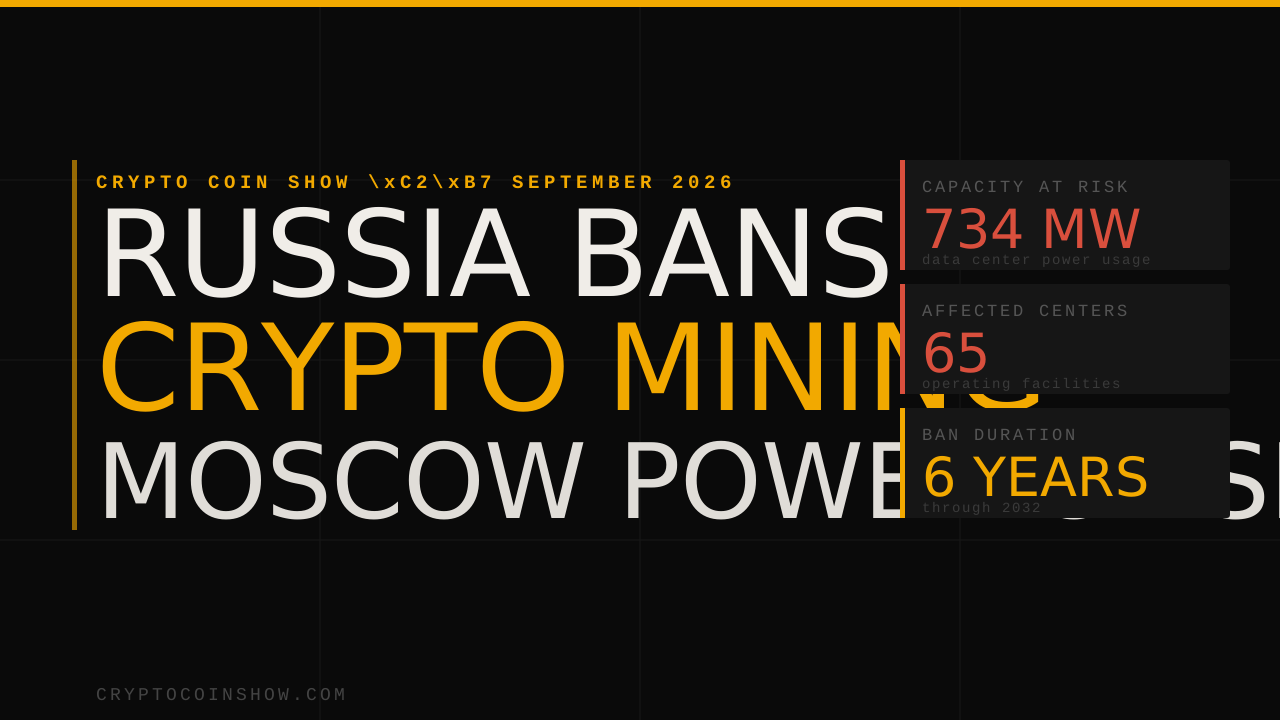
Russia set to ban crypto mining in Moscow, prosecute illegal miners
Russia’s government commission has recommended a six-year ban on cryptocurrency mining across Moscow, Moscow Oblast, and parts of Kursk region, potentially extending to 19 regions served by the capital’s power grid. The move signals a sharp reversal in Moscow’s stance toward mining despite legalizing the activity in 2024, driven by acute electricity shortages that regional officials say threaten residential and industrial supply.
- Russia’s Deputy Energy Minister confirmed a proposed ban extending through at least 2032 covering Moscow and surrounding regions.
- At least 65 data processing centers with 734 MW capacity currently operate in Moscow and Moscow Oblast territories.
- The ban may expand to 19 regions across the Central Federal District, Russia’s most economically productive area.
- 2032 The year through which the proposed mining ban is set to remain in place, spanning six years.
- 734 MW Combined capacity of data processing centers in Moscow and Moscow Oblast versus regional electricity constraints.
- 19 Number of regions potentially affected if ban expands across Moscow’s power distribution network territory.
Russia’s government is moving to ban cryptocurrency mining in its capital and surrounding high-population regions, marking a dramatic policy reversal less than a year after the nation legalized the activity.
A government commission overseeing Russia’s electric power sector has formally recommended prohibiting all crypto mining operations in Moscow, Moscow Oblast, and portions of Kursk region through at least 2032, according to statements by Deputy Energy Minister Evgeniy Grabchak.
The restriction follows mounting pressure from regional officials who argue that concentrated mining operations are depleting electricity supplies needed for residential consumers and industrial production in areas already strained by geopolitical disruption.
Moscow and Kursk officials cite power shortages as rationale for six-year mining restriction
Regional leaders across central Russia have united behind the mining prohibition, citing electricity scarcity as an existential economic problem. Moscow Oblast’s Energy Minister Sergey Voropanov previously stated that crypto mining generates no economic benefit to the region while consuming power that could serve local households and factories.
Governor Andrey Vorobyov and Moscow Mayor Sergey Sobyanin both formally proposed the restrictions, signaling political consensus at the city and regional level.
In Kursk Oblast, Governor Alexander Khinshtein framed the ban as a matter of regional survival, noting that power supply problems have intensified due to the ongoing war in neighboring Ukraine.
He specifically proposed mining restrictions in eight districts and the city of Lgov, arguing that the ban would preserve electricity reserves for residential and industrial consumers facing acute supply constraints. Khinshtein’s administration claims the measure will redirect available capacity toward essential services rather than speculative digital asset production.
Current mining infrastructure in the two territories is substantial: at least 65 data processing centers with a combined capacity of 734 megawatts are already connected to the Moscow and Moscow Oblast grids, according to Russia’s energy ministry.
Expansion to 19 regions would eliminate mining across Russia’s wealthiest economic zone
The proposed ban may extend far beyond the capital and immediately adjacent areas. According to reporting by Russian business daily Kommersant, the government is considering cryptocurrency mining restrictions across 19 regions served by Moscow’s power distribution network.
If implemented, this would eliminate crypto mining throughout the Central Federal District, which represents Russia’s economic heartland and accounts for a disproportionate share of national GDP and industrial output.
Such an expansion would represent a near-complete reversal of Russia’s 2024 decision to legalize mining. That legalization was premised on capitalizing Russia’s natural advantages: abundant hydroelectric and natural gas resources combined with cold climates that reduce cooling costs for data centers.
The strategy aimed to monetize these competitive advantages and capture a larger share of global mining activity migrating away from China and Western markets under regulatory pressure.
The collision between this economic rationale and electricity reality has forced a policy recalibration. High concentrations of low-cost mining operations in regions with favorable power rates have created localized energy deficits, overwhelming the grid’s ability to serve other consumers.
This problem is not new to Russia: as of last year, local and federal authorities had already imposed mining bans in 13 regions until spring 2031, including Irkutsk Oblast, Republic of Buryatia, Zabaykalsky Krai, most North Caucasus republics, and four occupied Ukrainian oblasts.
Criminal penalties for illegal mining signal enforcement intent beyond regulatory restrictions
The government is pairing the proposed territorial ban with criminal prosecution measures for operators who continue mining illegally.
This dual approach, territorial prohibition plus criminal liability, indicates that Moscow intends to enforce the restrictions with more than administrative warnings or fines.
The addition of prosecution language suggests authorities recognize that mining operations, once established, have strong financial incentives to continue operating through concealment or bribery rather than relocating or shutting down. By introducing criminal penalties, the government aims to raise the cost and reputational risk of defiance beyond what administrative measures alone would achieve.
The enforcement framework also reflects lessons from the existing 13-region bans imposed in 2023 and 2024.
If those restrictions proved difficult to enforce or were circumvented through informal arrangements, the addition of criminal penalties represents an effort to close loopholes and demonstrate genuine enforcement commitment to regional officials who will monitor compliance in their territories.
Pending government decision on 19-region expansion will determine scale of Russia’s mining sector contraction
The critical question now is whether the government will approve the commission’s recommendation to expand the ban to all 19 regions of the Central Federal District. That decision has not yet been finalized, leaving the ultimate scope of the restriction uncertain.
If the government approves only the narrower ban covering Moscow, Moscow Oblast, and Kursk, the impact on Russia’s overall mining capacity will be significant but geographically contained. If it authorizes the full 19-region expansion, the decision would effectively shut down commercial mining operations across Russia’s most developed and densely populated zones.
The timing of this decision is strategically sensitive. Russia legalized mining specifically to attract international operators and capital seeking refuge from Western jurisdictions. A rapid pivot toward severe restrictions, imposed less than a year after legalization, would undermine Moscow’s credibility as a stable policy environment for crypto activity and likely deter future mining investment.
Conversely, regional officials argue that persistent electricity shortages pose immediate risks to their economies and will demand resolution regardless of national industrial policy.
The government commission has recommended the ban extend through 2032, but the decision on whether to expand it to all 19 regions served by Moscow’s power grid remains pending before Russian federal authorities, a determination that will establish whether crypto mining continues as a meaningful economic activity in Russia’s core territories or becomes restricted to outlying regions with surplus generation capacity.