
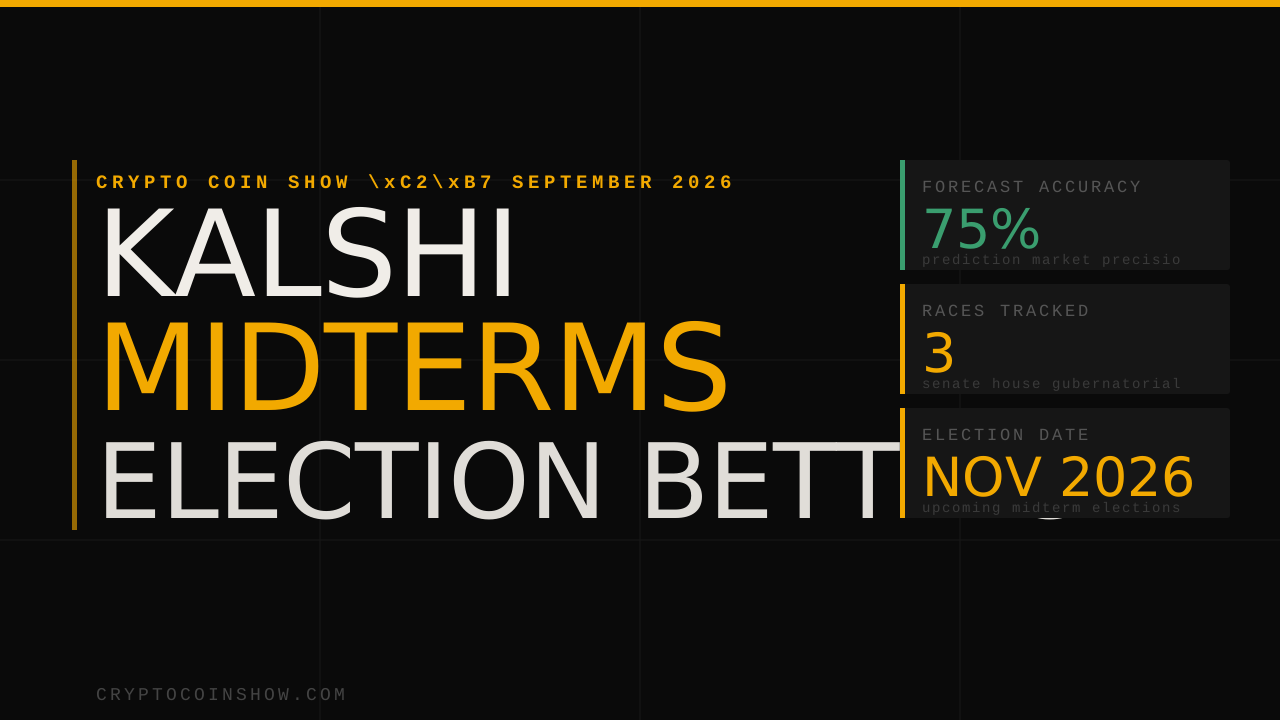
Kalshi launches Midterms Hub where users can follow how money is moving in markets related to this fall’s midterm elections
Kalshi’s new Midterms Hub provides institutional and retail traders with real-time access to prediction market pricing on U.S. Senate, House, and gubernatorial races, creating a transparent window into market expectations ahead of November’s elections. The move expands the utility of legally sanctioned election betting markets, which have demonstrated predictive accuracy of roughly 75 percent in recent contests, offering an alternative data source to traditional polling for institutional investors monitoring political risk.
- Kalshi’s Midterms Hub aggregates real-time election market odds alongside FEC campaign finance data, polling averages, and curated political news in a single public interface.
- Prediction market accuracy in 2024 primaries reached approximately 75 percent when candidates held odds between 70-80 percent, validated by Washington Post analysis of hundreds of contests.
- Election-related trading volume on Kalshi has approached $200 million, driven by 24/7 market operation and court approval of federal election wagering in 2024.
- 75% Accuracy rate of prediction markets versus traditional polls in 2024 primary races
- $200M Estimated trading volume on Kalshi’s platform related to midterm elections
- 75% Proportion of Kalshi users who view markets without placing trades themselves
Kalshi, a federally regulated financial exchange, launched its Midterms Hub this week to provide public access to real-time pricing data from prediction markets covering the November midterm elections.
The platform allows users to track where real-money traders are positioning bets across U.S. Senate, House, and gubernatorial races nationwide, creating what the company describes as one of the most comprehensive public windows into trader expectations for Election Day outcomes.
The hub integrates election market odds with Federal Election Commission campaign finance disclosures, polling averages, curated political news, and historical election results by state and congressional district, allowing users to compare traditional polling sentiment against market-implied probabilities in real time.
Kalshi’s Hub Integrates Market Odds with FEC Filings and Polling Data
The Midterms Hub is designed for four user groups: voters seeking current election information, journalists and researchers tracking political developments, campaign operatives monitoring competitor positioning, and institutional market participants analyzing political risk.
By consolidating multiple data streams, polling, market pricing, and campaign finance, the platform enables cross-referencing of different signals.
Users can observe, for instance, whether a candidate receiving strong grassroots funding (measured by the percentage of contributions under $200) is also gaining odds support in prediction markets, or whether polling leads match market confidence levels.
The platform’s real-time pricing updates whenever news breaks, candidates make statements, or debate outcomes are digested by traders. Markets operate 24/7, meaning odds adjust continuously rather than only during traditional trading hours, providing a more granular view of sentiment shifts.
According to Kalshi, approximately 75 percent of users who visit the platform view market contracts without placing trades themselves, indicating substantial demand for election market data as a research and intelligence tool rather than as a betting venue.
Prediction Markets Achieved 75 Percent Accuracy in 2024 Primary Elections
Kalshi’s credibility as a data source depends substantially on demonstrated predictive accuracy. In 2024, the company claims that traders’ favored candidates won nine of ten elections tested across a three-month window leading up to contests.
The Washington Post independently validated this track record by examining hundreds of 2024 primary races on the platform and found that when candidates held odds between 70 and 80 percent, a range indicating strong but not overwhelming market confidence, approximately 75 percent of those candidates ultimately won their races.
This accuracy rate exceeds many traditional polling methodologies, which frequently miscalibrate final margins and upset potential in primary contests. The distinction matters for institutional investors because prediction markets aggregate financially motivated forecasts rather than poll respondents’ stated preferences.
Tarek Mansour, Kalshi’s CEO and a former Citadel trader and Goldman Sachs analyst educated at MIT, argues that markets are harder to distort with partisan messaging than traditional opinion polls or political commentary, since traders risk capital on their predictions.
Prediction markets offer a clearer view of election expectations by reflecting financially backed forecasts rather than political rhetoric.
Tarek Mansour, CEO of Kalshi
The distinction between prediction market accuracy and polling error has acquired institutional relevance as asset managers and political risk specialists increasingly incorporate election outcomes into portfolio construction and hedging decisions.
Election Wagering Volume Approaches $200 Million Following 2024 Court Ruling
Kalshi’s expansion of its election trading platform follows a critical legal development: a 2024 court ruling that permitted Americans to place wagers on federal elections. Prior to that decision, election betting markets were constrained by regulatory ambiguity and legal risk, limiting both volume and participation.
The court approval removed these barriers, and Kalshi has captured the emerging market share, with midterm election-related trading volume now approaching $200 million on its platform alone.
The company previously launched the American Power Index, also known as KPOW, in May of this year, designed as a political analogue to the S&P 500. The index combines current control of government with trader expectations about future political outcomes, displayed as a single figure on a scale ranging from plus-50 (full Democratic control) to plus-50 (full Republican control).
This index tool targets institutional clients seeking a single-number summary of political positioning.
Trading volume has grown rapidly, reflecting both increased awareness of legal election betting and Kalshi’s establishment as the primary regulated venue for such activity.
The Midterms Hub’s launch and the approaching $200 million in election trading volume signal that institutional and retail participants now view prediction markets as a mainstream political intelligence tool.
The critical open question is whether Kalshi’s data integration model, combining market odds, polling, FEC filings, and news, will become the standard reference point for political risk analysis across asset management, campaign finance, and media industries, or whether its use will remain concentrated among specialized traders.
November’s election results will provide a definitive test of whether the platform’s 75 percent accuracy rate in primary contests carries forward to general election races, where different voter coalitions and turnout dynamics apply.
Regulatory Arbitrage: How Federal Court Approval Unlocked Election Betting Scale
Kalshi’s ability to offer election markets at institutional scale reflects a significant shift in U.S. regulatory stance. In 2024, federal courts rejected the Commodity Futures Trading Commission’s longstanding ban on election-linked derivatives, clearing the way for Kalshi to operate as a federally registered derivatives exchange.
This reversal created a legal foundation absent for nearly two decades, during which prediction market data remained fragmented across offshore platforms and academic research environments with limited real-money participation.
The regulatory opening has compressed adoption timelines dramatically. Kalshi’s election-related trading volume approached $200 million in the 2024 cycle, compared to cumulative volumes in the tens of millions across all U.S. prediction markets before 2024.
This expansion matters because market depth, the volume of real money wagered at various price points, directly correlates with forecast reliability. Thinner markets reward individual large bets and are prone to manipulation; deeper markets distribute risk across thousands of participants with heterogeneous information sets, pushing prices toward fundamental values.
The Midterms Hub launch tests whether institutional adoption will sustain beyond the novelty of legal access. Kalshi has disclosed that institutional clients now account for a meaningful but unspecified share of platform volume, though retail traders still dominate order flow by count. The coming months will reveal whether asset managers and hedge funds integrate election market pricing into systematic risk models, or whether trading remains concentrated among political enthusiasts and specialized bettors.