
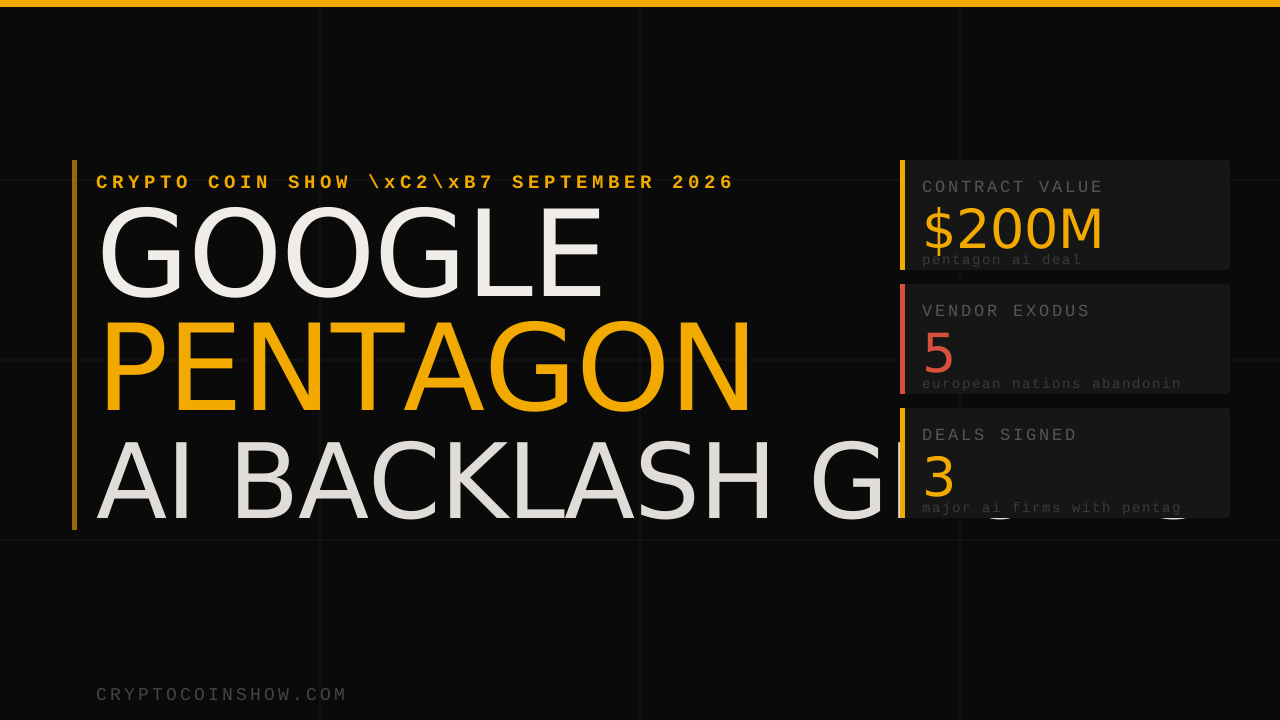
Google faces backlash over Pentagon AI deal
Google’s newly signed Pentagon AI contract worth up to $200 million has triggered fresh employee backlash and accelerated a strategic pivot by European and Asian governments to abandon U.S.-linked tech vendors entirely. The shift reflects institutional concern that American firms cannot separate commercial operations from national security obligations, reshaping global AI infrastructure investment patterns away from Silicon Valley.
- Pentagon signed agreements up to $200 million each with Google, OpenAI, and Anthropic in 2025.
- Google’s contract allows Pentagon use for “any lawful government purpose” but restricts domestic mass surveillance and autonomous weapons without human oversight.
- France, Austria, Denmark, Italy, and Germany are abandoning Microsoft and U.S. cloud providers for domestic or open-source alternatives.
- $200M Maximum value of Pentagon AI agreements signed per major U.S. firm in 2025.
- €180M European Commission sovereign cloud tender awarded to non-U.S. vendors including Scaleway.
- 2018 Year of CLOUD Act passage, compelling U.S. tech firms to hand over foreign data to law enforcement.
Google has signed a significant artificial intelligence contract with the Pentagon valued at up to $200 million, marking the third major U.S. AI company to enter into such an arrangement alongside OpenAI and Anthropic.
The agreement grants the Department of Defense broad authority to deploy Google’s AI systems for “any lawful government purpose,” a formulation that has immediately drawn criticism from Google employees and raised alarm among foreign governments about the strategic implications of deepening ties between American technology firms and the U.S. military apparatus.
The contract includes explicit prohibitions on domestic mass surveillance and autonomous weapons deployment without human oversight, yet leaves undefined what constitutes lawful government use in practice.
Google repeats Project Maven pattern as employees renew internal opposition
Google’s Pentagon deal echoes the internal crisis that surrounded Project Maven, a 2018 drone-imagery classification contract that ignited sustained employee revolt. Thousands of Google workers signed petitions against the arrangement, and some resigned in protest, ultimately forcing the company to decline renewal after the initial contract term expired.
The current agreement has triggered similar objections within the company, signaling that institutional pressure from the workforce remains a meaningful constraint on defense contracting decisions.
The contrast between Google’s public commitments on AI ethics and its willingness to partner with the Pentagon has created ongoing tension.
While the new deal includes contractual safeguards intended to limit misuse, the fundamental structure mirrors the Maven precedent: Google provides technology, the Pentagon controls operational deployment, and the company retains no veto authority over how the system is ultimately used. This asymmetry was central to employee concerns in 2018 and remains so today.
The Pentagon’s broader strategy of securing AI partnerships across multiple vendors suggests institutional confidence that at least some major firms will accept these terms despite internal opposition.
The fact that Google, OpenAI, and Anthropic all signed comparable agreements in the same period indicates the Pentagon’s negotiations were coordinated and that resistance from any single firm was unlikely to derail the initiative.
For institutional investors evaluating concentration risk among AI leaders, these defense relationships now represent material revenue streams and strategic dependencies worth modeling separately.
Pentagon, Trump administration dispute Anthropic over operational constraints
The Pentagon and the Trump administration publicly clashed with Anthropic over what activities the AI firm would permit under its government contracts, according to reporting on the negotiation process. Anthropic sought to maintain restrictions on certain operational uses, while Pentagon officials pushed for broader deployment authority.
The dispute underscores a structural fault line: U.S.-based AI firms must navigate between contractual commitments to foreign clients or domestic constituencies that oppose military AI development, and Pentagon demands for unrestricted operational flexibility.
This tension has direct implications for how foreign governments assess counterparty risk when evaluating American tech vendors. If Anthropic, which has built its brand partly on AI safety and constitutional AI frameworks, can be pressured to expand Pentagon access during government contract negotiations, the same logic applies to every other firm signing defense agreements.
Foreign policymakers observe that contractual safeguards exist only until political pressure makes them inconvenient.
The gray area surrounding what constitutes “lawful government purpose” creates additional vulnerability.
Neither Google’s nor Anthropic’s contracts define this term with precision, meaning future Pentagon use cases, drone targeting systems, signals intelligence processing, or surveillance applications that don’t explicitly target domestic citizens, could fall within government latitude to interpret as lawful.
This ambiguity is precisely what prompted European and Asian capitals to begin seeking alternatives outside the U.S. technology ecosystem.
European Commission awards sovereign cloud contracts to exclude U.S. vendors
The European Commission’s €180 million sovereign cloud tender, worth approximately $211 million, resulted in awards to four companies specifically chosen to offer solutions independent of American control. Scaleway, a domestically operated cloud provider, was among the winners.
Notably, Amazon’s AWS European Sovereign Cloud did not qualify, signaling that even U.S. firms offering theoretically sovereign infrastructure solutions face disqualification in European procurement if their parent company remains subject to American government data-access demands.
France has moved fastest to operationalize this shift. The French Health Data Hub, which manages sensitive citizen health records, is migrating away from Microsoft Azure to Scaleway’s domestic infrastructure.
Simultaneously, France is replacing Windows operating systems with Linux across government agencies, further reducing reliance on Microsoft products and associated vectors for U.S. government access to classified information. These aren’t symbolic gestures, they represent government-directed infrastructure repatriation affecting millions of citizens and billions in digital assets.
Austria, Denmark, Italy, and Germany have launched parallel initiatives, swapping Microsoft’s productivity suite for open-source tools like LibreOffice across government workforces.
The coordination among European states suggests this is not ad-hoc procurement fragmentation but coordinated policy, likely driven by EU member states working through the Commission to implement collective “digital sovereignty” strategies.
For institutional investors in cloud and enterprise software, this consolidation of purchasing away from U.S. firms represents a structural shift in addressable market geography.
CLOUD Act legacy reinforces foreign governments’ distrust of U.S. tech vendors
The 2018 CLOUD Act established a legal framework requiring American technology firms to comply with U.S. law enforcement data requests even when data is stored on foreign soil. This statute, passed with bipartisan support and largely accepted within the U.S. technology industry, has become a primary driver of government decision-making abroad to avoid U.S.-based vendors.
Foreign governments cannot contractually override the CLOUD Act’s reach, they can only remove themselves from its jurisdiction by using non-American infrastructure.
The interaction between CLOUD Act obligations and Pentagon data-access agreements creates compounding risk in foreign assessments. A European government using Microsoft Azure or Google Cloud services faces not only potential Pentagon access to data through defense contracts, but also exposure to law enforcement requests under CLOUD Act authority.
These are separate legal channels through which U.S. authorities can access foreign government information, and there is no contractual remedy available to purchasers.
This structural dynamic has become a primary driver of European government procurement away from U.S. firms regardless of their private-sector reputation or safety commitments.
Asia’s institutional response to U.S.-China AI competition dynamics
Asian governments are reevaluating relationships with U.S. tech firms not only because of security concerns but because Pentagon AI partnerships signal deeper integration of commercial technology with U.S. military strategy.
In the context of escalating U.S.-China competition and concerns about Taiwan, supply-chain security, and regional stability, Asian capitals interpret Google’s Pentagon deal as evidence that American technology firms serve strategic purposes beyond commercial returns.
Countries in Southeast Asia and the Pacific remain dependent on U.S. security partnerships, creating a different calculus than European governments face. However, even allied nations are beginning to hedge by investing in domestic AI capability and diversifying vendor relationships away from exclusive reliance on any single American firm.
Japan, South Korea, and Singapore have all announced AI development initiatives partly motivated by supply-chain independence concerns, though the initiatives remain relatively nascent compared to Europe’s sovereign cloud programs.
The strategic environment is accelerating these timelines. As U.S.-China tensions escalate and American government explicitly conditions technology access on geopolitical alignment, even close U.S. allies recognize they cannot rely indefinitely on