
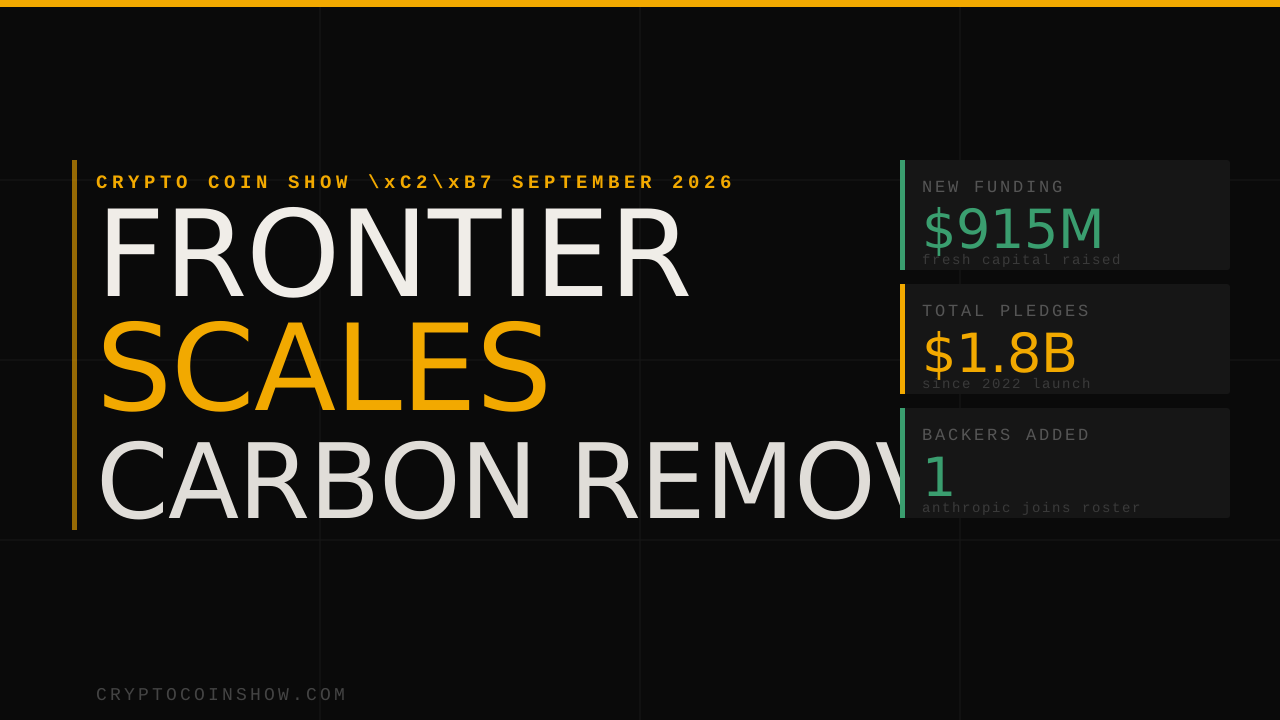
Frontier acquires $900 million from big tech to further carbon removal goals
Frontier, the Big Tech-backed carbon removal fund, raised $915 million in fresh capital to expand its advance market commitment model, bringing total pledges to $1.8 billion and signaling institutional confidence that engineered carbon removal can scale to meet climate targets. The expansion adds Anthropic to a roster including Google, Stripe, Shopify, and Salesforce, and signals a strategic shift from proving concept viability to building durable long-term demand for four distinct removal technologies.
- Frontier raised $915 million in new funding, doubling total commitments to $1.8 billion since its 2022 launch
- Anthropic joined Google, Stripe, Shopify, Salesforce, and H&M Group as financial backers in the latest round
- Seven portfolio companies broke ground on 1.4 million tons of annual removal capacity in 2025, with deliveries expected to double again this year
- $1.8B Total financial commitments to carbon removal via Frontier since inception
- 1.4M tons Annual removal capacity from seven Frontier portfolio companies beginning operations in 2025
- 350+ Corporate buyers now purchasing carbon removal credits across financial services, aviation, and retail
Frontier announced $915 million in fresh funding on Wednesday, doubling the carbon removal coalition’s financial firepower to $1.8 billion in total committed capital. The new round brings Anthropic, the AI safety company backed by Google and others, into Frontier’s investor base alongside existing backers Stripe, Google, Shopify, Salesforce, and the H&M Group.
The infusion marks a decisive expansion of the advance market commitment model, a contracting structure where large corporations pledge to purchase carbon credits from emerging removal companies before projects reach full scale, thereby reducing development risk and unlocking private capital that would otherwise remain inaccessible.
Anthropic Joins Tech Giants in Committing to Carbon Removal Market
The addition of Anthropic to Frontier’s funding base represents a symbolic expansion of the coalition beyond its original core of e-commerce and advertising platforms. Google, Stripe, and Shopify founded Frontier in 2022 alongside Meta and McKinsey with an initial $925 million pledge.
The 2025 round introduces Anthropic, a company whose computational operations consume significant electrical resources, as a buyer committed to offsetting emissions through engineered carbon removal rather than renewable energy certificates or forestry credits alone.
This diversification of corporate backers matters to institutional investors because it demonstrates sustained conviction across unrelated business models.
Tech infrastructure operators, payment platforms, and enterprise software vendors are all committing multiyear capital to the same removal companies, which reduces the risk that buyer demand will evaporate if a single sector faces economic headwinds.
The participation of H&M Group also signals that carbon removal demand is migrating beyond software and financial services into manufacturing and apparel, sectors with embedded, hard-to-abate emissions that neither renewable energy nor operational efficiency can fully address.
Frontier Shifts Strategy from Pilot Proof-of-Concept to Durable Scale
Frontier frames the new funding round as its “Growth AMC,” a deliberate move away from the 2022 model’s primary goal of proving carbon removal technology could function at commercial scale.
Hannah Bebbington Valori, Frontier’s head, characterized the original commitment as designed to “get carbon removal off the starting line.” The new $915 million deployment targets a fundamentally different objective: funding concentrated investments in companies that have already demonstrated technical viability, with the aim of pushing them toward the capacity thresholds required to sustain long-term buyer relationships and investor returns.
The coalition plans to make 10 to 15 concentrated investments through offtake contracts spanning 8 to 10 years, with some extending to 2040.
This structure differs materially from venture capital’s typical 5- to 7-year return horizon, creating predictable long-term cash flows that conventional institutional investors, pension funds, insurance portfolios, and sovereign wealth funds, can underwrite and model.
By locking in decade-long purchase agreements, Frontier allows portfolio companies to secure project financing at lower cost than would be available from venture or private equity sources alone.
Frontier explicitly targets four technology pathways: ocean alkalinity enhancement, biomass-based removal, enhanced rock weathering, and direct air capture.
Portfolio Companies Accelerate Capacity Build-Out Ahead of 2040 Deadline
The tangible output of Frontier’s 2022 funding round is now visible in operational capacity growth. Seven portfolio companies broke ground on 1.4 million tons of annual removal capacity during 2025, with projects expected to deliver more than 50,000 tons this year alone.
Frontier reported that delivery volumes have doubled for two consecutive years, indicating that capital deployment and project development are accelerating rather than stalling, a critical data point for institutional investors assessing whether engineered carbon removal can achieve the scale climate scenarios require.
The broader carbon removal sector has expanded dramatically in parallel. The number of carbon removal companies grew from roughly a dozen in 2022 to hundreds today, spanning more than 20 distinct technological approaches.
Corporate demand has followed suit: more than 350 corporate buyers across financial services, aviation, and retail have collectively purchased approximately 4 million tons of removal to date.
This expansion of both supply and buyer bases suggests that Frontier’s advance market commitment model is working as designed, reducing investor risk enough to unlock capital that flows through multiple funding stages and geographies simultaneously.
Randy Spock, Google’s head of carbon credits and removals, stated that Frontier’s work is “a cornerstone” of the company’s approach to using science and technology against planetary warming.
Google’s dual role, as both a founding investor and as a major corporate buyer committing to removal credits, demonstrates the company’s confidence that these technologies will deliver measurable outcomes at scale, not merely serve as marketing tools or offset-stacking exercises.
Frontier Targets Jurisdictions with Carbon Removal Policy Frameworks
A less visible but strategically important dimension of the new funding round is Frontier’s stated commitment to prioritizing projects located in jurisdictions with established carbon removal policies. This criterion matters because it signals that the coalition recognizes regulatory risk as a material constraint on project economics.
Nations and regions with dedicated carbon removal procurement targets, carbon accounting standards, or permanent storage verification protocols can support higher-priced removal credits than markets without policy guardrails.
For institutional investors, this policy-first approach reduces regulatory arbitrage risk, the possibility that removal credits purchased today will be devalued or deemed ineligible under future climate accounting rules.
By concentrating capital in jurisdictions with clarity on carbon accounting, monitoring, and permanence standards, Frontier creates stable conditions for long-term credit valuations and enables insurance and pension funds to meet their own decarbonization commitments with defensible methodologies.
The $1.8 billion in total commitments remains modest relative to the estimated $200+ billion annual investment needed in carbon removal to meet climate targets by 2050.
Carbon Removal Scale Remains Dependent on Policy and Cost Curve Momentum
The expansion from $925 million to $1.8 billion in committed capital represents material growth, but also underscores the early-stage nature of engineered carbon removal as an institutional asset class.
The four technological categories Frontier targets, ocean alkalinity enhancement, biomass-based removal, enhanced rock weathering, and direct air capture, each operate at different cost points and carry distinct permanence and verification risks.
Direct air capture, the most capital-intensive approach, currently operates at costs of $150 to $300 per ton or higher; enhanced rock weathering and ocean alkalinity enhancement may achieve cost curves below $100 per ton at scale; biomass-based approaches with permanent storage can compete in the $50 to $150 range depending on feedstock and location.
Frontier’s strategy of concentrating on all four pathways simultaneously, rather than betting on a single winner, acknowledges this technological uncertainty.
By committing long-term offtake agreements across multiple approaches, the coalition increases the probability that at least some portfolio companies will achieve the cost reductions and volume throughput required to contribute meaningfully to global decarbonization targets.
The next critical milestone will arrive when the first cohort of