
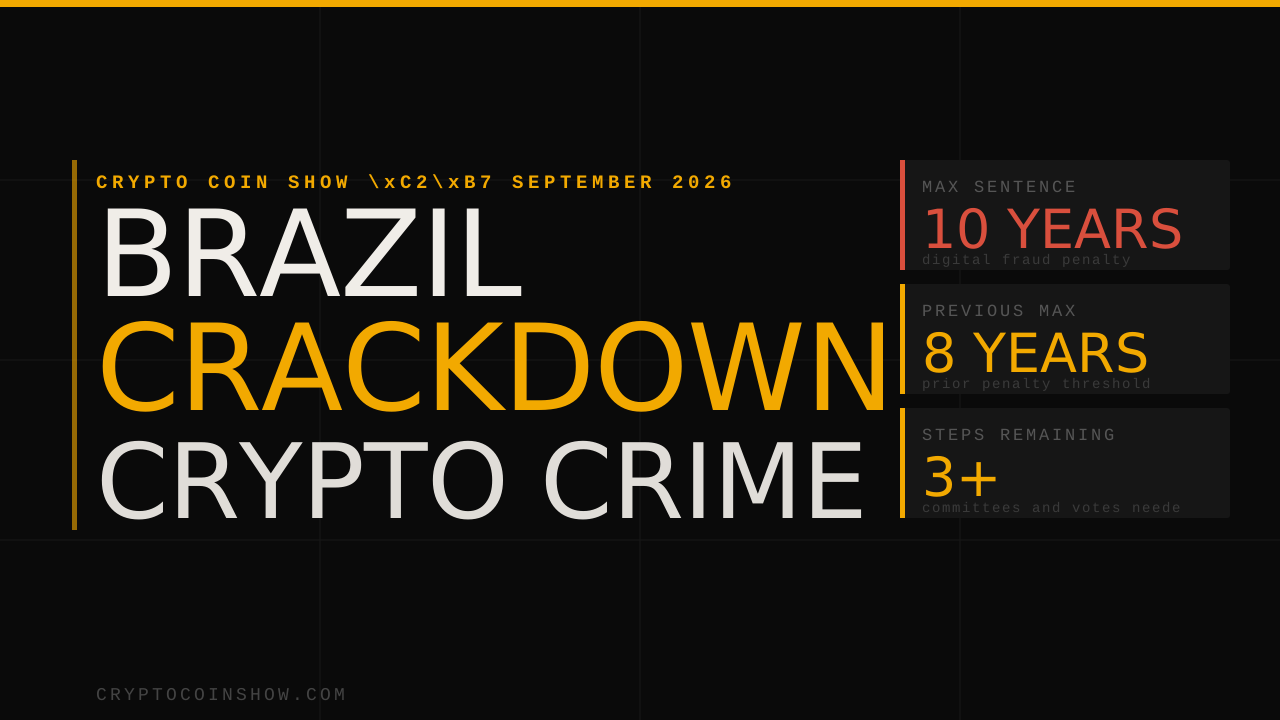
Brazil’s lower house committee approves crypto asset freezes and harsher sentences for digital fraud
Brazil’s lower house committee has approved legislation enabling judges to freeze cryptocurrency holdings and impose sentences up to 10 years for digital fraud, marking the country’s most aggressive statutory response to crypto-enabled crime to date. The bill now requires approval from two additional parliamentary committees, a full chamber vote, and Senate passage before becoming law, making the timeline and final scope of enforcement powers uncertain.
- Finance and Taxation Committee approved Bill 5819/2025, raising digital fraud sentences from four-to-eight years to six-to-ten years maximum imprisonment.
- Judges gain new powers to freeze bank accounts and crypto wallets as precautionary measures against fraud suspects pending trial conviction.
- Bill requires passage through Constitution Committee, full Chamber, and Senate votes before presidential signature, with no confirmed timeline for final enactment.
- 10 years Maximum prison sentence for digital fraud crimes under new sentencing framework versus prior ceiling
- $540 million Assets seized in September 2025 Operation Lusocoin, one of Brazil’s largest recent crypto enforcement actions
- $800 million Alleged losses from Bitcoin Sheik fraud ring across multiple countries, demonstrating scale of transnational crypto crime
Brazil’s Chamber of Deputies Finance and Taxation Committee has voted to approve legislation that would equip the country’s judicial system with broad new powers to combat cryptocurrency-enabled fraud.
Bill 5819/2025, authored by Representative Coronel Chrisostomo and championed by committee rapporteur Kim Kataguiri, would amend both the Penal Code and Code of Criminal Procedure to establish harsher penalties and expanded investigative tools specifically targeting digital fraud.
The approval represents the most comprehensive legislative framework Brazil has yet proposed to address a category of crime that has cost the country billions in losses and drawn the attention of federal prosecutors and law enforcement agencies at the highest levels.
The bill’s core provision doubles the maximum sentence for fraud committed via social media, email, phone, or other digital channels from eight years to ten years.
Under current law, judges have limited ability to seize or restrict a suspect’s assets before conviction. The new framework grants courts explicit authority to freeze bank accounts and cryptocurrency wallets as precautionary measures during investigations and trials.
This represents a significant expansion of pre-conviction asset restraint powers, which institutional investors and compliance officers have flagged as a critical gap in Brazil’s enforcement toolkit. Courts would also gain powers to restrict access to real estate, block social media and digital payment systems, and impose communication restrictions with victims.
The bill also introduces enhanced penalties for organized crime involvement in fraud schemes, mandating a one-third sentence enhancement when fraud is conducted as part of a criminal organization’s structured activities. When victim losses exceed 100 minimum wages in Brazil, currently equivalent to approximately 13,500 reais (roughly $2,430), courts may impose preventive detention before trial.
This threshold-based detention provision signals that lawmakers view certain fraud scales as presumptively serious enough to warrant incarceration pending adjudication.
Operation Lusocoin seizes $540 million in assets through coordinated federal enforcement
Brazil’s legislative push follows months of intensified cryptocurrency crime enforcement. In September 2025, the Federal Police executed Operation Lusocoin, targeting an organized network accused of laundering more than 3 billion reais through a combination of cryptocurrency exchanges, shell companies, and a proprietary token scheme.
The operation resulted in 11 arrests and the freezing of assets held across 65 individuals and entities, demonstrating both the scale of money laundering through crypto channels and the operational capacity of Brazilian law enforcement to identify and act on such networks.
Operation Lusocoin was not an isolated case but part of a sustained enforcement trend spanning multiple years.
Brazilian and U.S. law enforcement agencies have coordinated on high-profile cases dating back to 2022, when federal police and Homeland Security Investigations raided locations linked to Francisley Valdevino da Silva, known as the Bitcoin Sheik, who operated a transnational cryptocurrency fraud ring that allegedly stole nearly $800 million from victims across multiple countries.
More recently, three operators of the Braiscompany Ponzi scheme received combined sentences totaling 170 years after defrauding approximately 20,000 investors of roughly 1.1 billion reais, or approximately $190 million. These cases establish a pattern of major losses, sophisticated operational structures, and international coordination that has prompted lawmakers to seek stronger statutory tools.
The legislative initiative reflects frustration among Brazilian prosecutors with the limitations of existing law. Current enforcement relies on general fraud statutes that do not account for the speed, scale, or borderless nature of cryptocurrency-enabled schemes.
By codifying specific penalties and asset-freezing powers for digital fraud, lawmakers are attempting to create a legal framework that meets the operational reality of modern financial crime rather than retroactively applying law designed for traditional banking fraud.
Bill requires three additional approval stages before cryptocurrency asset-freezing powers take effect
Despite the committee vote, Bill 5819/2025 faces a multi-stage parliamentary approval process before it becomes law. The measure must next pass the Constitution, Justice, and Citizenship Committee, commonly abbreviated as the CCJ, which holds the second-level review for all legislation.
CCJ approval does not guarantee passage, as committee members regularly amend or reject bills that pass initial review. After CCJ clearance, the bill would require a full vote in the Chamber of Deputies, followed by passage in the Brazilian Senate, and finally presidential signature to become binding law.
The timeline for these stages remains uncertain. Brazilian parliamentary calendars are subject to shifts in legislative priority, committee scheduling, and political negotiations that can accelerate or delay bills for months. Institutional investors and compliance officers monitoring Brazil’s regulatory environment cannot assume passage dates based solely on committee approval.
The CCJ review stage is particularly consequential because constitutional and criminal procedure committees often raise technical or civil liberties concerns that can substantially modify enforcement language.
The bill’s framing of crypto wallet freezing as a precautionary measure, rather than final asset seizure, may face constitutional scrutiny in the CCJ. Brazilian law requires clear statutory authorization for asset restraint, and committee members may demand further specificity regarding how courts should balance the speed of cryptocurrency transactions against due process protections.
Clarifications on wallet identification, custody, and restoration procedures could delay passage or result in modifications that affect the practical enforcement of the measure.
Institutional crypto investors and exchanges operating in Brazil should monitor the bill’s progress through the CCJ in coming months; if approved there, the measure faces a full Chamber vote that could occur within the next legislative session, but the Senate timeline remains entirely unscheduled, making 2025 enactment uncertain and full implementation dependent on regulatory guidance from the Central Bank and Federal Police once law passes.