
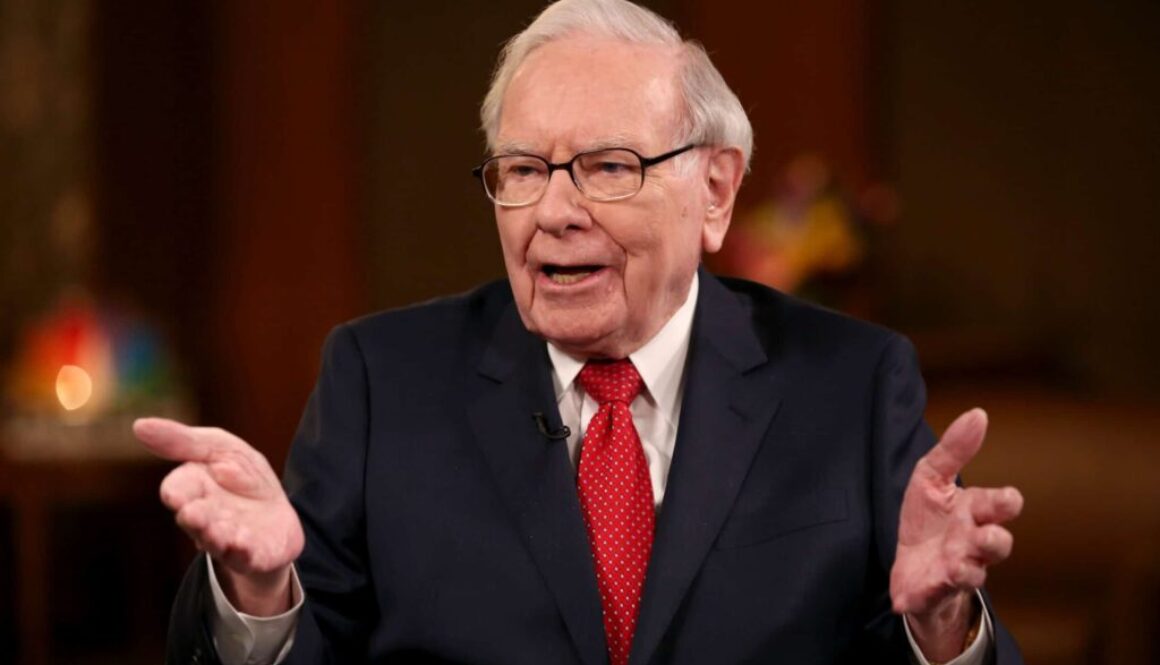
Warren Buffett exits Berkshire after 60 years as Bitcoin’s institutional skeptic departs
Warren Buffett’s departure as Berkshire Hathaway chairman after 60 years closes the active career of Bitcoin’s most persistent institutional skeptic, removing a voice that shaped mainstream finance’s negative view of crypto for over a decade. His consistent dismissal of Bitcoin as non-productive, speculative, and valueless stands in stark contrast to the asset’s $1.6 trillion market cap, which now exceeds Berkshire’s own valuation.
- Buffett called Bitcoin “rat poison squared” in 2018 and said cryptocurrencies would “come to a bad ending”
- Bitcoin’s market cap has grown to $1.6 trillion, exceeding Berkshire Hathaway’s $1.1 trillion valuation
- His retirement removes an influential skeptic whose 2014-2022 criticism shaped institutional resistance to crypto adoption
- $1.6 trillion Bitcoin’s current market cap versus Berkshire Hathaway’s $1.1 trillion
- 2014 Year Buffett first publicly urged investors to “stay away from” Bitcoin as a “mirage”
- 60 years Buffett’s tenure as Berkshire chairman before stepping down at age 96
Warren Buffett said in his farewell letter that the timing was right to “complete the transition” as Berkshire Hathaway chairman, a role he held for over six decades. His son Howard G. Buffett will succeed him, while Chief Executive Greg Abel continues to run the company’s day-to-day operations. The move marks the end of an era for one of finance’s most influential voices on Bitcoin, a voice that, from 2014 onward, consistently warned investors away from the asset as speculative, non-productive, and lacking intrinsic value.
Buffett called Bitcoin “rat poison squared” and predicted its failure
In 2018, Buffett described Bitcoin as “probably rat poison squared,” a phrase that became one of the most cited anti-Bitcoin quotes in traditional finance. That same year, he told investors that cryptocurrencies would “come to a bad ending” and stated that Berkshire Hathaway had no intention of taking any position in them.
His objection rested on a single principle: Bitcoin produces no cash flow, generates no earnings, and creates no productive output, unlike businesses, farmland, or rental properties that generate tangible returns.
Buffett told investors to “stay away” when Bitcoin cost only a few hundred dollars
Buffett’s skepticism predated his “rat poison squared” comment by years. In 2014, when Bitcoin traded for only a few hundred dollars, he told CNBC investors to “stay away from it,” calling it a “mirage.” He acknowledged that Bitcoin could transmit money but questioned why that function alone should confer major intrinsic value on the asset.
He described the cryptocurrency as “very speculative” and said he would not be surprised if Bitcoin no longer existed within 10 or 20 years. Over 12 years later, the asset has not only survived but grown to exceed his own company’s market valuation, Bitcoin now trades at a $1.6 trillion market cap against Berkshire Hathaway’s $1.1 trillion.
Buffett refused to buy all Bitcoin even for $25, citing its lack of productive value
At Berkshire’s 2022 annual meeting, Buffett provided perhaps his clearest articulation of why Bitcoin conflicted with his investment philosophy. He contrasted it with productive assets such as farmland and apartment buildings, which generate food and rental income respectively.
What would I do with it?
Warren Buffett, Chairman, Berkshire Hathaway
He went further, saying that even if offered all the Bitcoin in the world for just $25, he would not buy it because the asset ultimately depends on finding someone willing to pay more later, a bet on price momentum rather than productive value.
A year later, Buffett refined his critique, calling Bitcoin a “gambling token” and comparing its appeal to the draw of roulette. The characterization reflected his broader concern about speculative cycles in markets, where investor enthusiasm creates demand detached from underlying fundamentals, a dynamic he believed particularly acute in crypto.
The CCS read. Buffett’s retirement removes institutional finance’s most prominent skeptic just as Bitcoin’s network effects and settlement utility reshape how institutions view digital assets. His departure does not settle the debate on crypto’s value, but it does close the book on a generation of finance gatekeeping that dismissed Bitcoin on pure philosophical grounds rather than engaging its actual use cases in payments, collateral, and institutional treasury deployment.
Bitcoin proponents have long countered that scarcity, decentralization, censorship resistance, and fixed supply confer value even absent traditional cash flow, a framework Buffett explicitly rejected throughout his tenure. Watch whether Berkshire Hathaway’s next letter to shareholders addresses the firm’s stance on digital assets under new leadership, and whether Howard G. Buffett or Greg Abel signals any shift in the company’s historical position on crypto adoption.