
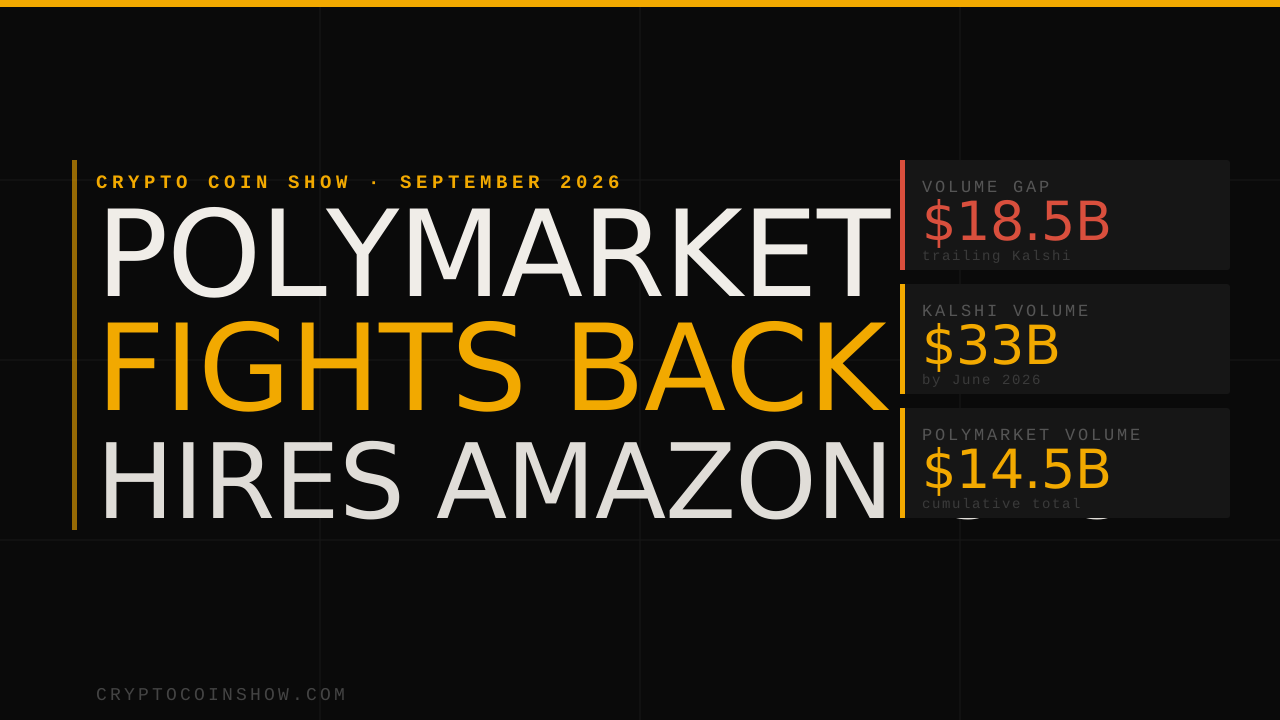
Warren Jenson joins Polymarket as CFO to narrow $18.5 billion volume gap with Kalshi
Polymarket’s appointment of Amazon veteran Warren Jenson as CFO signals a shift from product-focused growth to institutional-grade financial infrastructure as the platform trails Kalshi by $18.5 billion in cumulative volume. For institutional investors, the hire underscores prediction markets’ emergence as a multi-billion-dollar asset class, now requiring Fortune 500 operational discipline to scale.
- Kalshi generated $33 billion in volume by June versus Polymarket’s $14.5 billion, a 128% gap widening the competitive divide
- Warren Jenson served as CFO at Amazon, Electronic Arts, Delta Air Lines, and Nielsen before joining Polymarket
- Polymarket operates under CFTC licensing via its acquired QCX subsidiary while Kalshi faces multi-state regulatory challenges including a $36 billion lawsuit from New York
- $18.5B volume gap between Kalshi and Polymarket as of June 2025
- $922M Polymarket’s seven-day volume versus Kalshi’s $2.91 billion in same period
- $47.5B combined monthly volume from both platforms, exceeding US sportsbooks’ $14 billion average by 3.4x
Polymarket has appointed Warren Jenson, former chief financial officer at Amazon, as its own CFO, according to reporting announced Thursday. Jenson will report to founder and CEO Shayne Coplan and oversee capital strategy, long-range planning, and financial infrastructure. The hire arrives as Polymarket attempts to narrow a substantial volume deficit against rival Kalshi, which commanded $33 billion in trading activity by June compared to Polymarket’s $14.5 billion, a gap that has persisted even as prediction markets generated $4.05 billion in volume over the past seven days.
Amazon CFO to Manage Dual Regulatory Operating Systems
Jenson brings three decades of financial leadership from companies operating at far larger scale than existing prediction markets. His CFO tenure spans Amazon, Electronic Arts, Delta Air Lines, and Nielsen; he also served as president at both Nielsen and LiveRamp.
He holds accounting degrees from Brigham Young University and sits on the boards of DigitalOcean, Dropbox, and Ripple, placing him at the intersection of traditional finance, tech infrastructure, and blockchain systems.
His mandate at Polymarket is unusually complex: manage a domestic US platform regulated under CFTC licensing through the company’s 2023 acquisition of QCX, while simultaneously overseeing an international product geo-blocked from US users.
This dual-jurisdiction structure emerged as Polymarket’s regulatory strategy after Kalshi, the volume leader, faced escalating legal pressure from state attorneys general.
Jenson’s stated focus is “capital strategy and operating discipline to move quickly at scale,” language that signals preparation for institutional deployment of prediction market infrastructure across both regulated and unregulated markets.
Kalshi’s Regulatory Isolation Creates Opening for CFTC-Licensed Competitor
Polymarket’s structural advantage lies not in current volume but in regulatory clarity.
Kalshi operates as a CFTC-regulated exchange but faces coordinated state-level litigation that has isolated it from major US markets. New York’s lawsuit seeks over $36 billion in damages; Michigan ordered Kalshi to pull sports contracts and imposed penalties up to $500,000 daily; Nevada, Massachusetts, and Washington have all filed separate actions.
New Jersey escalated the conflict by asking the Supreme Court to define federal versus state jurisdiction over prediction markets entirely.
Polymarket’s CFTC-licensed domestic arm operates independently from its international platform, creating a legal foundation that avoids the jurisdictional conflicts that have constrained Kalshi.
This structure positions Polymarket to capture institutional capital that requires unambiguous regulatory status, pension funds, insurance firms, and asset managers that cannot trade on platforms facing multi-billion-dollar exposure or daily financial penalties.
Jenson’s financial infrastructure experience directly addresses the operational complexity of maintaining parallel systems under different rulesets.
Prediction Markets Approaching Parity with Traditional US Sportsbooks
The combined monthly volume from Kalshi and Polymarket, approximately $47.5 billion, now exceeds the US sportsbooks’ $14 billion monthly average by more than 3.4 times, indicating prediction markets have moved beyond a niche asset class into legitimate competition with established betting infrastructure.
Polymarket generated $922 million in volume over the past seven days against $4.06 million in revenue, demonstrating the revenue extraction challenge that Jenson must solve: high transaction volume that does not yet translate to sustainable unit economics.
The immediate test for Jenson’s financial engineering is whether CFTC licensing and institutional-grade operating discipline can close Polymarket’s volume gap faster than Kalshi resolves its regulatory entanglement. Kalshi continues to trade $2.91 billion weekly against Polymarket’s $922 million, but the multi-state litigation against Kalshi remains unresolved, with New Jersey’s petition to the Supreme Court potentially redefining which regulator controls prediction markets nationwide.