
Polygon co-founder Sandeep Nailwal opens crypto channel for Nepal flood fund
Polygon co-founder Sandeep Nailwal has launched a stablecoin donation channel for Nepal’s glacier disaster relief, offering institutional crypto participants a direct on-chain mechanism to fund government recovery efforts, a model that tests blockchain’s practical utility in cross-border humanitarian aid at scale. The initiative pools contributions through Ethereum and Polygon before converting to fiat and routing to Nepal’s official relief fund, with multiple crypto firms coordinating the infrastructure.
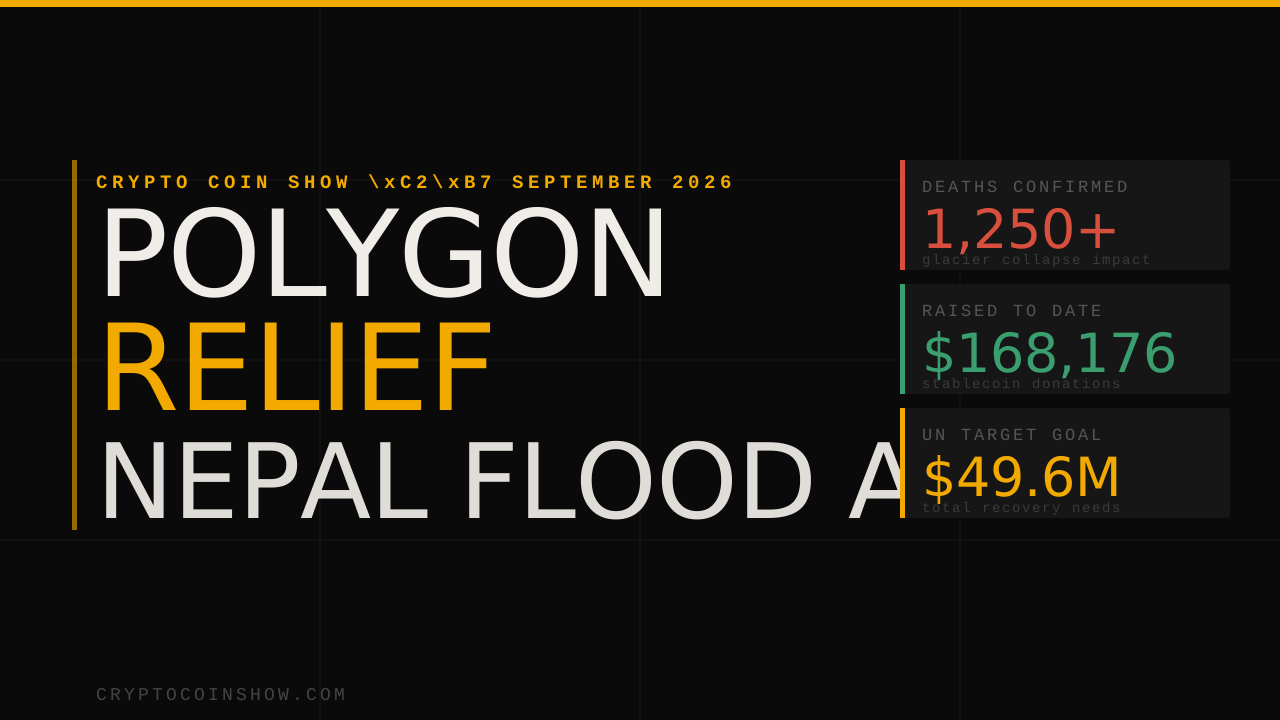
- A glacier collapse on August 26 killed over 1,250 people and affected 84,270 individuals across seven Nepali districts.
- The nepalrelief.org campaign had raised $168,176 as of the announcement, with the UN targeting $49.6 million total for recovery.
- Ripple, Solana Foundation, and other crypto firms have pledged $466,946.50 combined, establishing a pattern of sector mobilization.
- $168,176 Total raised on nepalrelief.org at time of announcement on September 4.
- 1,250+ Deaths from glacier collapse, with thousands reported missing by United Nations.
- $49.6M UN’s estimated funding target for affected households and infrastructure recovery.
On September 4, Nailwal announced the relief initiative via social media, framing stablecoins as the optimal vehicle for rapid humanitarian disbursement across borders. The campaign accepts donations in any token on any blockchain, with all contributions ultimately converted to USDC and held in a public relief wallet on Ethereum or Polygon before final transfer to Nepal’s government relief fund.
The architecture delegates custody and compliance to established intermediaries: Engage Nepal, a US-registered 501(c)(3) nonprofit, oversees fund collection and accounting, while Cross River Bank handles fiat movement to Nepal, Open Money Stack manages routing and conversion, and Coinme provides payment infrastructure.
This structure deliberately interposes regulated financial entities between donors and the Nepali government, mitigating regulatory and counterparty risk for both institutional participants and the receiving nation.
Nailwal positions stablecoins as superior to fiat remittance channels for emergency relief speed
Nailwal’s core argument rests on execution velocity. Traditional cross-border aid transfer, even through established NGOs, involves correspondent banking delays, currency conversion friction, and regulatory clearance that can stretch disbursement timelines to weeks.
Stablecoin-native infrastructure collapses that pipeline: donors can deposit USDC or convert other tokens to stablecoins within minutes, funds settle on-chain in seconds, and Coinme’s fiat on-ramp can move capital to Nepal’s banking system within hours rather than days.
For a disaster response where early-stage infrastructure repair and emergency supplies determine survival rates, that compression matters operationally.
The multi-chain acceptability (Ethereum and Polygon both offered) is deliberate institutional design. Ethereum hosts the deepest liquidity and regulatory clarity for institutional stablecoin holdings, while Polygon reduces transaction costs for smaller donors and addresses concerns about network congestion.
By accepting USDC natively on both chains, the campaign avoids forcing donors to bridge assets, a friction point that historically suppresses participation from cautious corporate donors and wealth managers unfamiliar with liquidity pool mechanics.
Nailwal did not specify whether Polygon the company would contribute capital directly, only that the foundation’s infrastructure would support the campaign. This distinction matters: Polygon has faced criticism over founder involvement in yield-farming and DeFi yield aggregation products, and keeping the relief effort separate from protocol-native fundraising avoids entanglement with those optics.
Engage Nepal and Cross River Bank create regulated handoff between crypto and government treasury
The presence of Scott DeLisi, former US Ambassador to Nepal, as lead for Engage Nepal signals explicit alignment with diplomatic and regulatory norms.
A 501(c)(3) nonprofit managing the funds positions the campaign as tax-compliant infrastructure for US donors while insulating Nepal’s government from direct cryptocurrency custody, which would expose the nation-state to regulatory scrutiny from its own banking partners and international lenders like the IMF.
Cross River Bank’s role as the fiat intermediary is the critical compliance gate. Cross River is a New Jersey-chartered bank with established corridors to Nepal’s banking system; it absorbs the counterparty and settlement risk that would otherwise fall on Nepal’s central bank or the Kathmandu government directly.
By converting USDC to fiat on US rails before final transfer, the structure ensures that Nepal receives aid in its official banking system rather than holding volatile crypto reserves, a material distinction for a nation-state with limited crypto treasury infrastructure.
This model sidesteps a persistent institutional barrier: central banks and treasuries remain deeply hostile to direct cryptocurrency holdings, even stablecoins pegged to their anchor currency.
By routing through a regulated US bank and a recognized nonprofit, the campaign offers institutional crypto firms a template for large-scale humanitarian deployment without requiring recipient governments to adopt crypto-native treasury practices.
Ripple, Solana Foundation, and crypto sector establish coordinated disaster response pattern
Nailwal’s initiative arrives amid a broader wave of crypto-sector engagement with the Nepal disaster. Ripple pledged $300,000 without specifying whether the contribution would be denominated in XRP, fiat, or its RLUSD stablecoin, a notable silence that suggests either internal deliberation over optics or a commitment flexible enough to adapt to Nepal’s actual needs.
The Solana Foundation and NFT marketplace Mallow jointly auctioned nine advertising slots and raised $166,946.50 in USDC, routing that capital directly to Engage Nepal for deposit into the same government relief fund.
The coordinated use of Engage Nepal as the common beneficiary is significant. Rather than spawning competing relief efforts, Ripple, Solana, and Polygon are converging on a single trusted intermediary, which concentrates accountability and reduces the risk of donor fragmentation or redundant overhead.
This contrasts sharply with early crypto disaster responses (2015 Nepal earthquake, 2017 Hurricane Harvey) that fragmented donations across dozens of wallet addresses and informal channels, creating tracking and theft risks.
The sector’s combined commitments now exceed $466,946 in pledges and verified transfers, establishing a meaningful floor below the UN’s $49.6 million target but demonstrating institutional capacity for rapid mobilization.
Campaign accepts anonymous tokens or US-verified identity donations across multiple chains
Nailwal structured the donation interface to accommodate both privacy-seeking donors and those requiring tax documentation. Anonymous contributions in any token on any blockchain route through the nepalrelief.org platform’s aggregation logic, while US-based donors can use Coinme’s identity verification to link donations to their names for tax purposes.
For donors preferring to bypass the web interface entirely, a single USDC address published on the site accepts deposits on both Ethereum and Polygon directly.
This optionality is operationally pragmatic. Institutional investors, particularly foundations and corporate matching programs, require donation receipts and publicly verifiable transaction records. Individuals and smaller entities may prioritize anonymity or speed.
By offering all three pathways (verified identity, anonymous token, direct USDC address) simultaneously, the campaign maximizes addressable donor base without sacrificing compliance for institutional participants.
The $168,176 raised at announcement represents early traction but remains fractional relative to the $49.6 million UN target. The campaign’s success will hinge on whether institutional adoption accelerates in week two and three post-announcement, when corporate compliance teams finish internal approval workflows and larger pledges flow through the channel.
The next material test comes when Cross River Bank reports the first fiat transfer to Nepal’s government fund, an event Nailwal did not specify a timeline for. That transfer will determine whether the on-chain-to-fiat bridge functions as designed under real-world pressure and whether Nepal’s central bank and finance ministry accept the funds without friction, creating a model for future sovereign disaster response or establishing operational barriers that other crypto initiatives must then address.