
Namada exploit drains $600,000 as Cosmos ecosystem absorbs another hack
Privacy-focused blockchain Namada lost approximately $600,000 in a targeted exploit of its multi-asset shielded pool on June 20, marking the latest security breach to strike the Cosmos ecosystem within 24 hours. For institutional investors evaluating Cosmos-based protocols, the incident exposes gaps in smart contract validation and chain infrastructure monitoring that span multiple projects and suggest systemic risk across the ecosystem rather than isolated incidents.
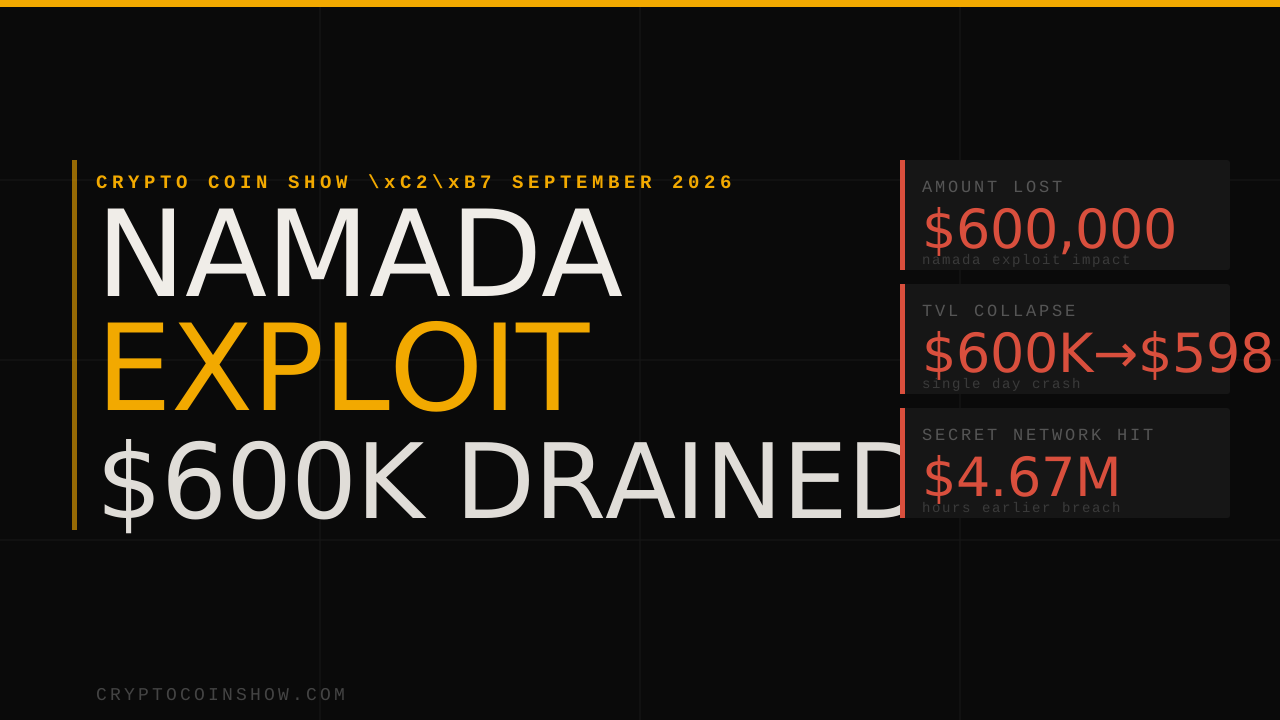
- Namada’s total value locked crashed from $600,000 to $598 in a single day following the exploit of its core privacy feature.
- Secret Network suffered a $4.67 million drain hours earlier due to an unpatched validation bug in Axelar-bridged cross-chain code that existed since March 2023.
- Two major hacks totaling roughly $900,000 struck Cosmos protocols within 24 hours, compounding exodus of projects and 96% decline in ATOM token since 2021 peak.
- $600,000 Amount drained from Namada shielded pool in single exploit attack
- $4.67M Value lost in Secret Network cross-chain validation vulnerability breach
- 96% Decline in ATOM token price from 2021 all-time high to current levels
Namada confirmed the breach on June 20 via social media, announcing it was investigating the compromise of its multi-asset shielded pool (MASP), the protocol’s primary privacy infrastructure designed to enable encrypted holdings and transfers of multiple token types.
The exploit wiped nearly all liquidity from the pool, reducing Namada’s total value locked from approximately $600,000 to just $598 within hours. The project’s block explorer appeared stalled following the attack, with the most recent indexed block dated June 7, suggesting potential infrastructure failures that may have preceded or accompanied the security breach.
Namada’s Shielded Pool Drained While Chain Infrastructure Shows Signs of Dysfunction
The timing of Namada’s loss raises questions about the chain’s operational resilience. The gap between the last indexed block on June 7 and the confirmed exploit on June 20 indicates either that monitoring systems failed to detect anomalous activity or that the underlying chain infrastructure experienced a disruption.
For institutional custodians and protocol integrators, this lag between when an attack occurs and when it is detected represents a critical vulnerability window that undermines real-time risk management.
Namada’s core value proposition depends on the MASP functioning as a trustworthy privacy mechanism. The exploit’s success suggests that either the mathematical or cryptographic guarantees underpinning the shielded pool were compromised, or that the smart contract implementation contained a validation flaw.
The project has appealed to the attacker for return of funds and characterized the person behind the exploit as potentially a white hat, but this framing obscures the operational reality: users who deposited assets into what they believed was a secure privacy pool lost access to them entirely.
Secret Network’s Unpatched Code Vulnerability Reveals Ongoing Cross-Chain Risk Exposure
The exploit that struck Secret Network occurred hours before Namada’s breach and exposed a more insidious systemic problem: security vulnerabilities that remain unaddressed for over a year. According to blockchain security firm Common Prefix, the missing validation check in the cross-chain smart contract code had existed in production since March 2023 without being patched.
An attacker exploited this flaw to drain $4.67 million in Axelar-bridged tokens, demonstrating that known attack vectors can persist across multiple development cycles if security audits and code reviews fail to surface them.
The Secret Network vulnerability is particularly significant because it implicates both the Axelar bridge infrastructure and Secret Network’s own development practices.
Cross-chain protocols are high-value targets because they control the movement of assets between disparate blockchains, and a missing validation check, a relatively basic security control, should have been caught during initial auditing.
The fact that it persisted for 15 months suggests either insufficient security resources allocated to monitoring and maintenance, or a breakdown in communication between the teams managing the bridge and the chain receiving bridged tokens.
For institutional investors, the Secret Network incident confirms that bridge-related risks cannot be assumed away through reputation or token market capitalization. The attack vector was elementary; the duration of the exposure was negligible compared to the window of opportunity for security review and remediation.
Institutional custodians and treasury managers now face elevated scrutiny on how deeply they assess bridge code quality before routing significant capital through cross-chain protocols.
Cosmos Ecosystem Contends with Persistent Project Exodus and Structural Confidence Collapse
The back-to-back exploits in June represent only the most recent chapter in a broader deterioration of the Cosmos ecosystem’s standing among institutional participants.
Starting in late 2023 and accelerating through 2024, major Cosmos-based protocols have announced departures: Noble, a stablecoin infrastructure project that processed billions in transaction volume, migrated to an EVM-based layer-1 chain. Penumbra, another privacy-focused project, shut down operations entirely.
Development halted on Comdex, Kujira, and Evmos, while Omniflix, Elys, and Jackal migrated to other ecosystems.
This exodus is not driven by technical obsolescence alone. ATOM, the Cosmos ecosystem’s native token, trades at approximately $1.78, representing a decline of more than 96% from its 2021 all-time high.
For institutional investors who viewed Cosmos as a multichain hub capable of capturing interoperability value, this decline signals that the ecosystem has not delivered the competitive advantages or network effects required to retain projects or attract new institutional capital.
The security incidents compound this narrative: they suggest that technical execution and infrastructure quality are not meeting institutional-grade standards.
The combination of security failures, project departures, and token depreciation has created a negative feedback loop.
Developers and projects are less willing to commit resources to Cosmos when other ecosystems offer either stronger security track records or larger user bases for achieving network effects. Fewer projects mean less activity, less developer attention, and reduced urgency around security maintenance across the ecosystem’s infrastructure layer.
Cosmos Labs has begun responding to this pressure by acquiring the Mintscan blockchain explorer and opening a Seoul subsidiary to consolidate operations around the Cosmos Hub and core infrastructure projects, but these moves represent defensive positioning rather than a forward strategy to recapture institutional momentum.
Institutional Risk Assessment Must Now Account for Cross-Ecosystem Contagion Effects
The 24-hour window that encompassed both the Namada and Secret Network exploits, along with a separate compromise of mySwap (a Starknet-based DEX), totaling approximately $900,000 in aggregate losses, demonstrates that security vulnerabilities are not distributed randomly across blockchain ecosystems.
Instead, they appear to cluster in emerging or less-monitored protocol families, suggesting that attackers have developed reconnaissance capabilities to identify chains and protocols with weaker security infrastructure or lower levels of institutional audit coverage.
For institutional investors, this pattern implies that a single breach in one Cosmos-based protocol can trigger broader contagion through bridge integrations and cross-chain liquidity pools. The Secret Network exploit, which targeted Axelar-bridged tokens, created direct exposure for any institutional actor who had routed capital through Axelar’s bridge into Secret Network’s ecosystem.
The attacker’s ability to profit from a 15-month-old code vulnerability confirms that institutional custodians cannot assume that simply holding a long position in a bridged asset insulates them from bridge-layer risks.
Cosmos Labs’ acquisition of Mintscan and establishment of a Seoul subsidiary indicate a strategic pivot toward operational consolidation, but the critical test will be whether these moves translate into accelerated security review cycles, third-party audit commitments, and public disclosure of infrastructure monitoring practices across the ecosystem’s core protocols. Institutional investors should monitor whether Cosmos publishes a coordinated security roadmap with defined audit schedules and post-incident remediation timelines for the Namada and Secret Network exploits by Q3 2024; absence of such commitment would suggest that the ecosystem remains in reactive posture rather than shifting to proactive institutional-grade risk management.