
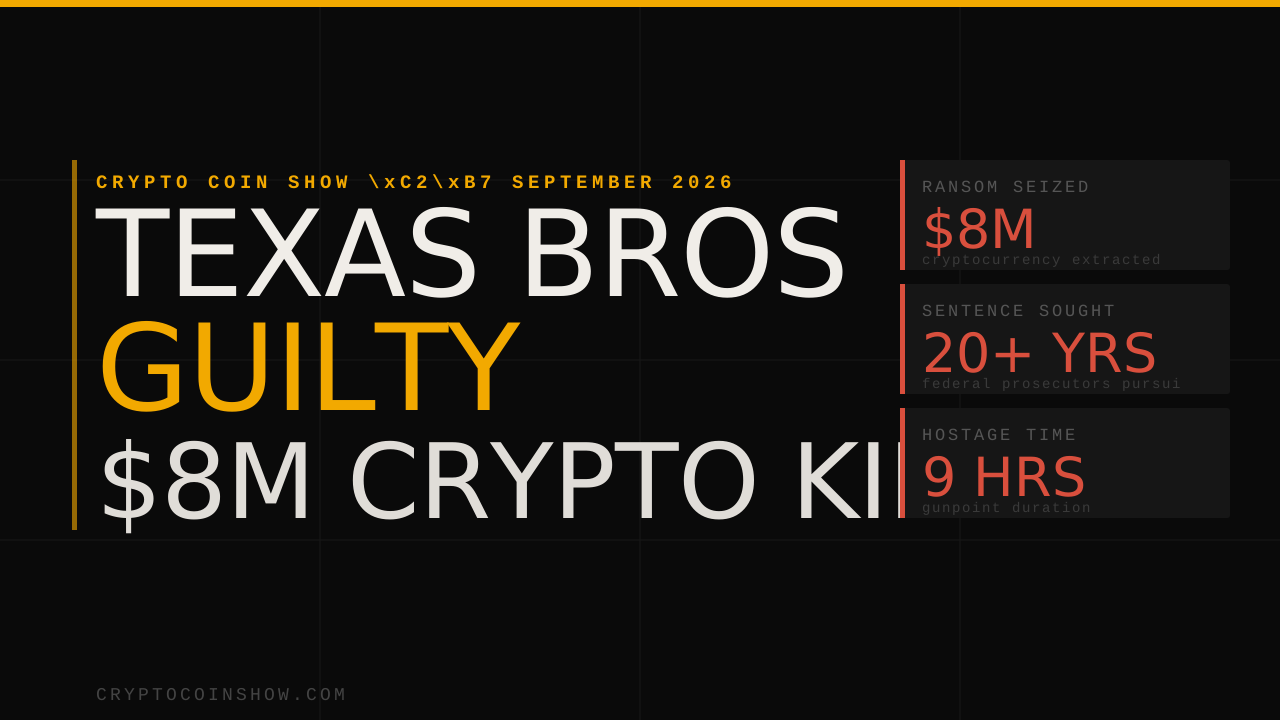
Texas brothers plead guilty to armed crypto kidnapping
Two Texas brothers have pleaded guilty to armed robbery and kidnapping after forcing a Minnesota family to surrender $8 million in cryptocurrency, a case that exemplifies a global surge in violent crypto theft now prompting federal prosecutors to pursue sentences exceeding 20 years and insurers to launch specialized kidnap-and-ransom policies. The incident underscores an emerging asset-class risk for institutional crypto holders: physical security threats tied to digital wealth concentration.
- Isiah Angelo Garcia, 25, and Raymond Christian Garcia, 24, pleaded guilty to interference with commerce by robbery in federal court Thursday.
- The brothers held a family at gunpoint for nine hours across two Minnesota locations, extracting $8 million in cryptocurrency transfers.
- Wrench attacks, violent crimes forcing victims to unlock digital assets, rose 41 percent in early 2026 compared to the same 2025 period.
- $8 million in cryptocurrency stolen during nine-hour kidnapping of Minnesota family by armed brothers
- 41% increase in wrench attacks in first four months of 2026 versus same 2025 period
- 20 years maximum federal prison sentence each Garcia brother faces under guilty plea
Isiah Angelo Garcia and Raymond Christian Garcia, brothers from Waller, Texas, forced their way into a Grant, Minnesota, home where they bound the family members with zip ties and held them at gunpoint. Raymond Garcia carried an AR-15-style rifle while Isiah wielded a shotgun, positioning themselves to prevent escape during an ordeal that lasted approximately nine hours.
The father was compelled to log into his cryptocurrency accounts and authorize transfers while his wife and adult son lay restrained on the floor.
When the brothers discovered the family maintained additional crypto holdings at a cabin in Jacobson, approximately three hours north, Isiah drove the victim there to extract the remaining funds, ultimately accumulating more than $8 million in stolen digital assets.
Garcia Brothers Face 20-Year Maximum Sentences After Guilty Pleas to Federal Robbery Charges
Both brothers entered guilty pleas to one count of interference with commerce by robbery in federal court Thursday, each facing up to 20 years in prison. As part of their plea agreements, they have committed to full restitution of the $8 million they stole.
Law enforcement tracked the brothers to the Houston area using personal items left at the crime scenes, identified by FBI and Washington County Sheriff’s Office investigators who recovered evidence during the nine-hour ordeal after the victim’s son managed to call 911 and enable their arrest.
The Garcia case arrives amid a measurable escalation in violent cryptocurrency theft across federal jurisdictions. A related case involves Adam Iza, 25, who operated under the alias “The Godfather” and pleaded guilty to organizing an attempted kidnapping of a Connecticut couple in connection with theft of 4,100 Bitcoin, valued at approximately $245 million at the time of the crime.
Federal prosecutors in that matter are seeking a 35-year sentence, with Iza facing combined exposure of 55 years across two separate federal cases.
These prosecutions signal a hardening of the federal judiciary’s posture toward crypto-motivated violence.
Wrench Attacks Surge 41 Percent as Criminals Target Digital Asset Holders Through Physical Force
Security researchers now use the term “wrench attacks” to describe a category of crimes in which perpetrators employ physical coercion to bypass digital security infrastructure. The Blockchain security firm CertiK documented 34 confirmed wrench attacks during the first four months of 2026, representing a 41 percent increase from the same January-to-April period in 2025.
Extrapolating this rate of growth forward, experts project approximately 130 such incidents could occur by year-end 2026, signaling an acceleration in criminals’ willingness to deploy violence to access concentrated digital wealth.
France has emerged as a particular hotspot for such crimes, with authorities recording approximately 70 crypto-related kidnappings or extortion attempts since January 2026 and charging 88 individuals in connection with those offenses.
Several French cases trace back to a data breach affecting Waltio, a cryptocurrency tax platform that exposed portfolio values and personal identifying information for approximately 50,000 users.
The breach created a targeting list that criminals then weaponized: knowing both the digital assets held and the residential locations of victims eliminated significant reconnaissance costs and reduced operational risk for perpetrators.
The data-to-violence pipeline reveals how crypto market infrastructure vulnerabilities directly translate into physical security threats for asset holders.
Specialized Insurance Products Emerge as Market Response to Kidnap-and-Ransom Demand
Responding to the documented surge in violent crypto theft, the decentralized insurance protocol Nexus Mutual has begun offering “kidnap-and-ransom” coverage specifically designed for cryptocurrency holders. The product reflects insurer recognition that digital asset concentration creates quantifiable hostage scenarios distinct from traditional high-net-worth crime insurance.
Underwriters now price risk around the premise that a single individual holding substantial crypto positions constitutes a targeted asset pool that criminals can identify, locate, and coerce into liquidation under direct physical threat.
The emergence of such specialized coverage signals market maturation around a risk category previously absent from institutional finance. Insurance products require actuarial tables, loss history, and pricing models, all of which necessitate transparent incident reporting and law enforcement coordination.
The availability of kidnap-and-ransom policies thus creates indirect incentive structures for victims to report crimes, potentially improving data collection on wrench attack prevalence and informing both regulatory and prosecutorial strategy.
Federal prosecutors continue evaluating sentencing recommendations in pending crypto-violence cases, with Adam Iza’s 35-year recommendation in the Connecticut kidnapping matter pending judicial approval and potentially establishing precedent for future sentencing in similar federal robbery and kidnapping prosecutions tied to cryptocurrency theft.
Wrench Attack Trajectory Accelerates Amid Institutional Adoption
The 41 percent spike in wrench attacks during early 2026 represents a material shift in crypto-related crime patterns and reflects broader institutional adoption of blockchain assets. Prior to 2024, such violent theft incidents remained isolated; the FBI’s Internet Crime Complaint Center logged fewer than a dozen confirmed wrench attacks annually.
The acceleration coincides with cryptocurrency holdings concentration among high-net-worth individuals and family offices, creating visible targets for organized crime networks that now operate across state and international lines.
Law enforcement agencies have begun classifying wrench attacks as a distinct criminal category requiring specialized investigative units, similar to kidnap-and-ransom task forces. The U.S. Secret Service established a cryptocurrency theft response division in 2025, and federal prosecutors now coordinate cases across districts to identify patterns and organized networks.
Insurance underwriters including Chubb and AIG have launched crypto-specific kidnap-and-ransom products priced between 2 and 4 basis points annually, a cost structure comparable to traditional ransom coverage but reflecting elevated volatility risk tied to digital asset price fluctuations during active incidents.
The Texas brothers’ guilty plea may signal prosecutors’ shift toward expedited federal sentencing in wrench cases, potentially setting precedent for 15- to 20-year sentences that could deter organized theft networks. The outcome of sentencing in May 2026 will establish benchmarks that institutional investors monitor when calculating physical security costs alongside digital custody fees.