Stock surge from SpaceX $60B deal for Cursor maker challenges Amazon,, Microsoft valuation
SpaceX’s $60 billion all-stock acquisition of Cursor, the AI code editor, has reshaped the valuation hierarchy among US public companies and signals a major strategic pivot toward developer tools for its newly integrated AI division. For institutional investors, the deal raises critical questions about platform lock-in risk, the sustainability of Cursor’s multi-model strategy under SpaceX ownership, and whether the valuations of competing AI infrastructure plays like Microsoft and Amazon can withstand pressure from a combined SpaceX-xAI competitor.
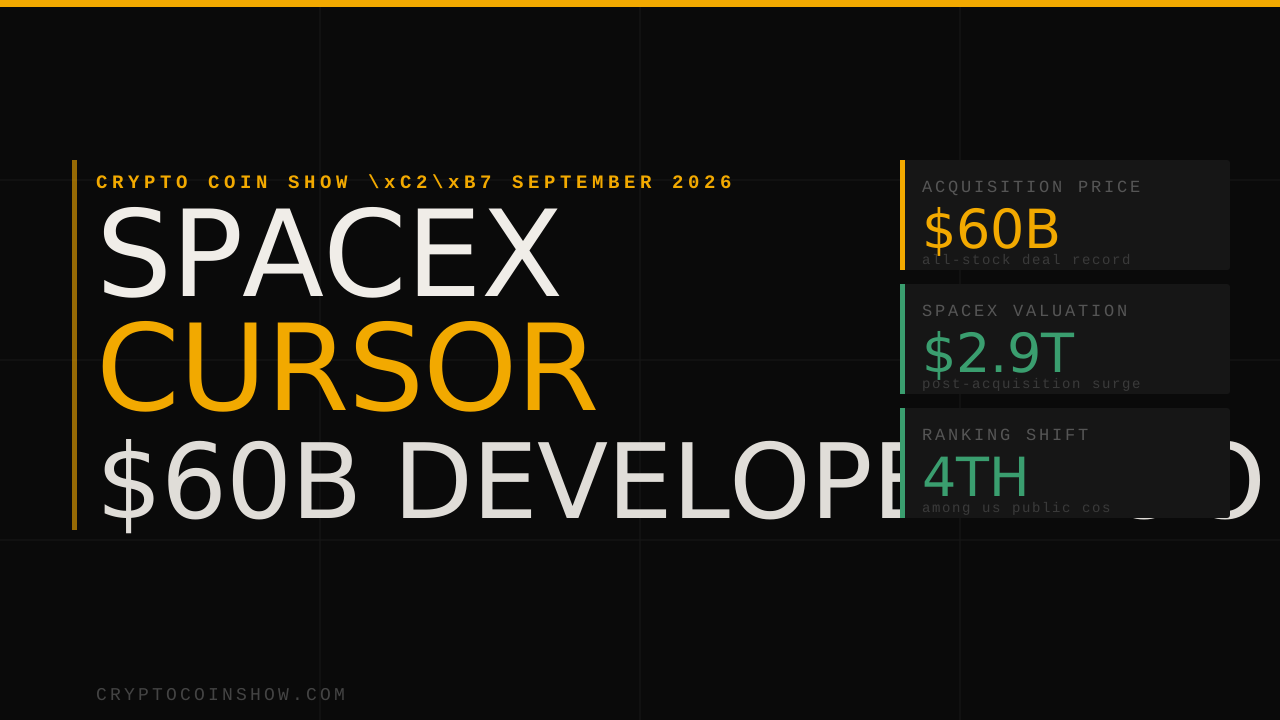
- SpaceX paid $60 billion in stock for Cursor, largest developer tools acquisition on record and company’s first major move post-IPO
- Deal pushed SpaceX valuation to $2.9 trillion, briefly making it fourth most valuable US public company ahead of Amazon
- Cursor generates over $4 billion in annual revenue as of June 2026, with 64% penetration among Fortune 500 firms
- $60B Price SpaceX paid for Cursor in all-stock transaction
- $4B Cursor’s annualized revenue as of early June 2026, up from $1 billion last year
- 64% Fortune 500 companies deploying Cursor as of latest survey data
SpaceX has moved decisively to plug a critical gap in its AI infrastructure business by acquiring Anysphere, the company behind Cursor, for $60 billion in stock just four days after its record-breaking initial public offering.
The all-stock transaction, disclosed through regulatory 8-K filing, converts an optional partnership agreement SpaceX secured in April into a binding acquisition that marks the largest developer tools deal in history.
The deal sent SpaceX shares surging approximately 14 percent to close near $219, lifting the company’s market capitalization to $2.9 trillion and briefly positioning it as the fourth most valuable publicly traded company in the United States, ahead of Amazon’s $2.8 trillion valuation and nearly level with Microsoft’s $2.95 trillion.
The timing underscores SpaceX’s urgency to scale AI product offerings.
Earlier this year, SpaceX merged with Elon Musk’s artificial intelligence startup xAI, integrating the Grok conversational model and Colossus, a supercomputer equipped with over 220,000 specialized processors designed for large-scale model training.
That combination gave SpaceX formidable compute infrastructure but left the company without a successful, revenue-generating developer product. xAI alone reported a $6.35 billion loss last year despite the computational firepower behind it.
Cursor solves that problem immediately: the AI code editor, launched in 2022 by MIT-trained founder Michael Truell and now led by the 25-year-old CEO, has achieved what most AI startups take years to reach, generating over $4 billion in annualized revenue as of early June 2026, compared with just $1 billion last November.
Cursor’s Rapid Climb to $4 Billion Revenue Reflects Developer Market Appetite
Cursor’s financial trajectory reveals institutional demand for AI-assisted development tools that SpaceX apparently judged too valuable to pass up. The platform allows software engineers to select among competing large language models, including options from Anthropic, OpenAI, and others, to optimize code generation for specific tasks.
That flexibility has driven adoption across enterprise organizations: independent surveys show Cursor deployed inside 64 percent of Fortune 500 companies, giving it market penetration that most venture-backed developer tools require a decade to achieve.
The revenue composition also matters for investors evaluating Cursor’s defensibility under SpaceX ownership. Of the $4 billion in annualized run rate, approximately $2.6 billion derives from enterprise customers, suggesting sticky, high-touch contracts rather than consumer-grade freemium churn.
That enterprise revenue base provided the financial rationale for SpaceX’s valuation and likely influenced the decision to use stock rather than cash, preserving liquidity for Colossus expansion and xAI operations while leveraging post-IPO equity to close a transformational deal within days of public listing.
For SpaceX, the acquisition grants instant competitive position against Microsoft’s GitHub Copilot, Amazon’s CodeWhisperer, and native AI coding assistants from OpenAI and Anthropic.
However, the price tag, equivalent to roughly 15 times Cursor’s annualized revenue, assumes continued growth and retention of the installed user base, a premise now dependent on SpaceX’s post-acquisition strategy toward model compatibility.
Model Lock-in Risk: Whether Cursor Remains Multi-Model or Becomes Grok-Only
The central institutional question surrounding the deal concerns Cursor’s future support for rival AI models. SpaceX has disclosed that the two companies are collaborating on a new model for joint deployment in both Cursor and Grok, signaling intent to deepen integration.
However, the company has not publicly committed to continuing support for models from Anthropic, OpenAI, Meta, or other third-party providers that currently drive Cursor’s appeal.
Developer adoption of Cursor stems directly from its model agnosticism: users can test different LLMs against a given coding task and select the performer without switching tools or abandoning their IDE workflow. That flexibility is a defensible moat against single-vendor platforms.
If SpaceX restricts Cursor to Grok and internal models, the platform risks losing enterprise customers who depend on multi-model evaluation and wish to avoid dependency on a single AI vendor, particularly one primarily engaged in aerospace and satellite operations rather than AI research.
The competitive risk is concrete and measurable against existing incumbents.
GitHub Copilot operates within Microsoft’s broader enterprise ecosystem and benefits from GitHub’s dominant position in version control and DevOps workflows. Restricting Cursor to Grok would eliminate a key advantage over Copilot: the freedom to comparison-shop models.
Enterprise procurement officers, particularly at companies with existing OpenAI or Anthropic investments, may view model lock-in as unacceptable operational risk.
For institutional investors in AI infrastructure and developer platforms, SpaceX’s model strategy over the next 90 days will determine whether the $60 billion represents strategic asset accumulation or a costly acquisition of a product whose primary value lies in neutrality now forfeit.
Integration Timeline and Market Clarity on Multi-Model Commitment
SpaceX has not announced a definitive close date for the acquisition, only that the deal is expected to complete, leaving material regulatory or shareholder approval hurdles unspecified.
The lack of a stated timeline suggests potential complexity in integrating Cursor’s independent development organization, user agreements with third-party model providers, and data governance structures into SpaceX’s aerospace and xAI operations.
The regulatory path may also involve review of data handling between Cursor users and Grok infrastructure, particularly if code snippets or context windows flow into xAI training datasets.
Enterprise customers in defense, aerospace, and financial services, who represent meaningful portions of Cursor’s $2.6 billion enterprise revenue base, operate under data residency and model usage restrictions that single-vendor architectures cannot easily accommodate. SpaceX will face pressure to define those boundaries quickly to prevent customer churn during the integration window.
Investors should monitor three specific developments: first, a formal statement from SpaceX on whether Cursor will continue supporting non-Grok models and on what timeline; second, announcement of the deal’s expected close date and any conditions precedent; and third, early signals of customer retention or defection from Fortune 500 accounts dependent on multi-model access.
Each of these milestones will test whether the $60 billion valuation reflects durable acquisition of a strategic developer asset or a costly consolidation play that destroys the very flexibility that made Cursor valuable in the first place.
The next 60 to 90 days will clarify whether SpaceX commits to maintaining Cursor’s multi-model architecture as a neutral platform or whether it subordinates Cursor to Grok exclusivity and xAI product strategy; any announcement narrowing model access would likely trigger material customer and investor reassessment of the deal’s strategic merit and precedent for AI platform consolidation in developer tools.
Original reporting: cryptopolitan.com