
Staci Warden / Algorand
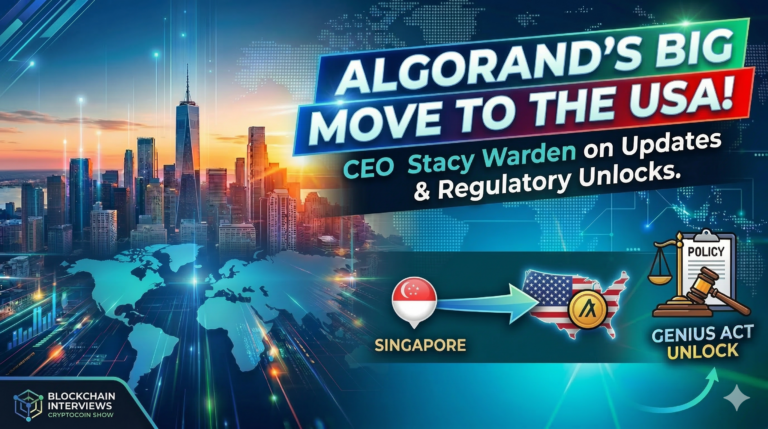
Staci Warden on Algorand's U.S. return and blockchain regulation in 2026
In this episode
In this episode of Blockchain Interviews, Ashton Addison sits down with Staci Warden, CEO of the Algorand Foundation, to explore where Algorand is headed and how blockchain infrastructure is evolving from experimentation toward foundational status. The conversation covers the Foundation’s relocation back to the United States, shifting regulatory dynamics, and why this moment could signal a more constructive phase for blockchain innovation in America. Staci also breaks down how blockchain can modernize payments, settlement, and record keeping, why verifiability matters for institutions and regulators, and where real-world impact is already happening in humanitarian aid and public sector use cases. From ecosystem growth priorities to long-term infrastructure vision, this interview examines what it will take for blockchain to become embedded in global financial systems over the next five years.
- Algorand has maintained zero downtime over six years of operation and is positioning itself as infrastructure for finance rather than speculative crypto.
- The Algorand Foundation relocated from Singapore to the United States, became a for-profit entity, and restructured its board with regulatory and payments experts.
- Public discourse increasingly distinguishes between Bitcoin, crypto, and blockchain technology, with growing recognition that different chains serve different purposes.
- Regulatory clarity in the U.S. allows Algorand employees to earn and hold native tokens, addressing previous operational constraints from avoiding U.S. jurisdiction.
- Blockchain infrastructure is approaching foundational status in traditional finance through convergence with existing systems rather than replacement of traditional finance.
Chapters
Transcript
Read the full transcript
I'm Ashen Addison from the Crypto Coin Show and today on Blockchain Interviews, we have Stacy Warden, CEO of Algrand Foundation, here to discuss Algarand's latest direction, real world impacts, and where the ecosystem and the industry is headed. Stacy, welcome to the show and thanks for taking the time.
Thanks, Ash. I'm so happy to be here.
Yeah, likewise. I've been following
Algarand over the many years having the team on around the launch seven eight years ago now and it's amazing to see the foundation still doing strong the US regulatory environment waking up and understanding the original vision and now further integrating into the mainstream outside of just the crypton natives and the financial system stable coins payments humanitarian aid all the
ways that blockchain can help the world. I would love to start off our conversation with a high level from you on for those who haven't followed closely as of recently a lot's happened with Algarand. Can you talk about how Algarand is best positioned to you know grow over the next few years from from recent events?
Yeah I mean when I first of all it's
worth saying that since you first learned about Algorand we haven't gone down for one nancond in that over six years that we've been in existence. important
but you know yeah yeah so you know when I arrived our tagline was the future of finance and I was like oh boy oh marketing startup grandiose tagline this is a little but you know as the years have gone by we have really honed
in on that vertical and it really is of course not just Algarand is the future of finance but it's aspirationally true for us for sure and we are incredibly focused on issues isues around finance and financial empowerment, access to capital, permissionless access, all the things that you know are some of the core values of crypto and we think we
can win in that space because the technology is very performant in ways that finance cares about instant finality, high throughput, that kind of thing. So we are really we've been pretty missional aligned in this vertical since the beginning actually.
Definitely. I completely agree and there's so much capital in traditional finance. We've started to see a lot of
it come in through ETFs. But there's still so much to come in actual blockchain infrastructure tokenized plays and stable coin payments moving through instead of just fiat. Where do you think the blockchain infrastructure stands today in the stage? Are we still in experimental phase or early adoption or approaching foundational status in the eyes of TRDFI?
I will say approaching foundational status if you put a lot of emphasis on approaching we are of course still very small compared to the huge financial markets. But when I look at my you know cocktail party life as I'm sure your cocktail party life is the same. It used to be that you know Bitcoin and crypto were used interchangeably as nouns and you don't see that so much anymore. It
used to be that c you know Algoran what is Algoran doing to the environment and there's this understanding now that there are lightweight chains and there are more environmentally impactful chains. There is a little bit of a distinction now between crypto and blockchain and those are not exactly the same thing. So I think in the public discourse is definitely a one good
indication of the fact that people are getting used to the idea that digital assets are here. They're here to stay. They are going to converge some in some to some extent with traditional finance. It's not going to take over traditional finance, but there are going to be products and there's going to be infrastructure that make that can make the entire financial system better. And
I think that is probably despite the nonsense that is in crypto. I think that broader narrative that blockchain can bring things to finance more broadly is much more entrenched now. I completely agree and I'm glad people areing starting to understand the difference and the value in the blockchain technology part and that Bitcoin is a blockchain but most likely
for Tradfi it's not the blockchain that they're going to be using because it serves a totally different purpose and that technology that can be put into traditional finance under other chains like Algarand for example serves [clears throat] a very different and unique purpose different than Bitcoin.
Yeah. And Ashton, I think you're an important part of helping us tell
that story and getting that narrative out to the to the broader public. You have, you know, what do you have over 100 million followers, 100,000 followers, and so it's it's these kinds of shows that help a lot.
Definitely. And we're happy to syndicate to Tradfi Networks and get it into the eyes of the old money as well as the young crypto generation. And
you know that's all converging and an important part I think for Algarand is this recent move moving from into the United States more directly. Can you talk about that what happened with Algarand and then we can dive into the US jurisdiction and regulation?
Yeah, you know, we did a couple of things all together at once. So, first we did move our jurisdiction to the
United States. We used to be we had a jurisdiction in Singapore before. So we moved to the United States, we became a for-profit entity in the United States, and we completely revamped our board. And so now we have a very we have a board of crypto and policy and regulatory heavyweights, payments heavyweights. We are in the United States. We have the ability to make
money if we want to. That might of course we still act like a nonprofit. if we were to make profits, we wouldn't distribute them, you know, we would pour that money right back into the kinds of things that the foundation has already done, but it does give us more opportunities to kind of think more broadly about what we want to do. And so all of these and you know we have been
very careful in the past and I think this is anticipating your next question a little bit to stay clear of the US regulatory perimeter but now we are all in and it's a huge market and we're very excited to be there and we're very excited to be part of the America first story for digital assets. And we deserve to be there. We were, you know, as you know, founded out of MIT, one of
the most important and prestigious universities in the United States. We're founded by one of the most important and prestigious cryptographers in the United States. And we've all the core chain was built in the United States. And so we're kind of coming back where we belong more than anything else, I would say, at this point.
Yeah, it is very exciting. And I went
through the same thing in my early days around when Alar was starting also incorporating in Singapore because the innovation they saw it ahead and it's really nice to have the green flag in the United States where you know the biggest financial markets in the world are we need to have that infrastructure that's going to evolve those right here you know because
every every second matters and being close although decentralized as well being close and in the jurisdiction is important Yeah, I mean we would contort ourselves in all kinds of crazy ways to you know one that I found particularly annoying was that I you know we have some incent like you know how regular companies might have stock options or something.
So we would have we have performance crypto that you can earn and me as an exe as the CEO of the foundation I could not get crypto I could not get alos because we wouldn't issue alos in the United States and I'm a US citizen right
so they would send me my you know a little algo a allotment and immediately convert it into dollars and pay me in dollars because we were so careful about
this but it's a bad look right for the CEO of course I have on my own purch purchased plenty of algos, but it's a bad look for the CEO not to be holding on to the stock of the company or the coin of the company that they're and so these are things that like now US our US employees can earn algos and keep them the way that our regular our worldwide employees can there are
other just things with committees and h making you know having meetings in the Cayman Islands making sure big decisions were not made in the United States being worried about am I going to get a call from the Department of Justice worried about bank accounts like all that stuff is very
and we are a place that tries not to do anything wrong you know what I mean
and all this stuff was so distracting to us and so we are as as much as anything else just happy that we can like spend our time
doing our day job not worrying about if something that we didn't think we did wrong turned out to be wrong or something like that you know
definitely there's huge hurdles that we see in other countries and the levels
of bureaucracy and how and hurdles that the reason that outside of crypto in the US have made it so such a great place to do business and it was just that one thing about crypto and blockchain technology because it's new it was like in this different category that it's like you got to watch out and it really put a hindrance on the innovation and now that switched over the last
couple years here the race is on you know we need to continue green green lighting and going all in to be the crypto capital of the world and Algran and I'm sure you guys are going all in on it and I'd love to hear your take on the recent regulation like for example the Genius Act in the US and the Clarity Act and how those actually relate to Algarand being able
to do the work that you need to do inside the US.
Yeah. I mean so I think you know I think the biggest unlock we've had is the genius act of course right and that has been very important to us and we would like as an industry to have the clarity act passed of course and there was a bit of a
discussion shall we say shall we shall we say as to whether it's good enough
now or whether we should hold out to make sure certain key provisions are in there and I personally am of the mind that you just get legislation enacted and you can always improve it there is no legislation is not frozen once it's enacted. You ha you have an you have an opportunity through rule making to you know improve things and fix things and that's the case with all
kinds of legislation. So we tend now to act cautiously but opportunistically around these things, right? And so for us when you have an unlock that we can now offer things to US customers, the rest is a little bit like a cherry on top, right? So we are now mostly focused on doing offering the kinds of things that you know other customers around the globe can offer and making sure that
The protocols that build on Algrand have an opportunity also to serve us customers. That's the most important thing for us and the stable coin legislation because stable coins as everybody knows now is so fundamental to crypto that's going to be a big part of it of course. Definitely. I agree. And from what I saw following the Clarity Act being pushed down, you know,
Brian Armstrong of Coinbase is advocating for that as sort of as a head of the crypto community and the younger people across social media that there were things that were going to hurt DeFi or you know, sort of the nature of what the crypto punks wanted and that's why he didn't want to push for it at the end. U things that were going to hurt Coinbase.
Yeah. Yeah. Exactly. you know that's one thing hurt the crypto community and hurt Coinbase of course so yeah
we have all yeah we have all free ridden a bit on Brian Armstrong's you know excellent policy machine so I am you know I have nothing to say about that of course but he you know as an exchange he has specific things that he's quite
interested in this case the ability to pay interest on stable coins very important agenda item for him but I think
more broadly we just need to be we don't want to be the red-headed stepchild. We want to be treated you know appropriately, what regulatory appropriately and have a right to exist and not be worried about if you can't you know get a bank account. I was
sitting at a Fed breakfast and I was sitting next to Tuli at from Solana and he said you know one of his engineers was trying to get a mortgage and he couldn't get a mortgage approved from his bank because he worked at Solana. So this is the kind of thing just
Yeah. No, it's like now now we have a seat at the table, but it's the kids seat on the corner
a little bit. Yeah, we're not [laughter] Exactly. We're a little
Yeah. So, we need to be to upgrade, you know, to have a fair say. Yeah.
And I want to dive into stable coins more because it's so important. You're right. And especially you know when there's volatility and if we want smaller businesses large larger enterprises and any things outside of
the financial industry as well just to run faster and more efficiently stable coins is there on Algarand's side with you know payments settlements stable coins how are you guys using Algarand sort of help outside of crypto and financial industry with stablecoin payments? Well, we are the rails that stable coins that companies can use. So, we're
the rails that you can run stable coins on. And so, we and we bring something to the party that is quite different than other chains. And that is the fact that our finality is instant. And so when you have in particular a stable coin and you are promising to give $1 back for every you know $1 stable coin that you that a customer redeems you
can't have even for a nancond especially with a bunch of bots running around
two versions of that world even for a little bit right where you have to redeem potentially $2 or you get $2 for the one stable coin that you redeem. So we are very focused on this area and making sure that we can be a big player in payments. And when we think about
payments particularly this is of course quite early days we think about agentic payments. We think about merchants maybe that can take a payment from an agent and take that payment and give that merchandise immediately but prefer to be paid maybe on credit card rails or banking rails. And you aren't going to be able to do that unless you have
certainty that when the payment is made in stable coins, it's on the ledger. It can't be messed with. It can't be revoked. It can't go back. That you know, transactions are not going to be reversed. And then you can kind of wait for payments if you want to your traditional rails if you want. That's the kind of thing that you can only do on the Algoran blockchain. Now, stable
coin payments more broadly you can do on any blockchain, almost any blockchain you want. But things like this are very they're niche use cases, but they're niche use cases that we're trying to drive a truck through because you can only do it on Algarand. We also have a lot of momentum in humanitarian payments and in stable coins that are denominated
not just in dollars. Of course, dollars are the majority of stable coins, but we, you know, we run an Afghani stable coins. An Afghani stable coin runs on Algarand Rails. Like, it's kind of a crazy thing to imagine. But the af you know there's an Afghani stable coin running on Algoran rails used by international humanitarian organizations to make payments to the you know
recipients women and aid recipients in Afghanistan. The Taliban is very aware of this. The central bank of Afghanistan understands that this is happening, but they appreciate the transparency in the speed and the money of course that this enables and so it's a it's a you know it's a everybody everybody understands what's happening and everybody sees the
benefits of it.
Yeah. No, that it's really interesting with the humanitarian aid. One of the questions I have with regards to stable coins because, you know, there's there becoming so many options on other chains and so many companies even traditional like PayPal, etc. are are creating their own stable coins that a lot of it needs to move to the back
end or people get confused. You know, it goes back to, you know, which which chain or which L2, you know, I have to be compatible with yours if I want to send you this USDC. But then we got a bridge and all that stuff that we need to get rid of that all the crypto people know about. How do you guys make it easy for companies that might be accepting first there's you know the
credit card onramp offramp with fiat or if there's other chains you know does it have to be compatible? Yeah, this is a very interesting question. Because what I think is going to happen is that there's going to be a pendulum shift where companies are going everybody's going to want to have their own stable coin. I really believe this to be true and this is
starting to happen and it's going to happen more and more and more and it's going to be kind of a pain in the ass for everybody and I do think the pendulum will initi will eventually shift back. But if you imagine somebody like Amazon, right, they have a lot of suppliers all over the world. You Exxon, Exxon has something like somebody told me 3,900 different bank accounts because they're
trying to maintain these correspondent banking relationships all over the world. Now, if you're Amazon and you have suppliers that you need to pay, you have to keep money in these banking relationships in all of these countries. Or, you know, you could issue a stable coin to your suppliers, keep all your money in JP Morgan, the way you where you feel it's much more safe. You have
to worry a little bit about the liquidity of course in these countries, but it's just a much better way, much more efficient way to do things. And so,
that's one piece. The second piece is if you're using Tether, why is Tether getting all the economics? How come I can't get some of the economics? How come I can't share some of the economics with my customers? Right? So like this
kind of thing is going to be I think whittleled away and different and different institutions are going to want to own that economics. They're going to want to own their own destiny with stable cocoin. So I do think we're going to have this proliferation. Then that raises though some of the questions that you talked about. We're going to need
bridging that can so that you can go from stable coin to stable coin. All stable coins also this is much more interesting problem as far as I'm concerned. All stable coins are not created equal. So every stable coin, you know, some stable coins you might not have as much insight into the collateral that's backing them. Others you do, but you're not sure about the
collateral. This is a great thing about the Genius Act is that, you know, US issued stable coins can be thought of more or less the same. Now, this is the great thing about regulation is you get some standardization in the way that you can think about these things. And so for Algarand, we are we just want to be available for anybody that wants to issue a stable coin anywhere. And you
can issue on Algarand or you can clear on Algarand settle the payments on Algarand. You can do any number of things, but we just want to be in the mix on it.
Yeah. No, it is nice to have that standardization and sort of that gold star from the US. If you know that it's a US-issued stable coin, that's going to make a huge difference because you know
there could be a stable coin that's backed by nothing internationally and all these companies if they can create their own stable coin similar to how over the last few cycles companies just created their own token and it got easier to make it. It was just a one-click thing. You didn't need to be a developer. Now there's two million tokens and then a lot of them die and we
sort of go back to just the ones that have a foundation. We'll probably see that in stable coins. With for example if Amazon which I don't believe they have created a stable coin yet I know I gave the example of PayPal they do have the PYUSD if they wanted to create a token I could see how that would benefit them greatly would they could they approach Algarand and be like
we want to make it we want to make our own token can you help us and we can put it on Algarand and we can do the fiat offramps and or with Exxon you know help so that we can convert these 3,000 bank accounts into stable coin infrastructure
100% %
amazing. That's awesome.
And what interest are you seeing? You know, maybe not Amazon, but from
large enterprises or conglomerates that want to do this right now. Are you actually in talks with big companies that are preparing to do it?
Well, for us, it's much more about putting the making sure that the infrastructure is available for anybody that wants to do it. So the great thing about crypto is that you don't have to call the foundation of any crypto and
say hey is it okay if we do this you know you can do whatever you want right and so what our job is to make sure that we have the bridging across chains to make sure that we have partnerships with on-ramps to make sure that we have partnerships with liquidity providers to make sure that our DeFi ecosystem is you know deep and liquid and that we
are supportive of that. So these are the kinds of things that we tend to pay attention to at the foundation.
Definitely. And on that DeFi aspect, how important do you think that is for clients just beyond doing the payments, you know, looking into other financial products or ways to utilize or get yield in terms of these companies that are
coming on board with initially just thinking about stable coins?
Yeah, I mean you what you but the thing is you don't really just want to think about stable coins. want to think about onchain capital markets in my view and if you think about onchain capital markets you think about the tokenization of financial assets
and this and stable coins are one
example of a tokenized financial asset right but there's many other examples right so if you tokenize a money market fund what you want to be able to do is right now you know borrow lend platforms tend to be typically about borrowing against crypto assets
but what if you want to borrow against a money market fund and in defi right now the questions there the problems there
or the challenges there I should say are not technical they're regulatory right so this is absolutely a security and so since it's a security your borrow lend which tends to be permissionless now needs to have some a regulated white label whitelisted version of it so there's all these kinds of elements to using tokenized securities which I think is like if we can solve
these kinds of problems is where the really interesting thing is. So, you know, I say this all the time, so I apologize to anybody listening to this who's hearing it for like the 10th time, but if you can just have a pay for, you know, a Starbucks coffee with a tiny little bit of a sliver of a of a money market fund, Black Rockck money market fund, say, and the north star for me
there is that you are earning yield until you hand it over to, you know, Ashton coffee and cupcakes and then Ashton, you're immediately earning the yield on that as soon as I pay for it. But there are all sorts of regulatory implications around that because that money market fund is a security. And so for me it's much more that the lawyers need to get busy making all of
this possible than the you know that the engineers need to get busy.
I agree and we're we're seeing the expansion of real world assets, tokenized equities and all of the other assets in the real world that can be tokenized beyond money market funds. I think it was one of the earlier use cases. I'm starting to talk to companies that are doing privatized
stock. We're eventually going to get to public stock and exchanges that are are all tokenized. Is that
private credit I think is interesting too.
definitely. It's interesting though because we used to think or at least I used to think and I'm you know not the only one that it was illquid things that would be tokenized first but illquid things are
illquid for a reason that is you know oftentimes more fundamental than just whether they're tokenized or not and so liquid things like money market funds or you know being you know liquid stocks they tend to be liquid and so a tokenized form of them will increase the liquidity as Well, but they're all right. They all start out, you know,
pretty liquid.
Definitely. Yeah. No, we often think of like, you know, the real estate building where we can do do get a million people in that wouldn't be able to afford it before or things that are high in capital to allow, you know, that was sort of the ethos of crypto to like allow people that couldn't afford things to be able to purchase small amounts of it,
right? I mean, this is a really interesting company building on Algarand actually. They it's they're called Lofty AI and they allow you for as little as $50 to invest in rental earning rental income earning real estate.
And if you go to their website and you look at the different properties that they have that you can invest in, they give you all the rental history. They
give you the tax receipts for the area. They give you all the documents around the piece of property. all of these things so that you can be really a much more informed and transparent investor than you ever would be if you invested in a REIT say and you can do this on a property bypropy basis and they have organized and done things in invest as
investors in these properties like one time they fired a property management company the different $50 a piece you know kind of investors in this another time they a woman was I think she had some medical bills and so they gave her you know a break on her rent for a couple of months so that she could get caught up with her medical bills. So, they act often, not all the
time, but they act often like, you know, they own this piece of property and they're getting the and because it's crypto, they get paid, of course, in more continuous finance manner than you would if you were you know, actually buying a piece with you know, a hundred of your friends a piece of a rental property. You know,
definitely. Yeah, the that's
really, you know, it's great to be able to own a part of a building for the appreciation, but that's still going to take a long time. You know, you're not going to sell the next day, but finding ways that can generate passive cash flow is important and automate it into your bank account. That's where the tokenization really drives value.
Yeah. Yeah.
Now, you I want to dive into the humanitarian aid aspect more. The Afghani project sounds interesting. there's so many NOS's that are probably not too techheavy and they're especially helping in emerging countries as well. What do you think like what's the most appealing thing to them where it say that you did approach them or you
guys started a communication in how Algoran and how blockchain in general can benefit NOS's. Okay, so this is can I use this Afghani example again because it's a really great story. So we leave Afghanistan, the Taliban comes back in, all of a sudden there's a rule, no financial dealing with, you know, it's it's blacklisted, it's you know sanctioned, right? So like
nobody can do any and then these NOS's come, these humanitarian aid agencies, they're like, "Okay, well you know we had a bunch of women that we were trying to help. We had a bunch of families that we were actually feeding like this cannot stop. And so, a bunch of fintech companies said, you know, trust us, basically like we will pay the people that we told you we were going to
pay. You just need to trust us.
And the co-founder of Hassan Pay said,
don't trust me.
I'm gonna put it on the blockchain and you can see.
So, it doesn't matter about me. it doesn't matter what I tell you we're going to do, we're going to put it on the Algoran blockchain and you can see. So that happened for a year or so and then they came up with this really I
thought brilliant idea which is well you can see if you use a block explorer but like these aid agencies like they're not so good at using a block explorer and also it's a little bit like you know well you know what a block explorer is. It's a little tricky to kind of get get. Yeah. So they built this like palunteer type overlay on the block explorer and it's called the a
transparency portal and you can see you have your list of recipients and then you have the wallets and you can match them as as a user and you can see where your aid has gone to the wallets that they received and then you can see the next hop what those wallets are doing with the payments that you made to the next and you can see like lots of people
a lots of the wallets that were sending money to you. They all seem to be going to this one place. Well, what is this guy? Oh, he's a money changer. Or, you know, this is an electric company. So, they're all paying their bills with these, you know, to the electric company in this way. So, it's this combination of things. I think it's the instant payments. It's the dignity that comes
with getting paid electronically, right? So, you don't have women waiting in lines around the building anymore to get paid. It's much safer, right? Because if there's a bunch of people waiting at a door around the building, like everybody's like, "Oh, those people are getting money. Might be a good idea to follow those people home. That's those are the people that we should spend our
time robbing, you know." So now they're paid, you know, in the comfort of their own home digitally, right? And they can use these with a smartphone or a regular phone or a card and pay and get their goods wherever they want, you know, using these Afghani stable coins. But in addition to that, the [snorts] beneficiary the humanitarian aid agencies can see through this
humanitarian aid portal, this a transparency portal where those funds are going in a way that shows flows in a userfriendly way that you can try to get insights from actually.
Wow.
So important. Obviously the safety is important but the transparency of the funds is just been such a huge thing. You know you hear stories over the years of well the foundation organizers
they actually have you know half a million dollar salary or somehow you know the government allocated this much money to building houses and somehow only two have been built and like where where did the money go? If we could just have the block explorer or an overlay in a user friendly interface into that so much crypto it's nothing crypto about this thing you know it's a
website but it's just really not it's been a game changer for these guys
and I do want to say that the statement especially that's come out of this administration that all aid is corrupt and it's all wasted. This is in my view vastly overstated, but it is a fair point that if we had more transparency in aid flows and we had more confidence about where aid flows
were going, imagine this Afghanistan example writ large and of course we have now been approached to help in Syria for example for the same reason, right? you know, when there's like good guys and bad guys all intermingled together, you need to be quite careful and smart about how you make sure your money goes to the people that you want it to
and not to the people that you don't want it to, right? And so bringing transparency to this, I hope, can give confidence and comfort in a very bipartisan way that can enable more aid to flow where it's needed. And so that's, you know, that's that's kind of the dream in that regard. Definitely. I would love to see that happen more and I'm hoping that the Afghani and now
the Syrian initiatives expand. I love to see that. So, thank you to the foundation for working with that as well. You know, we don't have a lot of time left, Stacy, but I want to jump back to one of my first questions about you answered, you know, approaching foundational status with the blockchain infrastructure. looking forward you know time's going
so fast with AI and crypto now but maybe over the next few years leading up to 2030 which I think will be a big a big event of some sort. What do you think needs to happen with blockchain infrastructure for it to be you know moving away from that approaching to like this is now everything is on blockchain. If you made me pick one thing, I would say that banks would have a
wallet based solution for their customers.
Mhm.
if that was true and that was widespread and we had tokenized deposits from banks and the ability to for banks to accept stable coins, then I think that would be that would mean yeah, we're here. We're finally here. You know, there's there's kind of two kinds of money. There's this liability based
money that banks have where they're constantly reconciling with each other their balance sheets. And if I make a payment to you, my bank and your bank send a big batch file to the Fed, the Fed nets it out, clears it at the end of the day. And even if it seems like for my credit card that I'm paying you instantly, I'm really not. Somebody's taking the credit risk and your bank is
getting paid and you're getting paid. You know, the records are constantly being updated, I guess, is my point. But with crypto, you know, clearing is settlement. You just in a wallet based infrastructure, you're going to make these payments are going to be direct from wallet to wallet. And if that's the case,
then then I think we will, you know,
we can say that we've arrived. [laughter]
Whether that will happen by 2030, I'm not sure. But yeah, you know, and the problem with financial in the financial sector more broadly is that it's just like so interconnected
that, you know, it's very hard for
City Bank to move without JP Morgan moving or you know, and you can do some things, but this but
ultimately they all kind of need to talk to each other and big crypto companies and crypto rails like ourselves, we all need to kind of be plugged into that, too. So getting that infrastructure layer right and is going to be you know that's where the work is going to need to be done. Yeah,
totally. It's a great point that the way that all of the banks work with each
other right now if one of them can't just go ahead and say we're going stable coin only because then it won't work with anything else. We all need to do it at [laughter] the same time. It's going to be a huge effort.
Right. Right. [clears throat] Exactly. Yeah.
So
but we're there for it, you know.
Yeah. Of course. Yeah, I'm I'm all in. You know, I
would beg every bank that I have an account at to be able to just accept stable coins and pay your bills and stable coins. Of course, that's just been a huge hindrance to anybody that's cryptonative, looking for solutions on how we can spend our crypto in the real world without having to go back to Fiat,
right? But you don't want your slightly
knuckleheaded nephew to have to keep his 24 words either and have nobody to call, you know, if things go wrong, right? I mean, I have no insight into your actual nephew situation, but you know what I mean? Like you want we want freedom, but we want protection from ourselves, too, right? And getting this right. And I guess you know maybe I feel like this is
said too many times so that's why I didn't answer your question this way but it is right is that we'll know when we've arrived when people start stop talking about the blockchain like we'll really have will really be embedded when people don't know anymore that they're using a crypto wallet or they're using you know they're on the blockchain. They just know that they're making payments
really easily. They know that they're earning the reference rate on all of their assets that they never did before. They know that it's like easier to get money when they don't have a bank account. They'll know all of these things. They might not know why. But that's the important thing. And you know, Tim Scott once said, if you're trying to teach somebody about about
You know, if you're trying to make somebody see the light, you know, turn on the light switch for them. Don't teach them how electricity works, right? And so what we need to do now is just like turn on some light switches for people. Make it easy. Abstract away the stuff that gives people headaches. Abstract away the stuff that makes this dangerous for them to use and just let
the light shine in, you know.
Yeah, definitely. You know, I always mention that first part, but the second part about the analogy of the light switch, that's good. I'm gonna I'm gonna take that one from now on. So,
okay. Yeah, please please footnote Tim Scott. [laughter] I appreciate your insights into everything in the you know in the US
Infrastructure plays right now. Algoran coming in I think there's exciting years ahead. There's a lot of work to be done especially to get the old money into the new money. But it's happening. It's it's it's inevitable and I think most people hope in crypto would hope that it happens faster than it will. But eventually we're going to get there. So, and we're
all making a dent and have been over over the many years, chipping away slowly at evolving into better, faster money and commerce.
Yep. 100%. Yeah.
Awesome. Well, thank you so much, Stacy. What's the best way to follow along with the updates for Algarand and the humanitarian initiatives and anything else we can do to learn more? Yeah, we can post in your comments.
We can post some handles, but definitely follow me on Twitter, follow our head of social impact. Matt Keller on Twitter, follow Hab Pay. Definitely check out our podcast, Verifiably Random. We just had a we just had an episode on not that we're competing with your podcast, Ashley. I don't I don't want to say, but we but we do tend to spotlight ecosystem companies on that
podcast, and we just did one on HAP. So, this is where you can really get a good deep dive on this kind of thing.
Sounds great. Yeah, we'll make sure we leave that in the show notes. Thank you again, Stacy. All the best with everything Algarand and evolving the US financial system and the world and all the humanitarian initiatives and
everything else. Would love to follow up again in the near future.
Okay. Thanks again, Ash. It was a pleasure to be here.
Related coverage
 Algorand’s U.S. Return: CEO Staci Warden on Stablecoins, Humanitarian Aid, and the Future of FinanceMar 16, 2026
 Stellar Nears 10M Accounts as Institutions Pile In: Could XLM Be Poised for a Major Breakout?Aug 29, 2025
 European Blockchain Convention 11, set to become Europe’s largest blockchain eventAug 25, 2025
More interviews
 Geo Protocol founder Yaniv Tal launches Geo Debates, its first productSep 28, 2026
 How Brave is expanding beyond ad blocking with Drew PotterSep 27, 2026
 Why Kevin Carter thinks China is winning the AI raceSep 25, 2026
 Brave's plan to bring self-custody payments to 120 million usersSep 18, 2026
 Arie Trouw on why AI agents now need proof of actionSep 14, 2026
 How XYO is building an audit trail for AI agentsAug 14, 2026