
Grayscale launches HYPG Hyperliquid ETF, HYPE continues to defy BTC weakness
Grayscale has launched HYPG, a Hyperliquid staking ETF on Nasdaq with a 0.29% fee, the lowest among competing HYPE ETFs, as the HYPE token defies broader crypto weakness and captures $132 million in net inflows during May alone. The move signals institutional appetite for yield-bearing crypto products and intensifying fee competition among major asset managers racing to capitalize on Hyperliquid’s explosive growth.
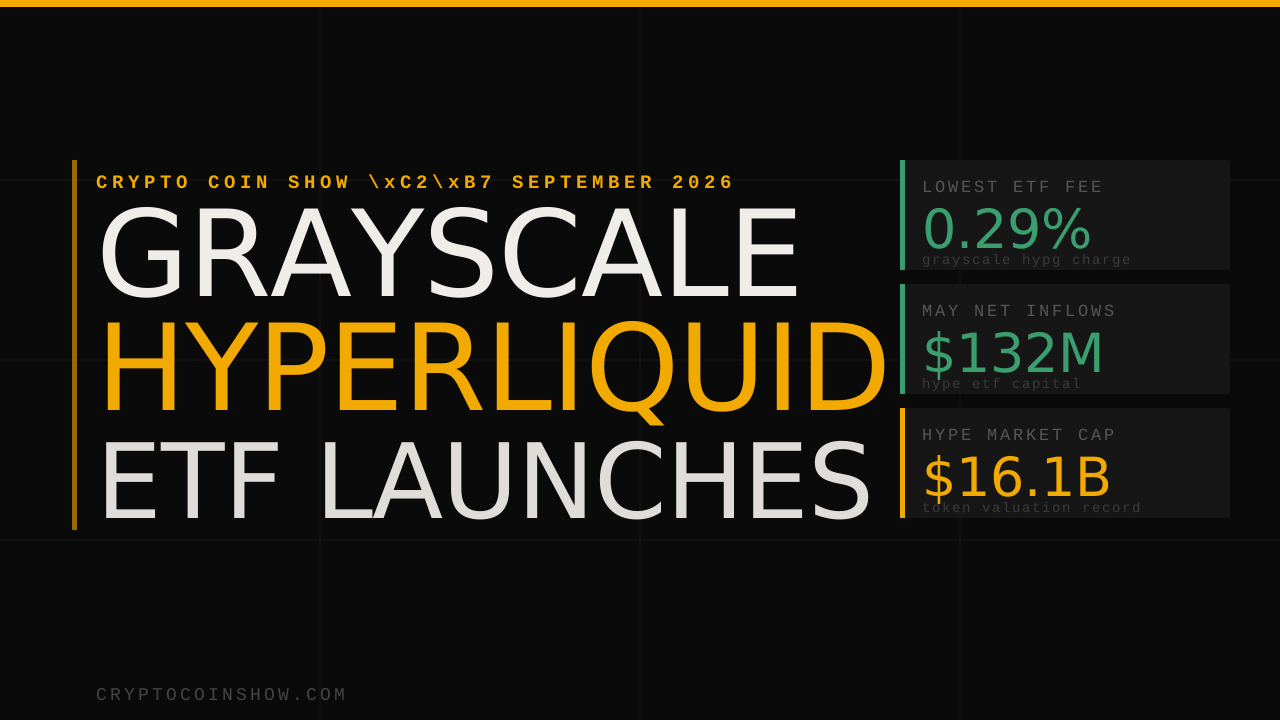
- Grayscale HYPG charges 0.29% fee, undercutting 21Shares’ 0.30% and Bitwise’s 0.34% on competing Hyperliquid ETFs launched within three weeks
- HYPE token reached record high near $76 this week while Bitcoin fell below $67,000, with Hyperliquid-linked ETFs capturing $132 million net inflows in May
- HYPE market cap now sits at $16.1 billion, ranking 9th among cryptocurrencies, surpassing Dogecoin as protocol generated $857 million revenue in 2025
- 0.29% Grayscale HYPG fee compared to competing Hyperliquid ETF fee structures
- $132M Cumulative net inflows to Hyperliquid ETFs during May versus record outflows from Bitcoin and Ether funds
- $16.1B HYPE market capitalization placing token 9th among cryptocurrencies by market value
Grayscale Investments has entered the accelerating race for Hyperliquid market share by launching HYPG on Nasdaq, positioning its staking-enabled ETF as the lowest-cost option among three competing U.S. listed products that debuted within a three-week window.
The 0.29% management fee undercuts 21Shares’ THYP, which launched May 12 at 0.30%, and Bitwise’s BHYP, which debuted May 15 with a temporary zero-fee promotional window before settling at 0.34%. This compressed fee structure reflects genuine institutional demand for exposure to Hyperliquid, a decentralized perpetual futures protocol that has expanded into smart contracts and tokenized assets since launching in 2024.
The rapid consecutive launches by three major asset managers signal that the Hyperliquid ecosystem has matured enough to support multiple competing products targeting different investor segments.
Unlike traditional crypto ETFs that simply hold tokens, HYPG actively participates in Hyperliquid’s staking mechanism, earning yield that flows into the fund’s net asset value.
Grayscale cited historical staking yield averaging 2.2% per year based on data from May 2025 through April 2026, according to stakingrewards.com. This yield-generating structure differentiates staking ETFs from plain spot holdings, offering institutional investors a tax-efficient vehicle to capture protocol rewards without managing private keys or navigating custody arrangements independently.
The fee war erupting across these three ETFs, with a mere 0.05% separating Grayscale from 21Shares, demonstrates that issuers view the addressable market as large enough to justify aggressive pricing despite razor-thin margins on flows. Each manager is betting that capturing early adopters will build sticky assets before the market consolidates around one or two dominant products.
HYPE Surges to Record High While Bitcoin Stumbles
The HYPE token reached a record near $76 earlier this week, trading around $72 at press time, while Bitcoin declined below $67,000, a roughly 3% drop in 24 hours. This divergence underscores HYPE’s decoupling from broader crypto market movements, a pattern rarely seen in altcoins during periods of Bitcoin weakness.
Over the same period, the newly launched HYPE ETFs captured this momentum with precision: THYP gained approximately 75% since its May 12 debut, and BHYP rose about 60% from its May 15 launch, according to Stocktwits data.
Hyperliquid-linked ETFs pulled in more than $132 million in cumulative net inflows during May, a period when both Bitcoin and Ether ETFs experienced record outflows.
The inflow contrast is striking: while traditional crypto ETFs endured significant capital redemptions, Hyperliquid products attracted fresh institutional capital at scale. This suggests that sophisticated investors are actively rotating exposure from passive holdings into yield-generating products tied to specific protocols with genuine revenue generation.
HYPE’s ability to attract inflows despite Bitcoin’s stumble indicates that the token’s value proposition, tied directly to Hyperliquid’s growing usage and buyback mechanics, has developed independent momentum from macro crypto sentiment.
HYPE’s market capitalization now stands at $16.1 billion, advancing past Dogecoin to claim 9th place among cryptocurrencies by market value. This ranking reflects pure market consensus rather than brand recognition alone, positioning Hyperliquid as a top-ten asset within a decade of launch.
The speed of this ascent has caught the attention of institutional allocators who track protocol fundamentals closely, particularly those evaluating alternatives to established derivative platforms.
Hyperliquid Protocol Generated $857 Million Revenue in 2025
Hyperliquid generated approximately $857 million in protocol revenue during 2025, according to Grayscale’s announcement. Nearly 99% of this revenue flows directly into HYPE buybacks rather than developer salaries or treasury diversification, creating a direct mechanical link between network usage and token value.
This buyback-heavy model differs sharply from traditional platforms that distribute revenue across operational expenses, marketing, and founder compensation, instead returning nearly all economic value to token holders.
The buyback mechanism creates a powerful incentive structure: as trading volume grows and fees accumulate, the protocol automatically purchases and holds HYPE on behalf of stakers, supporting the token’s price and distributing value without requiring token sales or dilution.
This approach appeals strongly to institutional investors accustomed to analyzing cash flows and buyback yields in traditional equities markets. Hyperliquid’s model translates familiar corporate finance concepts into decentralized protocol economics, lowering the conceptual barrier for institutional portfolio managers unfamiliar with crypto-native governance structures.
The protocol’s willingness to direct 99% of revenue back to the token holder base rather than operational expenses differentiates it from most Layer-1 blockchains and derivative platforms.
For HYPG investors, this revenue model matters directly because staking yields and token appreciation are mathematically linked to platform growth. As Hyperliquid expands market share in perpetual futures trading, generates additional revenue from smart contract fees, or adds new tokenized assets, the buyback flow increases automatically.
Institutional investors can model HYPE’s potential value based on trading volume growth, similar to how they analyze exchange stocks or betting platform equities. This fundamental framework has attracted analysts who previously dismissed crypto as speculative or yield-free.
Three ETFs Competing for Market Leadership Within Weeks
The rapid-fire launch sequence, 21Shares on May 12, Bitwise on May 15, and Grayscale entering the market afterward, reveals extraordinary institutional appetite for Hyperliquid exposure through regulated, custody-free vehicles.
Each manager bet independently that market demand justified product development costs, suggesting internal conviction that Hyperliquid’s growth trajectory justifies prominent positioning within crypto-focused allocations.
The compressed timeline also reflects that these firms maintain standing distribution and compliance infrastructure enabling quick product launches once they confirm demand signals.
Bitwise’s initial decision to waive fees entirely signals willingness to absorb near-term margin erosion in exchange for rapid asset gathering and competitive positioning. The move mirrors strategies used in passive index ETF launches, where managers accept temporary losses to capture market share before fee compression settles at equilibrium.
By introducing a zero-fee window, Bitwise forced competitors to choose between matching the promotion or ceding early market momentum, a tactic that accelerates price discovery on sustainable fee levels across the category.
The current fee structure, ranging from 0.29% to 0.34%, suggests that the market will stabilize around 30 basis points or slightly lower once initial flows peak. This compares favorably to Bitcoin spot ETF fees, which have compressed toward 0