ENS plans institutional expansion push with Foundation launch
The Ethereum Name Service DAO has formally established a legal Foundation with independent governance, creating the first institutional body capable of representing ENS in regulatory, standards, and trademark matters that a decentralized autonomous organization cannot undertake. This separation of legal and operational authority preserves token holder control over the protocol while enabling ENS to pursue formal recognition of its .ens top-level domain and defend against impersonation attacks.
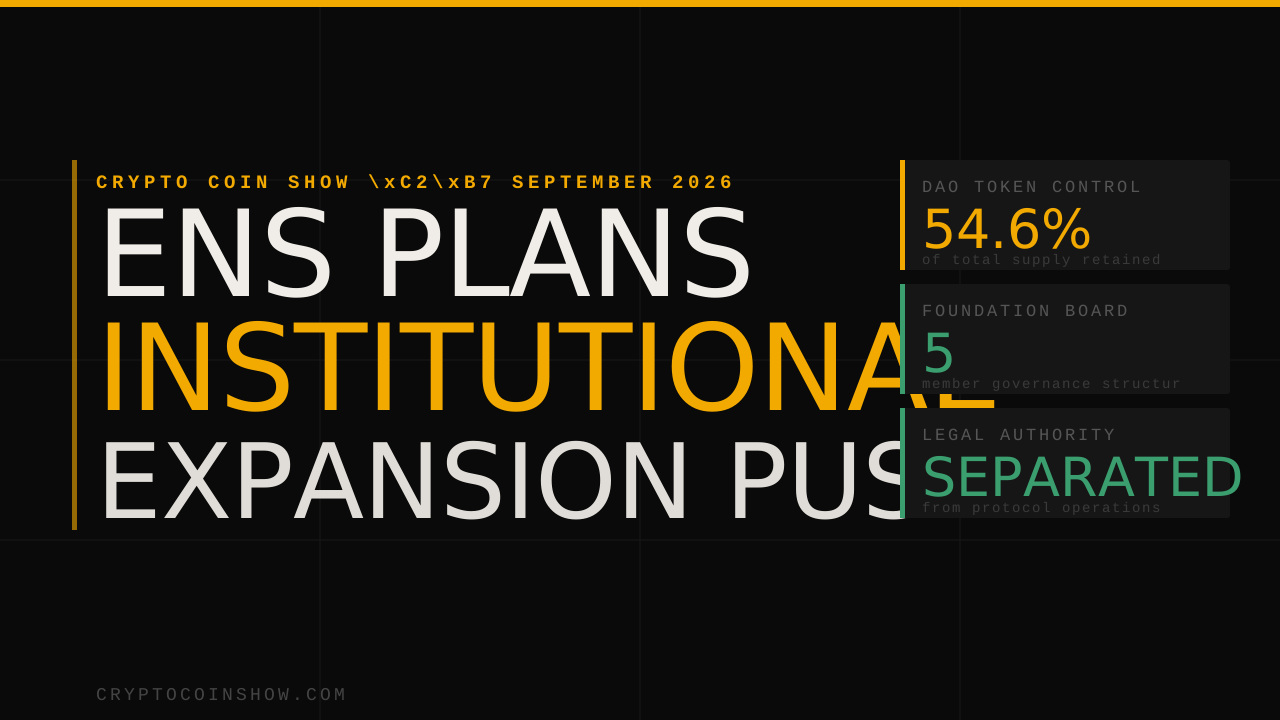
- ENS DAO retains 54.6% of total token supply and continues to control the protocol via token voting mechanisms
- Five-member Foundation board includes cybersecurity lawyer Alexander Urbelis as executive director and ENS founder Nick Johnson as founder seat
- Foundation gains legal standing to join ICANN, IETF, and W3C standards bodies and enforce trademark rights against phishing clones
- 54.6% ENS DAO token holdings as percentage of total token supply
- 5 Members on inaugural Foundation board with two-year terms
- 9 days Timelock period for Endowment transactions subject to Security Council review
The Ethereum Name Service community approved the “Next Era of ENS DAO” proposal on August 11, operationalizing a structural separation that addresses a fundamental constraint facing decentralized protocols: a DAO lacks legal personality to sign binding agreements, employ staff, defend trademarks, or respond to regulatory inquiries.
The establishment of the ENS Foundation creates a parallel governance structure where token holders retain control of the protocol through voting, while a formally constituted entity handles the administrative and legal work that drives institutional adoption.
This two-tier model has become increasingly necessary as mature blockchain projects seek integration with traditional internet infrastructure.
The Foundation’s mandate is explicit and bounded. It cannot make unilateral decisions about the protocol itself; instead, it serves as the organization capable of representing ENS in rooms where only legal entities are recognized. Token holders continue to set protocol direction, approve treasury expenditures from the DAO’s 54.6% token holdings, and establish governance rules.
The Foundation executes decisions already made by the community and handles tasks that require legal standing: joining standards-setting bodies, engaging regulators, defending intellectual property, and negotiating commercial partnerships with domain registrars and infrastructure providers.
Alexander Urbelis Appointed as Foundation Executive Director
Alexander Urbelis, a cybersecurity lawyer who previously served as general counsel and Chief Information Security Officer at ENS Labs and held the CISO position at the National Football League, has been named executive director.
Urbelis brings domain expertise in the intersection of information security, legal compliance, and institutional operations, a profile reflecting the Foundation’s immediate priorities around regulatory engagement and trademark enforcement.
The inaugural board includes four additional members beyond Urbelis. Nick Johnson, ENS’s founder and CEO of ENS Labs, holds a dedicated Founder seat on the board. Three independent directors, Kartik Talwar from A.Capital Ventures and ETHGlobal, Brett Sun, cofounder of Prelude, and Anthony Leutenegger, CEO of Aragon, complete the structure.
The independent directors serve two-year terms renewable by token holder vote, creating a mechanism for accountability while allowing sufficient stability for long-term institutional relationships.
The separation is legally and operationally explicit: ENS Labs does not govern the Foundation, and the Foundation does not own ENS Labs. Johnson’s founder seat does not grant him influence over Foundation funding decisions, nor do either organization control the other’s strategy or hiring.
Token Holder Control Preserved Through Nine-Day Timelock on Endowment
The structural design preserves token holder power over capital allocation through a nine-day timelock mechanism on Endowment transactions.
The ENS Endowment, funded by .eth domain registration revenue, remains under token holder control, but all transactions now pass through a review window during which the ENS Security Council may terminate any action that falls outside the Foundation’s stated mandate.
This creates a practical checkpoint: if the Foundation attempts to spend capital in ways inconsistent with its charter, token holders retain the ability to block the transaction before it settles.
The DAO’s treasury, comprising 54.6% of the ENS token supply, continues to operate under direct token holder governance. Proposals to fund new initiatives, hire contractors, or allocate resources for protocol development follow standard DAO voting procedures. The Foundation does not control or hold these assets.
This architecture prevents the Foundation from becoming an autonomous actor capable of overriding community preferences through control of capital.
The timelock and Security Council veto represent insurance against regulatory capture or institutional drift, technical safeguards embedded in the code itself rather than relying on board member honesty.
Foundation Pursues .ens Top-Level Domain Recognition and Trademark Enforcement
With legal standing now established, the Foundation’s immediate work includes pursuing formal recognition of .ens as a top-level domain through engagement with ICANN, the Internet Engineering Task Force (IETF), and the World Wide Web Consortium (W3C).
These standards bodies do not recognize DAOs; they require interaction with incorporated entities capable of entering binding agreements and committing to compliance frameworks. A DAO cannot credibly guarantee adherence to ICANN policies or sign contracts governing DNS delegation.
The Foundation changes that equation, enabling ENS to compete for institutional recognition alongside other domain infrastructure providers.
The Foundation is also tasked with consolidating and defending ENS trademarks and brand assets. This function addresses a concrete problem: bad actors have created phishing clones of ENS interfaces and registered similar domain names, exploiting the fact that a DAO cannot take legal action against trademark violators.
The Foundation can now pursue infringement claims, negotiate with registrars to remove infringing domains, and establish trademark usage standards that protect the brand while enabling legitimate community projects. This represents a shift from reactive brand defense (handled informally by ENS Labs) to proactive legal enforcement.
The Foundation will also serve as the formal point of contact for regulators, courts, and government agencies seeking compliance information or issuing legal process. Before this structure, no entity could credibly represent ENS to authorities because the protocol itself has no centralized operator and the DAO cannot be served with legal documents.
This liability was pushed onto ENS Labs and individual team members despite their limited responsibility over protocol governance. The Foundation absorbs this function into a formally designated entity with defined roles and insurance.
ENS Labs Refocuses on Protocol Development Including ENSv2
The creation of the Foundation allows ENS Labs to exit the role of de facto institutional representative and return to its core mission: engineering the protocol. ENS Labs was not equipped to handle standards body participation, trademark disputes, or regulatory correspondence, tasks that require legal expertise and institutional continuity separate from product development.
The separation enables faster iteration on technical upgrades.
Among the planned work is the ENSv2 upgrade, a protocol enhancement that has been deferred during the period when ENS Labs had to split attention between building and institutional functions. With the Foundation now owning the offchain institutional load, the engineering team can prioritize this development.
The upgrade represents the next phase of ENS evolution, following the establishment of the organizational structure needed to operationalize it at institutional scale.
This mirrors the pattern in other mature blockchain projects: once protocol governance separates clearly from protocol development, and both separate from institutional representation, each function can operate more effectively within its domain.
Tokenholders Will Renew Board Terms in Two Years
The two-year term for independent directors creates a concrete renewal point where ENS token holders can reassess board composition and accountability. This timeline balances the need for stability in institutional relationships against the community’s right to change leadership if the Foundation’s direction diverges from token holder expectations.
After two years, the independent directors must stand for renewal through token holder vote, creating a built-in mechanism for course correction.
The Founder seat held by Nick Johnson appears exempt from term limits based on the governance structure announced, though this may be subject to future token holder modification. The independent directors’ limited terms ensure that no board member can accumulate institutional power without periodic community endorsement.
This structure is directly responsive to concerns about founder-controlled DAOs and attempts to balance founder credibility with community control.
The Foundation is now live and operational. The next critical milestone is ICANN’s response to ENS
Original reporting: cryptopolitan.com