
Another public company abandons Bitcoin playbook after treasury volatility drove $22 million loss
KULR Technology Group has exited Bitcoin mining, liquidated nearly a third of its cryptocurrency holdings, and repaid its Coinbase debt in a sharp reversal from its late-2024 accumulation strategy. The retreat signals growing institutional skepticism about corporate Bitcoin treasuries as volatility clouds valuations and collateral risks threaten balance sheets.
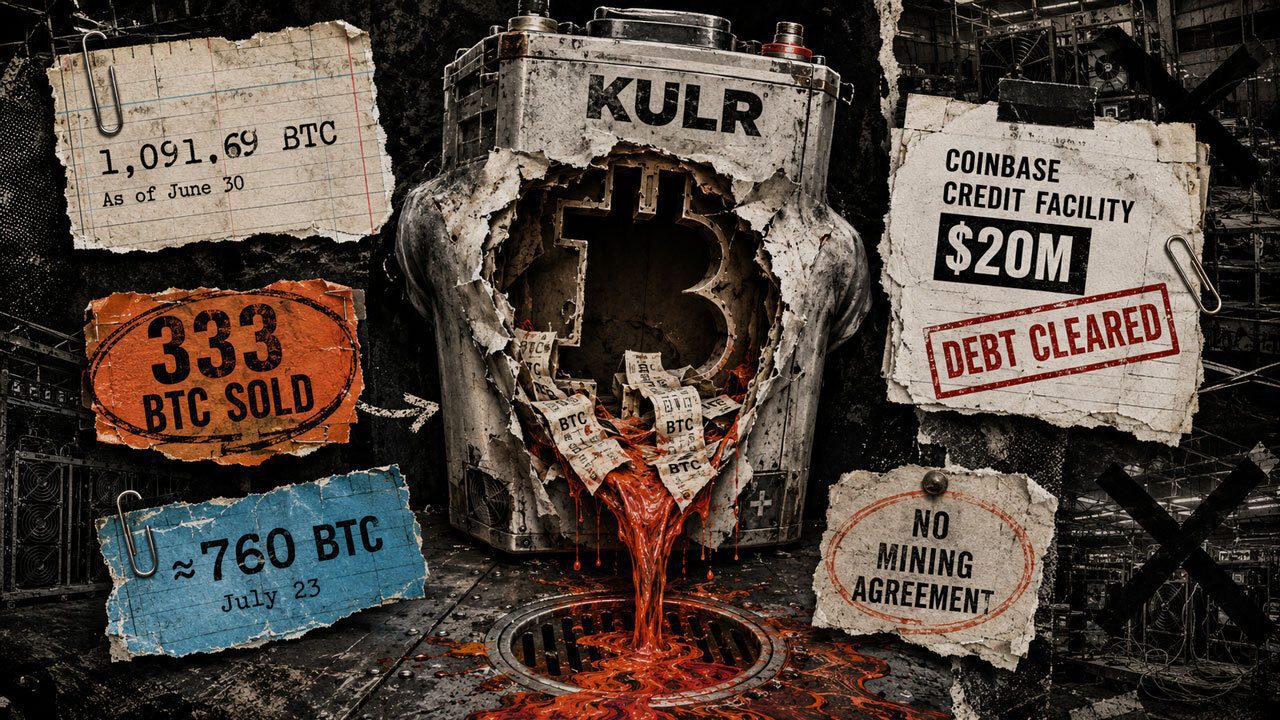
- KULR recorded a $10.59 million non-cash Bitcoin fair-value loss in Q2 2026, contributing to $21.97 million net loss
- Company sold approximately 333 BTC for $21.5 million post-quarter-end and used $20 million to fully repay Coinbase credit facility
- Bitcoin position fell from $109.8 million cost basis to $63.92 million valuation by June 30, representing 42% underwater mark
- $69.9M KULR spent acquiring Bitcoin in H1 2025 versus zero purchases in H1 2026
- 43% Revenue decline in Q2 2026 to $2.08 million year-over-year
- 30% Reduction in disclosed Bitcoin position from June 30 through post-quarter liquidations
KULR Technology Group, a battery technology company, has dismantled the corporate Bitcoin strategy it launched just eighteen months ago, marking the latest public company retreat from cryptocurrency treasury holdings. The shift accelerated sharply in the second half of 2026 as accumulated losses mounted and collateral risks intensified.
The company sold approximately 333 BTC for $21.5 million following quarter-end, used the bulk of proceeds to eliminate a $20 million Coinbase credit facility, and allowed its mining operations to lapse by declining contract renewals.
The moves reflect a broader institutional recalibration: Bitcoin volatility that once promised upside optionality now impedes investors’ ability to model core business performance, while collateral frameworks expose treasurers to liquidation risk on compressed timelines.
$10.59 Million Bitcoin Loss Exposes Volatility Risk to Core Business Valuation
KULR’s Q2 2026 results disclosed the financial cost of its Bitcoin accumulation strategy. The company recorded a $10.59 million non-cash fair-value loss on its cryptocurrency holdings during the quarter alone, contributing to a broader $21.97 million net loss for the period.
Revenue collapsed 43% year-over-year to just $2.08 million, while operating losses widened 19% to $11.2 million, underscoring the deterioration in underlying business fundamentals independent of cryptocurrency holdings.
The scale of the Bitcoin fair-value loss relative to revenue highlights the distortion that cryptocurrency treasuries introduce to financial analysis. KULR’s $2.08 million in quarterly revenue could not absorb a single quarter’s cryptocurrency write-down without material impact to reported earnings.
For institutional investors seeking transparent visibility into operational performance, this dynamic creates analytical friction: Bitcoin volatility masks whether management is executing on core competencies or whether treasury decisions are driving financial outcomes.
CFO Mike Kimel articulated this tension directly in the company’s SEC filing, stating that Bitcoin’s volatility was making KULR’s underlying battery business harder for shareholders to assess. The acknowledgment signals a shift in corporate thinking about cryptocurrency holdings.
Where early treasury adopters positioned Bitcoin as a hedge against currency debasement or a strategic optionality play, KULR’s retreat reflects a maturing view: the volatility tax on valuation credibility outweighs speculative upside potential when the core business requires capital discipline and investor focus.
Collateral Pledges Create Liquidation Risk That Forced Rapid Deleveraging
KULR’s most acute problem was not unrealized losses but contractual exposure. By June 30, 2026, the company held 1,091.69 BTC valued at $63.92 million, already 42% underwater versus its $109.8 million cost basis. Of that position, 565 BTC worth approximately $33.1 million were pledged as collateral against a $20 million Coinbase credit facility.
KULR had drawn $5 million in March and an additional $15 million in May, placing the company in active borrowing mode precisely as its collateral asset deteriorated.
Bitcoin’s volatility was making KULR’s underlying battery business harder for shareholders to assess.
Mike Kimel, Chief Financial Officer, KULR Technology Group
The collateral arrangement exposed KULR to liquidation risk if Bitcoin declined further or if lending terms tightened.
In response, KULR executed a rapid deleveraging sequence. The company sold approximately 333 BTC for $21.5 million and immediately deployed roughly $20 million of proceeds to repay the Coinbase principal in full. The repayment eliminated the debt entirely and released all 565 pledged BTC from collateral status, removing the associated liquidation trigger.
This sequence reveals a critical vulnerability in corporate Bitcoin treasury strategies that rely on lending: collateral frameworks are not passive. Declining asset valuations combined with operational cash burn force treasurers into reactive sales at unfavorable moments, transforming illiquid strategic positions into forced liquidations.
KULR’s experience aligns with broader 2026 collateral stress across Bitcoin treasury holders. The company’s move to eliminate debt exposure entirely suggests management concluded that the credit facility’s flexibility benefit no longer justified collateral pledge risk.
By concentrating capital exclusively on operations, KULR shifted from treating Bitcoin as a strategic lever to treating it as a potential liquidity source, a meaningful psychological retreat from the accumulation thesis.
Mining Exit and 30% Position Reduction Flatten Bitcoin Strategy Entirely
KULR dismantled its mining operation by refusing to renew one mining agreement that expired July 30.
Beyond treasury management, KULR eliminated the operational dimension of its Bitcoin strategy. The company did not renew at least one mining contract at expiration, signaling an end to the hardware and energy infrastructure commitments that underpin direct Bitcoin production.
Mining operations require ongoing capital expenditure, collateral for equipment financing, and management attention, all resources KULR now intends to redirect toward its battery technology platform.
The liquidation proceeded methodically post-quarter.
KULR sold approximately 333 BTC following June 30, reducing its disclosed position from its June 30 balance by roughly 30 percent to approximately 760 BTC. This paced selling approach, neither panic liquidation nor gradual trimming, suggests management retained some conviction in Bitcoin’s long-term direction while prioritizing operational flexibility and balance-sheet credibility.
The company issued no shares through its at-the-market program during H1 2026, indicating that management chose collateral elimination and asset sales over equity dilution to restore financial footing.
KULR’s 693.81 BTC acquisition during H1 2025 at $69.9 million total cost contrasts sharply with zero Bitcoin purchases in H1 2026, marking a complete reversal of accumulation posture.
Broader Institutional Retreat From Bitcoin Treasuries Accelerates Across Public Markets
KULR’s exit joins a widening cohort of public companies abandoning or restructuring cryptocurrency treasury strategies launched during the 2024-2025 bull cycle. The pattern reflects a consensus shift: Bitcoin accumulation strategies were premised on the assumption that excess corporate cash could fund speculative positions without operational cost.
That assumption has fractured as revenue pressure, balance-sheet volatility, and collateral stress converge.
For institutional investors evaluating companies with active Bitcoin treasuries, KULR’s filing provides a template for risk monitoring. Specific warning indicators include fair-value losses exceeding 10% of quarterly revenue, collateral pledges against operational credit facilities, and widening operating losses combined with Bitcoin depreciation.
Each of these metrics appeared in KULR’s Q2 results before the company pivoted away.
The company’s board made remaining Bitcoin treasury available to fund operations, converting the asset from strategic accumulation into emergency liquidity buffer.
KULR has not disclosed a target date or target position for complete Bitcoin exit,
Original reporting: cryptoslate.com