Optimum Targets the Hidden Ceiling Blocking Blockchain’s Mainstream Moment
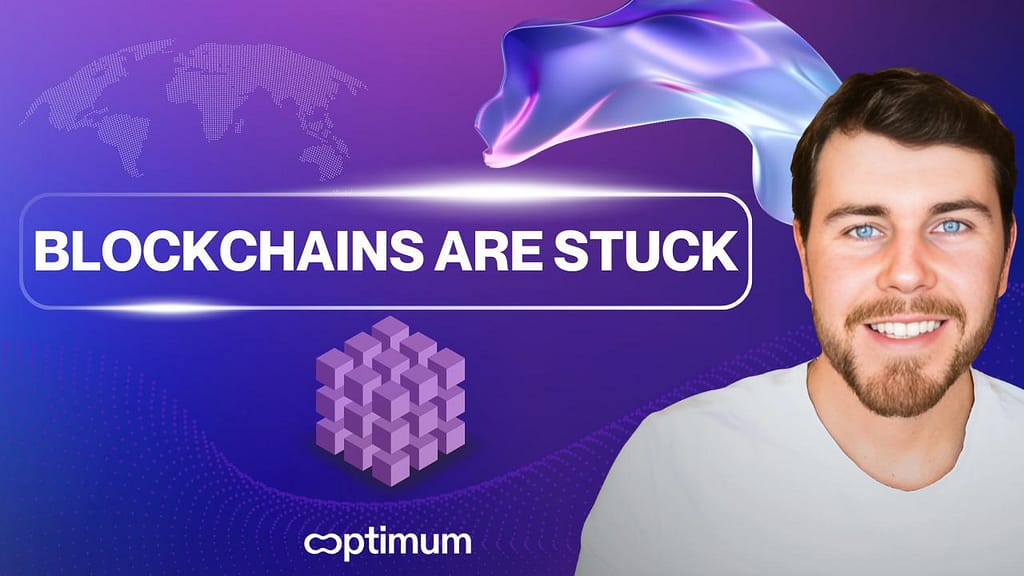
Crypto Coin Show sits down with Muriel Médard, Co-Founder & CEO of Optimum, to unpack why data propagation — not compute — is the real bottleneck for Web3 scalability
Blockchain adoption is accelerating faster than the infrastructure can keep up. Institutions are waking up to Bitcoin. Enterprises are integrating AI with on-chain systems. And yet, nearly every conversation about blockchain scalability is focused on the wrong thing.
In this episode of Blockchain Interviews, Muriel Médard — co-founder and CEO of Optimum and holder of the NEC Chair in Software Science and Engineering at MIT — makes the case that data propagation is the silent ceiling capping everything built on top of blockchain, and explains how Optimum is built to remove it.
The Problem No One Talks About
When people talk about scaling blockchain, the conversation usually goes to consensus mechanisms, layer-2 rollups, or validator performance. Médard points to something more fundamental:
If the propagation layer is inefficient, the knock-on effects are everywhere:
- Slower transaction finality
- Higher risk of forks and stale blocks
- Hard ceilings on throughput regardless of consensus improvements
- Compounding problems as AI-generated on-chain activity increases data demands
Decades of Research, Now Applied to Web3
Médard’s career at MIT has been built around one deceptively simple question: can a decentralized system perform as well as a centralized one at propagating data?
The answer is yes — and in some ways, better. Centralized systems require one powerful entity tracking state, routing traffic, and issuing instructions. That doesn’t scale. Decentralized systems, properly designed, eliminate the coordination bottleneck entirely.
Optimum‘s solution is called mP2P, built on a technique called Random Linear Network Coding (RLNC). Here’s the core idea:
- Traditional P2P: Sends duplicate copies of packets X, Y, Z — and hopes every node eventually gets all three
- Optimum’s mP2P: Sends equations instead — each node gets a unique linear combination of the data
Any node that receives enough unique equations can reconstruct the full dataset — even with packet loss or out-of-order delivery. Three unknowns, three equations, one solution. Robust by design, not by redundancy.
Flex Nodes: Participation Without Punishment
Optimum introduces a new class of network participant: the Flex Node. Anyone can become one — the compute requirements are intentionally low. Flex Nodes contribute by relaying equations, and the model flips the usual incentive structure:
- ✅ Rewarded for useful work contributed
- ❌ Not penalized for downtime
- ➕ Contributions are additive — every equation relayed helps
Compare that to traditional validator setups with strict uptime requirements and slashing conditions. Optimum’s model lowers the barrier to participation while keeping the network resilient.
Coming to Ethereum Mainnet
@get_optimum‘s immediate milestone is a mainnet deployment on Ethereum, with validator partnerships already in place. Confirmed partners include:
- Everstake
- P2P.org
- Nethermind
Beyond Ethereum, the roadmap points toward multi-chain deployment — with Optimum positioning itself as a universal propagation layer beneath any blockchain network that adopts it.
Why This Matters Now: The AI–Blockchain Collision
The timing isn’t accidental. Institutions aren’t just waking up to crypto — they’re waking up to AI and blockchain together. Autonomous agents, machine-generated transactions, and AI-driven on-chain activity are set to multiply the volume of data that needs to propagate across these networks.
Without a scalable propagation layer, none of the other infrastructure improvements matter. The ceiling holds. Optimum‘s thesis is that fixing propagation now is the prerequisite for everything that comes next in Web3.
“In a decentralized system you don’t need to keep track of state. That’s not a limitation — it’s a feature. And it’s what makes truly scalable propagation possible.”
— Muriel Médard, Co-Founder & CEO, Optimum
A pleasure to be on @CryptoCoinShow to discuss how @get_optimum addresses scaling bottlenecks by way of data propagation.
View on X →