Hong Kong court convicts ex-Wuhan official’s son over HK$64 million laundering scheme
A Hong Kong court has convicted the son of a former Wuhan anti-corruption official of laundering HK$64 million through underground banking channels, rejecting his defense that portions of the funds came from Bitcoin sales. The case highlights how crypto-adjacent money laundering claims are now scrutinized in institutional enforcement contexts, with judges demanding the same documentary rigor applied to traditional assets.
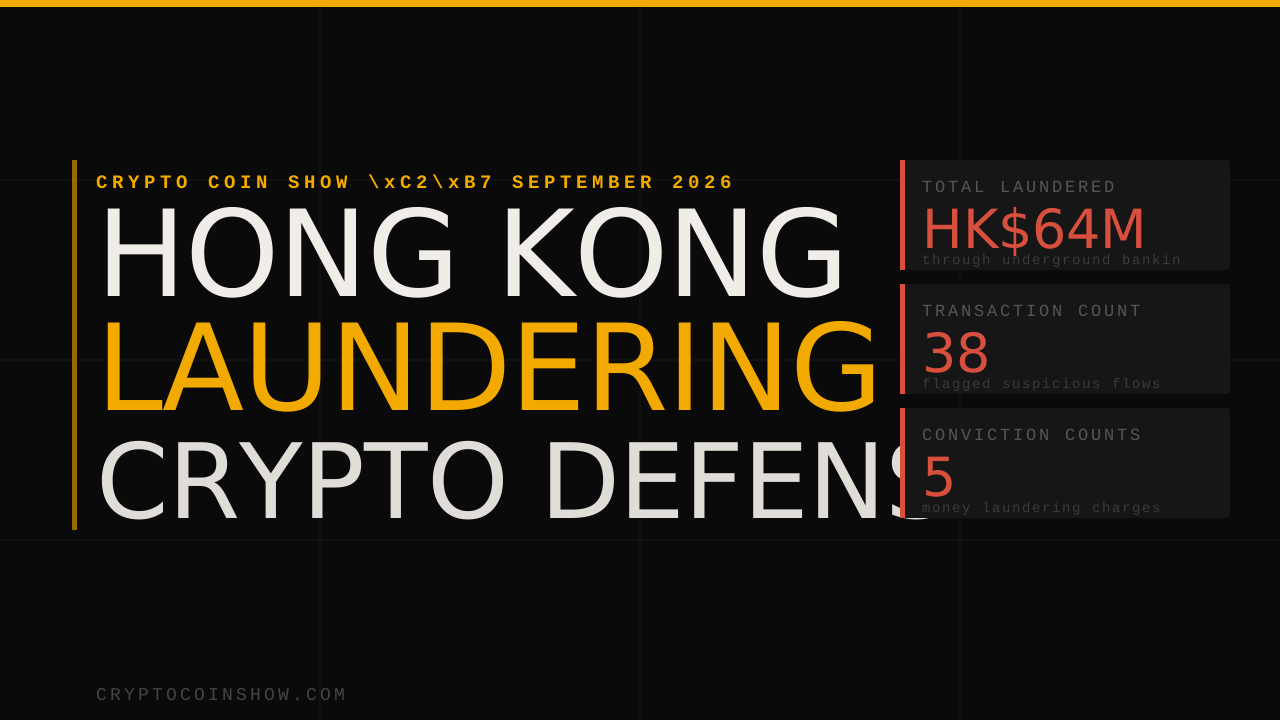
- Xiao Rui convicted on four money laundering counts and one false document charge; sentencing set for July 23
- HK$64 million flowed through personal accounts via 38 transactions from 12 companies and 12 unrelated entities between 2014-2023
- Judge rejected Bitcoin sale defense for lack of transaction dates, wallet addresses, or any supporting records whatsoever
- HK$64M Total amount laundered through underground banking over nine-year period
- 38 Individual transactions flowing into defendant’s accounts from unrelated sources
- 2013 Year Xiao applied for Hong Kong residency using fabricated bank deposit certificates
Acting Judge Bernard Chung’s conviction of 37-year-old Xiao Rui in Hong Kong district court marks a significant moment in how cryptocurrency claims are treated within formal money laundering prosecutions.
The case centers on HK$64 million that flowed into Xiao’s personal bank accounts at Standard Chartered, DBS, and HSBC between March 2014 and November 2023, originating from at least 12 companies and 12 individuals with no documented business relationship to his asset management firm.
Rather than acknowledge the funds’ actual provenance through underground banking channels, Xiao constructed a layered defense that included claims of Bitcoin sales proceeds and maternal gifts, both of which the court systematically dismantled.
The conviction signals how institutional courts now treat cryptocurrency-related explanations for suspicious fund flows: not with deference to decentralized ledgers or the purported difficulty of proving blockchain transactions, but with the same evidentiary standards applied to traditional asset transfers.
When Xiao claimed that some deposits stemmed from Bitcoin sales, Judge Chung required the most basic documentation: transaction dates, reference numbers, and wallet addresses. The absence of any such records, a trivial matter if the transactions had actually occurred, proved fatal to his credibility.
Judge rejects Bitcoin defense for complete lack of transaction records or wallet documentation
The centerpiece of Xiao’s attempted crypto defense was his assertion that he had sold Bitcoin and deposited proceeds into his Hong Kong accounts. This claim might have gained traction in earlier enforcement cases where authorities lacked technical sophistication in tracing blockchain transactions.
Judge Chung’s response revealed a different posture: if the transactions were real, the supporting evidence should be elementary and immediately available.
The judge found Xiao’s explanation weak precisely because it lacked any of the minimal documentation that even casual crypto transactions generate. No reference numbers from exchanges. No wallet addresses that could be cross-referenced.
No dates correlating to identifiable Bitcoin price movements or market activity.
The contrast with how courts have sometimes treated traditional asset sales, where a witness’s word might carry weight if supported by broad outlines, illustrates a hardening institutional approach: claims involving cryptocurrency must meet at least the same threshold of proof as conventional finances, and often a higher one, since the technology itself creates permanent, auditable records.
This evidentiary approach may reshape how money launderers attempt to obscure the origins of suspicious funds.
Court finds contractor’s testimony credible; link to father’s Wuhan position establishes corruption nexus
Beyond the cryptocurrency claim, the case against Xiao rested on documented fund flows with explicit quid pro quo implications. A contractor named Yao Qian deposited approximately HK$4.72 million into Xiao’s accounts after securing a municipal water-pump project in Wuhan.
The critical detail: Xiao’s father, Xiao Jun, had reportedly assisted with that contract while heading a bureau in the Wuhan People’s Procuratorate. The elder Xiao was previously suspended amid a mainland corruption investigation, though the conviction documents do not elaborate on the outcome or current status of that probe.
The judge found Yao’s testimony credible and the sequence of events probative of illicit intent. This is institutional money laundering prosecution fundamentals: the money did not flow randomly, but followed an identifiable pattern linked to official position.
When a contractor delivers millions in deposits immediately following the award of a public contract facilitated by a government official’s son, the appearance of legitimate business income collapses.
The court rejected Xiao’s counterclaim that the HK$4.72 million represented honest business proceeds, reading instead a transparent corruption payment, the kind that requires layered financial vehicles to obscure.
The remaining HK$59.28 million in deposits came from additional companies and individuals with no established connection to Xiao’s stated business activities, deepening the inference that the entire flow represented illicit wealth in transit rather than genuine commercial income.
False Hong Kong residency documents reveal layered fraud infrastructure spanning bank branch forgery
The false document conviction adds structural context to how Xiao operated. In 2013, he applied for Hong Kong residency through the Capital Investment Entrant Scheme, which required proof of assets exceeding HK$10 million. Rather than deploy legitimate capital, Xiao submitted fabricated deposit certificates purporting to come from a China Construction Bank branch in Wuhan.
Bank staff later confirmed the accounts listed on those certificates did not exist, a straightforward forgery.
Despite the fraudulent application, Xiao was approved for residency in 2014. That same year, he then used an HSBC account to purchase fund products worth HK$10 million, apparently creating retroactive legitimacy for residency status he had obtained under false pretenses. The judge rejected Xiao’s claim that his mother had handled the application and that he was unaware the documents were fake.
This excuse mirrors the broader pattern: Xiao consistently attributed responsibility for illegal conduct to family members while positioning himself as a passive conduit, a narrative the court found structurally implausible.
The fake deposit certificates suggest Xiao had access to document forgery infrastructure capable of replicating banking credentials, raising questions about whether similar methods were applied to other transaction documentation.
Money launderers must now demonstrate cryptocurrency transactions with same rigor as traditional assets
For institutional investors and compliance officers, the Xiao Rui conviction establishes a clear enforcement precedent: courts will no longer treat cryptocurrency claims as benefiting from a lower evidentiary bar or technical obscurity.
If a defendant asserts that funds came from digital asset sales, regulators and judges will demand the same documentary proof, exchange records, wallet addresses, blockchain evidence, that would be required for a claim involving stock sales or bond redemptions.
This shift has immediate compliance implications. Financial institutions accepting deposits from parties with questionable source documentation will find that a vague invocation of cryptocurrency holdings no longer satisfies due diligence obligations. KYC and AML teams must now probe such claims with the same intensity they would apply to any other asset class.
The absence of basic transaction records is not a technical limitation unique to blockchain; it is an evidentiary failure that courts interpret as a sign of fabrication.
The case also underscores how corruption networks in mainland China continue to channel proceeds through Hong Kong’s financial system, despite tightening controls.
Xiao Rui’s use of Standard Chartered, DBS, and HSBC accounts, institutions subject to heightened regulatory scrutiny, suggests that even tier-one banks may require more granular monitoring of deposit patterns that correlate with official procurement decisions or contract awards across the border.
Xiao Rui faces sentencing on July 23; the court’s penalty decision will signal whether Hong Kong courts view cryptocurrency-adjacent money laundering schemes as warranting distinct sentencing guidance or will instead treat them as functionally identical to traditional underground banking operations. Additionally, the conviction raises unresolved questions about whether mainland Chinese authorities will coordinate with Hong Kong prosecutors on a parallel investigation into Xiao Jun’s role in the Wuhan contract and his reported suspension under corruption charges.
Original reporting: cryptopolitan.com