
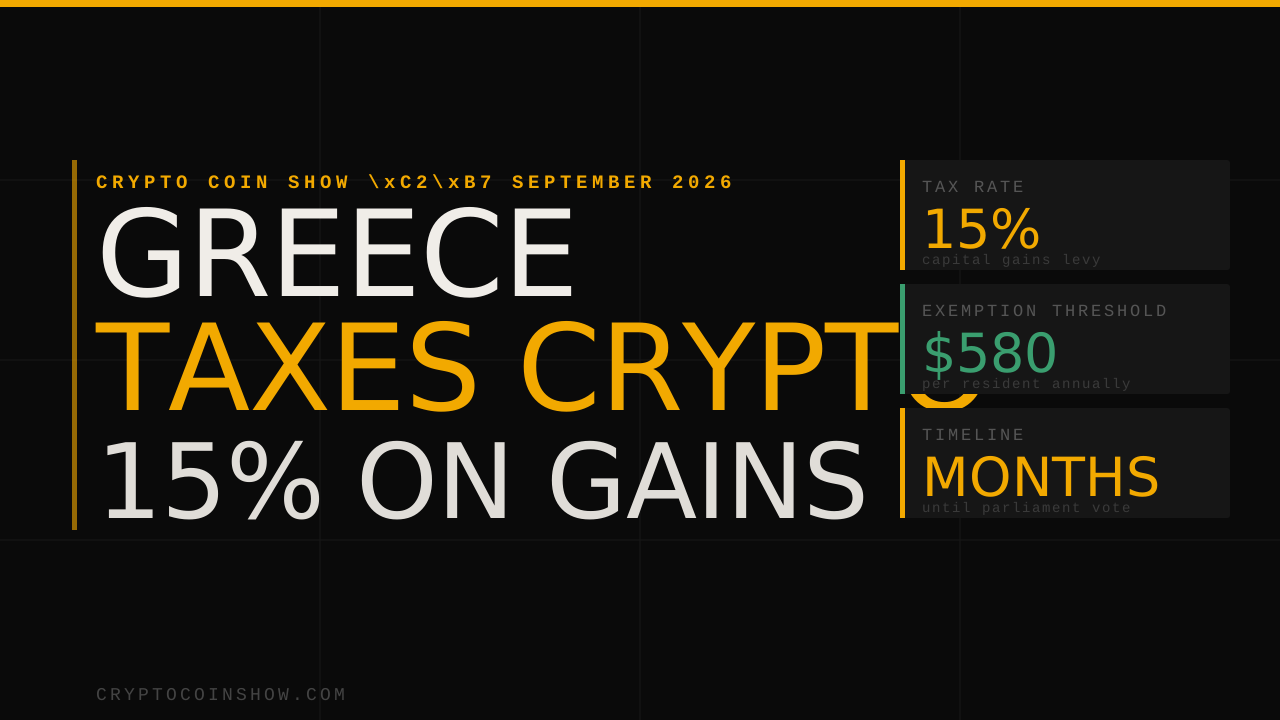
Greece moves to tax crypto gains at 15% with legislation expected within months
Greece is drafting legislation to impose a 15% capital gains tax on cryptocurrency profits, a move that would formally integrate digital assets into the country’s tax code for the first time and establish a middle-ground rate compared to other EU member states. The bill is expected to reach parliament within months, coinciding with Greece’s push to build regulatory infrastructure around Binance’s recent decision to establish its EU headquarters in Athens.
- Greece’s proposed 15% crypto capital gains tax includes a 500-euro ($580) exemption threshold per resident, with individual miners exempt from the levy entirely.
- Binance applied for a MiCA license in January and signaled that Greek regulators would fast-track the review process following the exchange’s selection of Athens as its EU base.
- Greece’s 15% rate positions it midway between Cyprus’s 8% floor and France’s 30% ceiling across EU member states with varying digital asset tax regimes.
- 15% Proposed crypto capital gains tax rate compared to EU member state range of 8-30%
- €500 Annual exemption threshold per Greek resident before capital gains tax liability applies
- 40 days Maximum working timeline for crypto exchange and wallet provider licensing under MiCA
Greece’s Finance Ministry is formalizing the country’s approach to cryptocurrency taxation through legislation that would establish a 15% levy on digital asset profits, according to government officials who disclosed details of the draft bill to Reuters.
The proposed regime marks the first time Greece would incorporate crypto gains into its formal tax code, addressing a regulatory gap as the country positions itself as a crypto-friendly EU jurisdiction. Passage is anticipated within the coming months, potentially before the end of the year, though parliament has not yet scheduled a vote.
The timing aligns with Athens’s broader effort to establish itself as a regulatory destination for institutional crypto operators, most notably following Binance’s January announcement that it would base its European operations there.
Greece’s tax framework carves out miners and sets middle-ground rate within EU
The proposed tax structure incorporates specific exemptions that reflect both political pragmatism and technical realities of the crypto market. Residents would owe nothing on capital gains up to 500 euros annually, creating a de facto exemption for small-scale traders and casual investors.
More significantly, individual cryptocurrency miners are entirely exempt from the new tax, a concession likely designed to encourage participation in blockchain validation activities within Greek borders. Corporate mining operations, however, receive no such carve-out and would be subject to the full 15% rate, creating a clear distinction between retail and commercial activities.
At 15%, Greece’s rate occupies the middle ground within the EU’s fragmented crypto taxation landscape. Cyprus, positioning itself aggressively for crypto business, charges only 8% on digital asset capital gains, making it the most competitive option in the bloc. France, by contrast, applies rates as high as 30%, the highest among major EU economies.
Greece’s midpoint positioning reflects a deliberate policy choice: competitive enough to retain and attract crypto businesses, while generating meaningful tax revenue and signaling fiscal seriousness to Brussels and other EU capitals concerned about regulatory arbitrage.
Government officials acknowledged a practical complication undermining any revenue projection: most Greek investors trade through cryptocurrency platforms registered outside the country, making the true size of the domestic market difficult to estimate with precision.
Binance’s Athens base creates institutional stakes in Greece’s regulatory framework
Binance’s decision to establish its EU headquarters in Greece transformed Athens from a minor player in European crypto regulation into a jurisdiction with direct leverage over the world’s largest cryptocurrency exchange by trading volume.
The announcement, made in January 2025, was publicly justified by Binance co-CEO Richard Teng, who cited the country’s technical talent pool and security environment during remarks at the Global Finance and Technology Network forum in Tokyo.
The company filed its application for a Markets in Crypto-Assets (MiCA) license through Greece’s Hellenic Capital Market Commission in January, and Greek regulators indicated they would accelerate the review timeline beyond the standard 40 working day maximum permitted under EU rules.
Binance’s presence creates immediate institutional pressure for Greece to deliver both regulatory certainty and an attractive tax environment. A punitive capital gains regime could drive the exchange to reconsider its commitment, while excessive leniency might trigger criticism from EU capitals already concerned about regulatory arbitrage in the bloc.
The 15% rate represents a compromise designed to satisfy both constituencies: high enough to demonstrate fiscal responsibility and EU alignment, low enough to remain competitive against Cyprus and more attractive than France’s rates.
Prime Minister Kyriakos Mitsotakis has signaled consistent commitment to formalizing crypto oversight, telling cabinet members in January that the government aimed to “bring order to a largely ambiguous and unregulated domain” and to regulate what he characterized as the “dubious” aspects of the market.
The tax legislation arrives alongside Greece’s regulatory modernization. In August 2024, the Hellenic Capital Market Commission completely overhauled its licensing regime for cryptocurrency exchanges and custodial wallet providers, bringing Greek rules into alignment with the EU’s MiCA regulation.
The updated framework requires platforms to complete a formal licensing process, capped at 40 working days, while explicitly barring unlicensed service providers from operating within Greek jurisdiction.
This combination of licensing discipline and now formal taxation creates a structured environment in which Binance and other institutional players can operate with both clarity and competitive advantage over unregulated or jurisdictionally ambiguous alternatives.
Parliament vote timing remains uncertain as Greece finalizes tax code language
The Finance Ministry has not publicly confirmed when exactly the capital gains tax bill will be submitted to parliament, though multiple government officials indicated the timeline spans “the coming months.” This language suggests submission before mid-2025, but leaves room for delays if either technical drafting questions or coalition politics within the governing structure require additional negotiation.
The absence of a published revenue projection from the Finance Ministry indicates either that government economists have not finalized demand modeling given the difficulty of sizing the Greek crypto market, or that officials have chosen not to front-load expectations ahead of parliamentary debate.
Institutional investors and crypto operators with Greek exposure should monitor several open questions as the bill progresses. First, whether parliament will approve the 15% rate intact or whether debate produces amendments either raising the levy to align more closely with broader capital gains taxation or lowering it to increase competitive positioning.
Second, the precise definition of “capital gains” in the final text matters significantly: whether it covers only spot transactions or extends to derivatives, staking rewards, yield-bearing protocols, and other passive income streams remains unspecified.
Third, whether the Finance Ministry will publish detailed guidance on tax administration and compliance mechanisms, or whether implementation details will emerge only after passage, creating initial uncertainty for filers.
Greek regulators are expected to make a formal determination on Binance’s MiCA license application within the accelerated timeline in the coming weeks, a milestone that will signal whether Athens intends to follow through on its commitment to crypto-friendly regulation and whether the pending tax legislation might be adjusted if Binance signals concerns during the consultation period.