
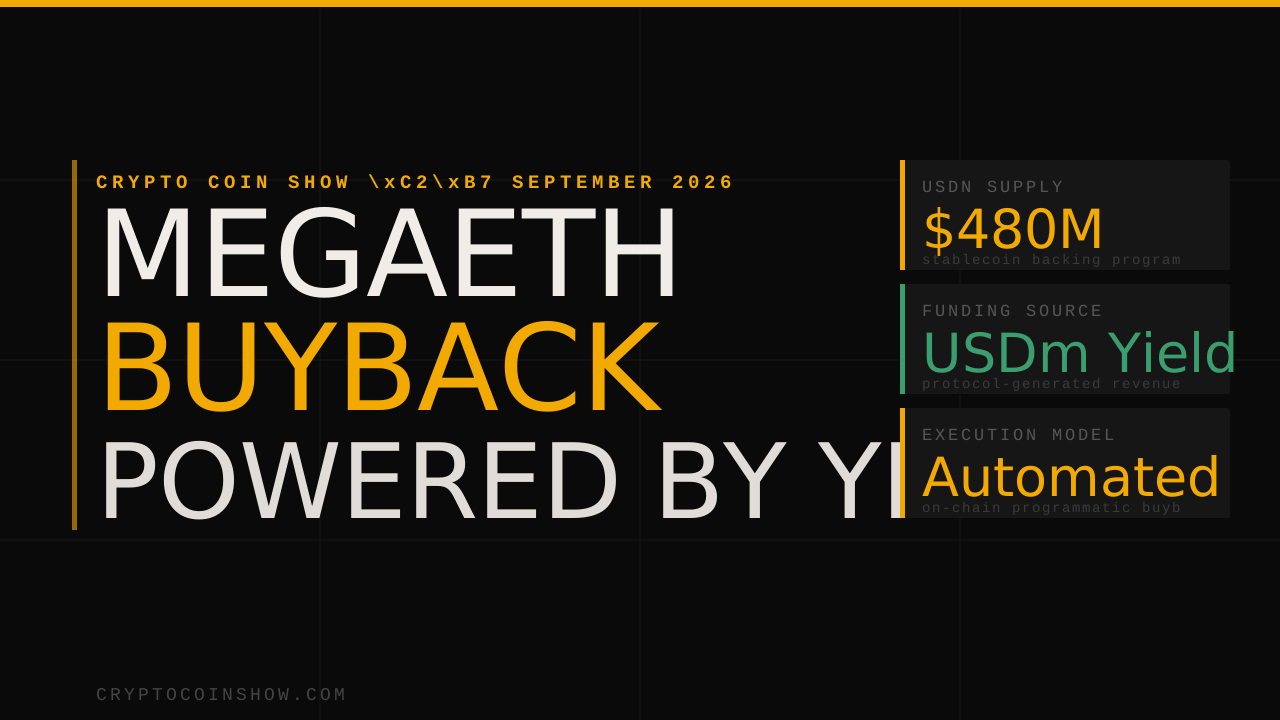
MegaETH launchs a token buyback program funded by yield from the USDm stablecoin
MegaETH Foundation has launched an automated token buyback program funded entirely by yield generated from USDm, a synthetic stablecoin it created with Ethena, marking a direct attempt to create persistent capital returns for token holders through protocol revenue. The move tests a mechanism long promoted in crypto but rarely executed sustainably, as competing models show wildly different outcomes depending on revenue scale and token fundamentals.
- MegaETH completed its first buyback using all net rewards from USDm through April, with stablecoin supply now at $480 million.
- Future buybacks will run programmatically and on-chain to eliminate discretionary decisions and route capital through MegaETH’s own network.
- Buyback amounts will fluctuate based on USDm supply changes and returns on underlying reserve assets, making predictability difficult.
- $480M USDm stablecoin supply funding the buyback mechanism
- $575M Aave deposits on MegaETH as of May 1, showing protocol traction
- 46% Hyperliquid’s share of all crypto protocol buyback spending through October 2025
The MegaETH Foundation announced on May 7 that it had closed its inaugural token buyback, deploying all accumulated rewards from USDm through the end of April. Unlike discretionary repurchase programs common in traditional finance, MegaETH’s structure routes revenue directly into on-chain, programmatic buybacks executed on its own Layer 2 blockchain.
The foundation stated explicitly that the mechanism exists to prevent subjective capital allocation decisions and to consolidate trading activity within MegaETH’s ecosystem rather than fragmenting it across external venues. This design choice reflects a broader institutional push toward algorithmic, transparent fund deployment in crypto protocols.
USDm Yield Model Creates Revenue Stream Independent of Token Utility
The buyback program draws funding from USDm, a synthetic stablecoin developed jointly by MegaETH and Ethena. USDm supply has reached $480 million, generating ongoing yield through reserve asset returns. This structure decouples the buyback mechanism from transaction fees or protocol revenue, which remain volatile and difficult to forecast.
Instead, the buyback relies on the financial engineering of stablecoin reserve yields, a model that works only if USDm adoption continues expanding and underlying reserve assets maintain positive carry.
The foundation emphasized that USDm is neither issued nor operated by MegaETH Foundation or MegaLabs directly, limiting the protocol’s direct liability but also constraining its control over the revenue source.
Buyback amounts will vary materially based on two independent variables: fluctuations in USDm supply as users mint and redeem the stablecoin, and shifts in yields on underlying reserve assets as market conditions change.
This variability eliminates the possibility of predictable shareholder-like returns, a critical difference from traditional equity buyback programs where companies can commit to consistent repurchase volumes.
Aave’s rapid deployment of $575 million in deposits on MegaETH as of May 1 demonstrates the liquidity depth now available on the Layer 2 chain. That capital base underpins the yield generation flowing into USDm and ultimately into future buybacks, creating a feedback loop where protocol adoption directly strengthens the token buyback program.
Hyperliquid’s $645 Million Buyback Spending Exposes the Model’s Revenue Requirements
MegaETH’s programmatic approach mirrors mechanisms already deployed at scale elsewhere, most notably at Hyperliquid. That derivatives protocol spent approximately $645 million repurchasing HYPE tokens through its Assistance Fund, accounting for 46 percent of total buyback spending across the entire crypto industry as of October 2025.
Hyperliquid routes between 97 and 99 percent of its trading fees into buybacks and permanent token burns, a commitment that requires enormous transaction volumes to sustain meaningful repurchase activity.
The Hyperliquid precedent reveals both the potential and the prerequisites of the model. Generating hundreds of millions in annual buyback capital requires either massive fee revenue or high-yield reserve assets yielding material percentage returns.
MegaETH’s reliance on USDm yield rather than protocol trading fees represents a different bet: that stablecoin reserve returns will prove more stable and predictable than trading volumes. This distinction matters because trading fees are discretionary, users can migrate to cheaper venues, while reserve yields depend on external market conditions beyond the protocol’s control.
The contrast sharpens when viewed against Pump.fun, a Solana-based meme coin launchpad that initially committed 100 percent of revenue to PUMP token buybacks for nine months following launch.
Despite aggressively repurchasing and burning approximately $370 million worth of tokens, representing roughly 36 percent of circulating supply, PUMP traded approximately 81 percent below its all-time high and spent most of 2026 near record lows.
Pump.fun’s Buyback Failure Forces Mid-Course Correction on Program Design
The Pump.fun case study exposes a fundamental disconnect: buyback programs cannot rescue tokens whose underlying utility or adoption trajectory does not justify the market valuation. In late April, Pump.fun’s team acknowledged this reality and pivoted its model, acknowledging the burned tokens had not restored market confidence.
The protocol shifted from 100 percent revenue allocation to buybacks toward a split model: 50 percent now flows to operations, while the remaining 50 percent funds a new programmatic buyback-and-burn mechanism.
This pivot demonstrates institutional recognition that buyback-only strategies fail when the protocol lacks sufficient organic adoption and revenue growth. Redirecting capital toward product development and operations signals that Pump.fun concluded its token price depression stemmed from market skepticism about long-term viability rather than from insufficient capital returns.
By contrast, MegaETH’s structure avoids this trap by not committing 100 percent of available capital to buybacks; the mechanism consumes only USDm yield, leaving other protocol revenue streams available for development, marketing, and operational expenses.
MegaETH’s explicit disclaimer that USDm is neither issued nor operated by the foundation further shields the protocol from regulatory risk while complicating its ability to expand USDm supply or modify yield structures unilaterally. Any future changes to the stablecoin would require coordination with Ethena, limiting MegaETH’s autonomy over its own buyback funding source.
Automated Execution on MegaETH’s Chain Tests Ecosystem Capital Recycling
The decision to run buybacks programmatically and exclusively on MegaETH’s own Layer 2 blockchain serves two strategic objectives: it eliminates human discretion that could invite regulatory scrutiny or community accusations of self-dealing, and it concentrates trading activity on MegaETH’s own venues rather than fragmenting purchases across external exchanges.
This design reinforces the Layer 2’s liquidity depth and market microstructure.
From an institutional investor perspective, programmatic on-chain buybacks offer verifiability and transparency that discretionary programs cannot match. Every buyback execution is auditable, timestamped, and irreversible.
However, this transparency cuts both ways: it also locks the protocol into predetermined rules that cannot adapt if market conditions change dramatically or if the buyback mechanism proves ineffective at supporting token price.
MegaETH’s success will hinge on whether USDm adoption accelerates beyond $480 million and whether the underlying reserve assets sustain meaningful yields over a multi-year horizon. The protocol has committed to ongoing programmatic buybacks, but the variability of funding and the mixed results at comparable protocols mean the first 12 months of execution will determine whether institutional investors and large token holders view the mechanism as a genuine value driver or as financial theater masking deeper questions about token utility and protocol sustainability. Watch whether Aave’s $575 million deposit base on MegaETH expands materially over the next quarter, as that adoption will directly determine future buyback funding availability.