
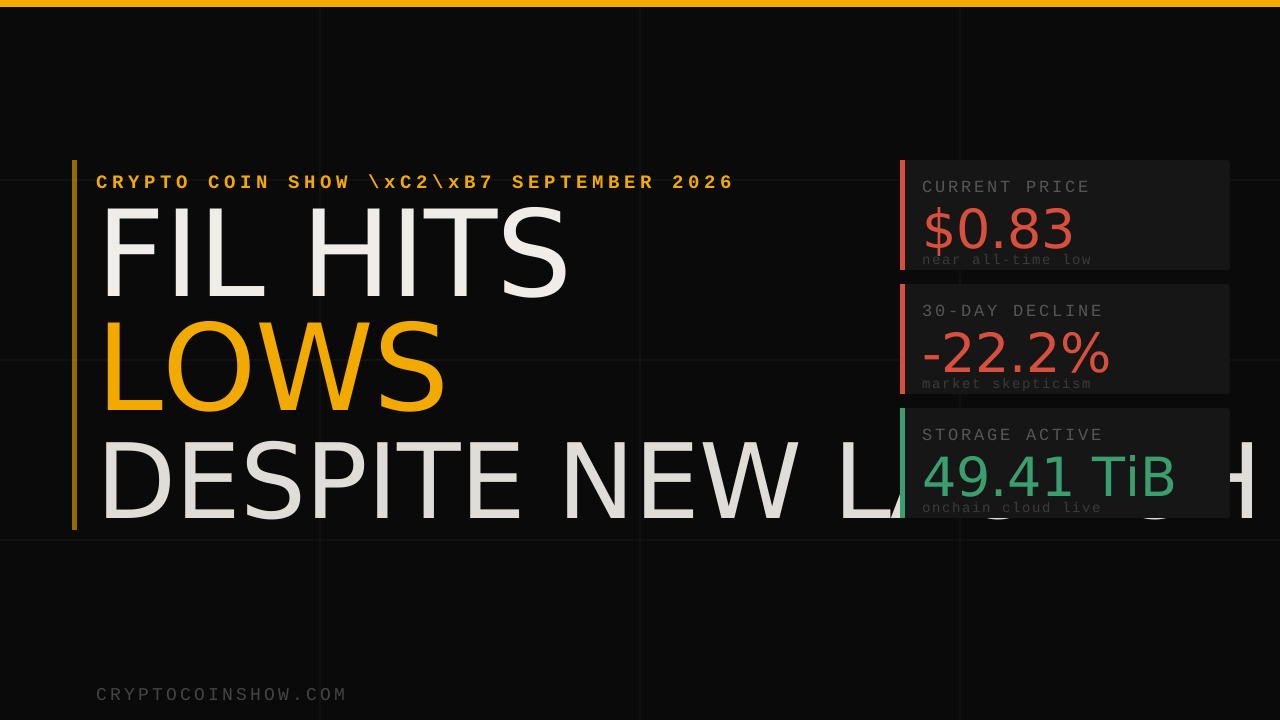
FIL trades near all time low despite the launch of Filecoin Onchain Cloud
Filecoin has launched its Onchain Cloud on mainnet with production-grade infrastructure for AI agents and autonomous systems, yet FIL token has collapsed to $0.83, near its all-time low, signaling persistent disconnect between protocol development and market confidence among institutional investors.
- Filecoin Onchain Cloud now live on mainnet with 49.41 Tebibytes stored across 478 active datasets and 81 payer wallets
- FIL token trading at $0.83, down 4% in 24 hours and 22.2% over 30 days, versus all-time high of $236.84 in April 2021
- Over 100 developer teams building on the platform; two-copy replication and production-grade storage providers enforce 95%+ success thresholds
- $0.83 Current FIL price versus $0.81 all-time low last month
- 99.6% Percentage loss from April 2021 peak of $236.84 to present
- 49.41 TB Data stored on mainnet across 478 active datasets and growing
Filecoin announced the mainnet launch of its Onchain Cloud platform, a programmable storage and payments layer designed explicitly for AI agents and autonomous systems that operate without human intervention. The infrastructure went live following a testnet phase that attracted over 100 developer teams building tools for AI workflows, dataset indexing, and decentralized applications.
Yet the launch has failed to arrest a severe price decline: FIL token trades at $0.83, near its all-time low of $0.81 set last month, representing a 99.6% crash from its April 2021 peak of $236.84. The disconnect between technical progress and market valuation presents a critical puzzle for institutional investors evaluating Filecoin’s long-term viability as a decentralized storage play.
Filecoin deploys two-copy replication and production-grade storage criteria for mainnet stability
The Onchain Cloud mainnet rollout included three significant technical upgrades aimed at strengthening reliability and performance for production workloads. Two-copy replication ensures that every file uploaded via the Synapse SDK lands automatically on two independent storage providers without consuming additional bandwidth, with each copy generating its own onchain proof of storage.
If one provider fails, the system replaces it automatically, eliminating single points of failure.
The network has also onboarded production-grade storage providers subject to strict performance enforcement: a storage success rate of 95% or higher, a Proof of Data Possession (PDP) fault rate below 1%, and a retrieval success rate above 95%. Providers failing to meet these thresholds face automatic removal from the network.
A Proof of Data Possession explorer is now publicly available, allowing anyone to audit provider performance, fault history, and proof status in real time.
The Synapse SDK, Filecoin’s developer toolkit, was upgraded to use viem instead of Ethers, improving TypeScript support and reducing query latency. These incremental infrastructure improvements reflect a maturing storage network, yet the mainnet state captures only modest early adoption: 49.41 Tebibytes across 478 active datasets and 81 onchain payer wallets.
For institutional storage operators and enterprise AI teams evaluating Filecoin against alternatives like Arweave or centralized cloud providers, the cost-per-byte and fault-tolerance profile now require real-world testing at scale.
FIL token plummets 22% in a month as TVL contracts and developer momentum stalls
Price action tells a starkly different story than the technical roadmap. FIL dropped 4% in the last 24 hours and 8% over the past week, extending a one-month decline of 22.2%, according to CoinGecko data.
The token currently ranks 83rd in market capitalization at approximately $639 million, a valuation that has compressed despite the launch of what Filecoin Foundation describes as a significant infrastructure milestone.
Total value locked on Filecoin has contracted as well. DeFiLlama data shows TVL slumped 9.88% in the 24 hours following the mainnet announcement, settling at $6.31 million, a figure dwarfed by established lending protocols and deFi platforms operating on Ethereum, Solana, or Arbitrum.
The decline suggests that even the launch of new infrastructure features is insufficient to attract capital or reverse institutional skepticism about Filecoin’s viability as a core infrastructure asset.
The 100+ developer teams announced as “building” during the testnet phase does not guarantee productive deployment or revenue generation on mainnet.
Institutional storage demand remains unproven despite AI agent use case positioning
Filecoin’s positioning around AI agents and autonomous systems addresses a genuine emerging need: intelligent systems require persistent, trustless data storage and onchain payment rails that do not rely on human operators.
The two-copy replication model and production-grade storage provider vetting suggest the protocol is attempting to address enterprise reliability concerns that have plagued decentralized storage platforms since inception.
However, the gap between aspiration and adoption remains wide. The current 49.41 Tebibytes stored on Filecoin pales in comparison to Arweave’s bundled permanent storage network or the raw capacity of centralized cloud operators like AWS, Google Cloud, or Azure.
Institutional crypto investors must weigh whether the architectural innovations justify a valuation that has eroded to near all-time lows, or whether the collapse in FIL price reflects rational skepticism about Filecoin’s ability to compete for mission-critical storage workloads against both decentralized and centralized alternatives.
The real test lies in whether the 100+ development teams actually deploy revenue-generating applications and whether enterprise storage providers begin migrating payloads to Filecoin’s network.
At current price levels, Filecoin trades at a severe discount to its market cap in 2021, yet the protocol has not yet demonstrated the transaction volume, network utilization, or customer concentration metrics that would justify institutional confidence. The technical soundness of two-copy replication and onchain proof auditing is now in the market’s hands.
Watch for concrete evidence of AI agent and autonomous system adoption over the next 60 days: specific developer projects going live, storage provider revenue data, and whether TVL expands or continues contracting.
The absence of any major enterprise deployment announcement by end of Q1 2025 would likely confirm that Filecoin’s infrastructure improvements are not addressing a sufficiently urgent market demand to reverse investor exit momentum.
Institutional Storage Demand Remains Nascent Despite Production-Grade Infrastructure
The 49.41 TB currently stored across Filecoin’s mainnet represents meaningful adoption of the protocol’s storage mechanics, yet the figure underscores how early-stage institutional deployment remains relative to competitive benchmarks.
Amazon S3 processes exabytes of data daily, roughly 21,000 times the total Filecoin mainnet capacity, while traditional enterprise cloud storage revenues exceeded $80 billion in 2023. The gap reflects both Filecoin’s youth as a production platform and persistent adoption friction among institutions accustomed to centralized providers with SLA guarantees and dedicated support.
The 81 payer wallets funding storage on Filecoin suggest diversity across users and workflows, though the figure offers limited insight into whether demand comes from organic developer interest or Protocol Labs ecosystem incentives. Historical crypto infrastructure launches show that early-stage transaction or storage volumes often spike during grant periods, then plateau once subsidies end.
Filecoin has allocated significant resources to developer grants and testnet incentives; understanding whether mainnet growth sustains after those programs wind down will be crucial to assessing genuine market-pull versus protocol-push adoption patterns.
The protocol’s next critical milestone arrives as developer grants begin expiring and the 100+ builder teams face genuine unit economics decisions on storage costs. If mainnet TB growth accelerates through Q2 2025 absent new incentive programs, institutional demand may be establishing a durable foothold; flat or declining usage would signal that AI agents and autonomous systems remain unproven as a Filecoin revenue driver.