
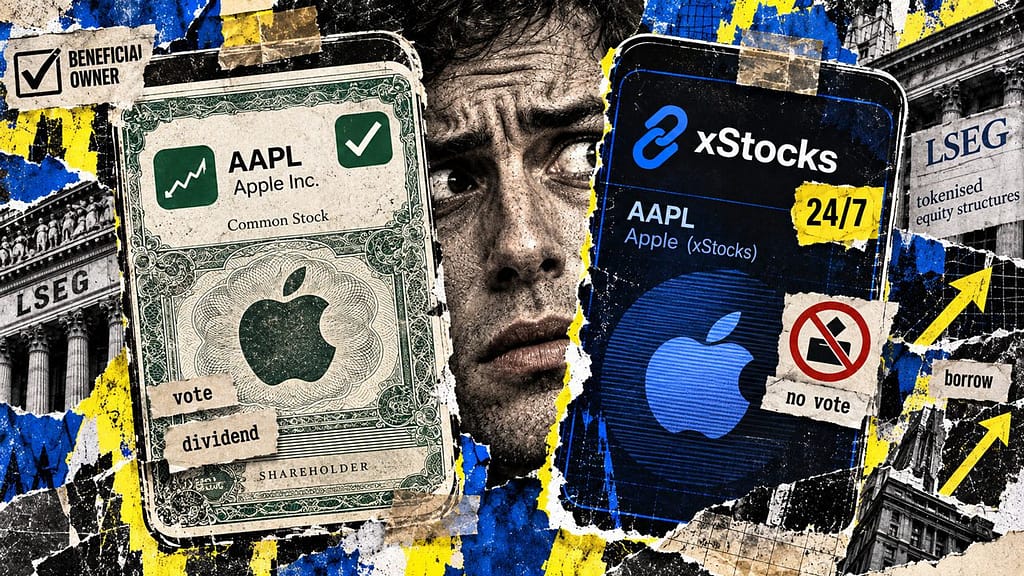
Tokenized stocks strip voting rights and dividends while mimicking price movements of equities
Tokenized stocks trading on blockchain networks can mimic equities in price movement while withholding shareholder voting rights and dividend payments, creating a two-tier market where identical-looking products carry fundamentally different legal claims. Institutional investors and fund managers now face a critical choice: whether tokenization democratizes stock access or merely multiplies venues for leveraged speculation without ownership.
- London Stock Exchange planning 2027 launch of xStocks on LSE 24 venue, separate from its blockchain-native share structure under regulatory review
- Kraken’s xStocks tokens track underlying equity prices but explicitly exclude shareholder voting rights and deliver dividend benefits only as reinvested holdings adjustments
- Token-based leverage amplification can occur when borrowed funds purchase more tokens backed by existing tokens, compounding downside risk during price declines
- 20% Token price decline reducing $150 total exposure to $120, or 30 percent loss on original capital invested
- 2027 Planned LSE 24 listing date for xStocks, subject to regulatory approval by London exchange
- $2 Example dividend reinvested as 0.02 share units in Kraken xStocks documentation illustration
A single ticker and buy button can now represent two entirely different legal claims on the same underlying company. One investor owns shares that carry voting rights and dividend payments; another holds a token designed to track that share’s price while explicitly excluding both those entitlements. The distinction matters most when defaults, insolvencies, or market stress force the legal layer back into focus. According to reporting on the structure, the London Stock Exchange is now pursuing two separate paths: one that would place actual company shares onto blockchain networks while preserving shareholder status, and another listing xStocks, a third-party token product, on its LSE 24 venue in 2027, both subject to regulatory approval.
LSE’s dual tokenization approach separates shareholder claims from price-tracking products
The September 1 announcement with Payward describes an issuer-sponsored structure where companies could issue tokenized shares while keeping the voting and dividend entitlements intact. If integrated properly, token transfers would transfer the shares themselves, preserving the investor’s status as a shareholder with all the legal claims that follow. The SEC staff’s January taxonomy distinguishes issuer-sponsored from third-party structures, making clear that the technology can accommodate either approach, but the legal arrangement, not the blockchain, determines what rights travel with the token.
The xStocks product launches on a different model entirely. A custodian holds the underlying shares; a separate business then issues tokens designed to track the value of those holdings.
Kraken’s xStocks documentation explicitly states that token holders do not receive underlying shareholder voting rights and that dividend benefits are reflected only through adjustments to effective holdings rather than separate cash payments.
If a holding represents $100 of share exposure and receives a $2 reinvested dividend at $100 per share, the investor now holds the economic equivalent of 1.02 shares instead of one, the capital is reinvested, not available to spend. The arrangement leaves the underlying company out of the relationship with the token buyer entirely.
Dividend mechanics and custody arrangements create competing legal claims
Shareholders own a residual claim on company assets, rank below creditors in bankruptcy, and receive whatever is left once those senior claims are paid.
Token holders in products like xStocks hold a claim against the issuing business and the custody arrangement protecting the underlying shares, a chain of intermediaries with their own insolvency risk. A 2024 Financial Stability Board assessment flagged the custody and collateral dependencies as material risks, noting that proof of backing only establishes that assets exist; the contract determines how holders can reach them if something fails. Ordinary brokerage accounts already use nominees and intermediaries, but shareholders retain their fundamental legal relationship with the company. Token structures add another layer: the issuer holds the shares, and the token holder’s claim depends on the issuer’s solvency, operational quality, and how insolvency law in the token’s jurisdiction treats the underlying custodial arrangement.
The dividend treatment exemplifies the difference in a concrete way.
In an ordinary brokerage account, shareholders typically receive reinvested dividends or cash depending on their account settings. In xStocks, the token’s displayed balance can increase through a multiplier while the on-chain token count remains unchanged, making the adjustment invisible on the blockchain itself.
Different products apply their own tax treatment and adjustment methods, and none of those design choices automatically preserve shareholder status in the company whose shares back them.
Leverage and after-hours trading create new speculation mechanics without ownership control
Tokenized stock access improves convenience for jurisdictions with high barriers to foreign equity markets, and fractional investing through blockchain networks can make small positions easier to manage and transfer.
Yet the same infrastructure that lowers barriers also enables continuous trading outside traditional market hours, creating price discovery problems when token markets operate while the underlying stock exchange is closed. A trader holding $100 in tokens can borrow $50 against them, buy another $50 of token exposure, and now carry $150 of risk on the underlying stock.
If the token price falls 20 percent, the $150 position is worth $120, leaving $70 after the $50 debt is repaid, a 30 percent loss on the original capital. Forced liquidations can occur before the trader chooses to exit, depending on lending terms and margin agreements.
Platforms generating fees or trading spreads have a commercial incentive to increase transaction volume, and they can reduce per-trade costs while expanding total activity enough to maintain profit. That does not align with investor outcomes: the number of trades made is a poor substitute for either lower costs or better access to investments that matter.
Kraken restricts xStocks access from several jurisdictions, including the United States, and conducts its own compliance review of which customers can participate. Global token infrastructure still operates within distribution rules and regulatory boundaries.
The London Stock Exchange’s 2027 LSE 24 listing of xStocks will test whether regulators permit price-tracking tokens to trade alongside the actual shares they reference. If approved, institutional platforms will need to decide whether the tokenized version’s extended hours and lower friction justify accepting subordinated legal claims, custody dependencies, and the amplified leverage mechanics enabled when tokens become collateral. The parallel progress on issuer-sponsored shares, also subject to regulatory approval, will determine whether institutional investors can access tokenization’s settlement efficiency while retaining shareholder rights, or whether the market fragments into tiers where one group owns the company and another merely owns exposure to its price.