
UK robot maker Humanoid raises $152 million, joins the unicorn ranks
Humanoid, a London-based industrial robotics maker, has raised $152 million in Series A funding at a $1.35 billion valuation, becoming Europe’s first robotics unicorn. The round signals institutional capital’s accelerating pivot toward physical AI and autonomous systems, creating a new asset class that institutional investors, particularly those tracking automation, labor economics, and supply-chain infrastructure, must now monitor alongside traditional crypto and blockchain holdings.
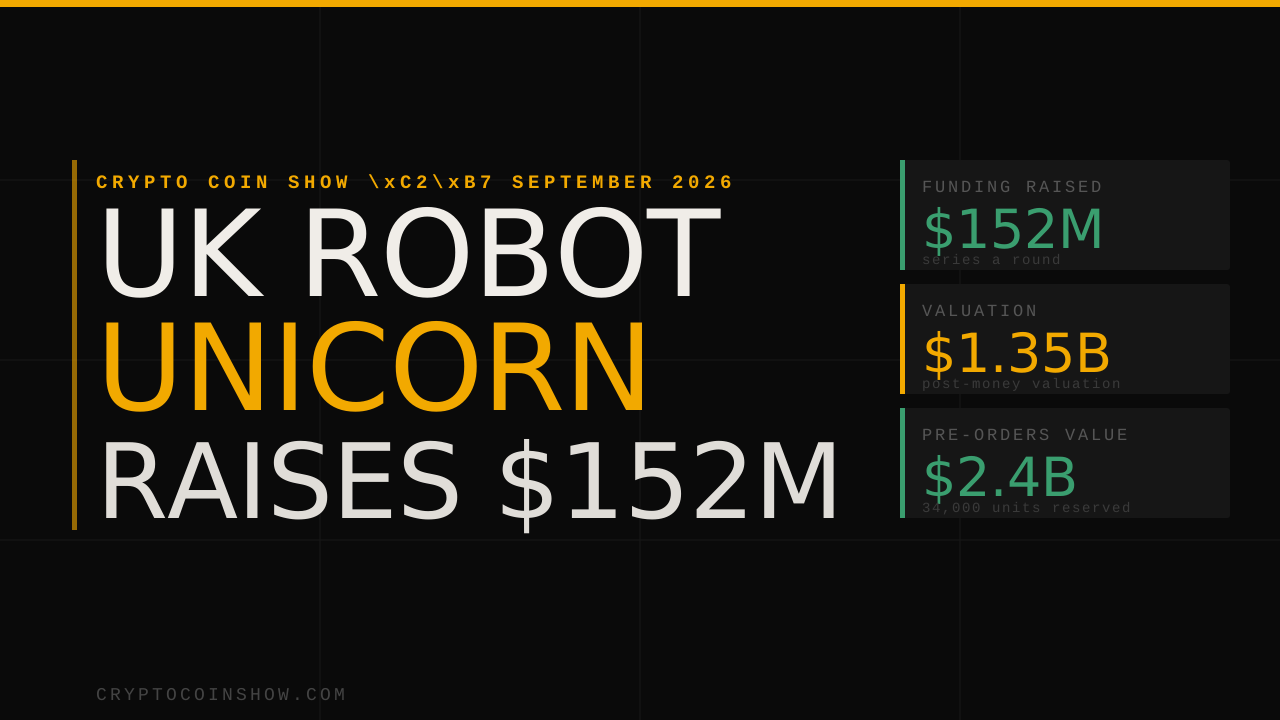
- Humanoid raised $152 million in Series A led by Prime Movers Lab, valuing the company at $1.35 billion after two years of operations.
- The company holds 34,000 pre-orders worth $2.4 billion and expects beta robots operational at customer sites by Q4 2026.
- Bosch will manufacture robots; Schaeffler has signed a separate agreement; SAP, NVIDIA, and Siemens rank among Fortune 500 partners using the platform.
- $152M Series A funding round valuing Humanoid at unicorn status
- $2.4B Pre-order value from 34,000 robot commitments across industries
- 80 UK unicorns as of July 2026, ranking third globally after US and China
Humanoid’s $1.35 billion valuation marks a watershed moment for physical AI infrastructure: a robotics company has reached unicorn status faster and with more tangible customer commitments than most software-only startups in prior cycles. The London-based manufacturer closed its Series A with Prime Movers Lab leading, bringing total funding to $270 million since inception.
More significantly, the round reflects a broadening institutional consensus that autonomous physical systems, not just language models or blockchain protocols, represent a critical economic frontier.
What distinguishes this capital raise from earlier robotics hype cycles is the specificity of customer acquisition and manufacturing partnerships. Humanoid has signed Bosch as its contract manufacturer and secured a separate production agreement with Schaeffler, the German industrial supplier, for deployment across Schaeffler’s own factory operations.
SAP, NVIDIA, and Siemens have each committed to integrating or deploying Humanoid’s robots, signaling that Fortune 500 companies are moving past pilot phases into operational commitment.
Bosch partnership and Q4 2026 rollout target production at scale
Humanoid’s path to revenue hinges on meeting its stated timeline: beta robots operational at customer sites by the fourth quarter of 2026. That 18-month window is aggressive by industrial standards and will determine whether the company can convert pre-orders into cash and market share.
The manufacturing partnership with Bosch, one of the world’s largest industrial suppliers, removes a critical constraint: in-house production scaling.
Bosch’s involvement signals confidence from one of Europe’s blue-chip manufacturers that Humanoid’s wheeled robot design, the HMND 01, meets industrial durability and repeatability standards.
Contract manufacturing also de-risks Humanoid’s capital requirements; the company avoids building its own gigafactory at launch and instead leverages Bosch’s existing supply chain for parts sourcing and assembly. Schaeffler’s separate agreement to deploy robots in its own factories amounts to a reference customer and a test-bed for fleet coordination at scale.
The 34,000 pre-orders worth $2.4 billion represent the largest tangible validation any robotics startup has announced. That figure translates to an average order value of roughly $70,600 per unit, consistent with industrial automation pricing but higher than consumer robotics.
If Humanoid executes the Q4 2026 launch and begins fulfilling even a fraction of that backlog, the company will move from venture-backed startup to revenue-generating industrial supplier within two years.
KinetIQ software and fleet autonomy reshape labor economics
The underlying technology justifying Humanoid’s valuation lies in its proprietary AI system, KinetIQ, described as the “brain” that allows robots to understand and execute physical tasks.
Critically, KinetIQ is designed to coordinate entire robot fleets regardless of their body type or function, a modular approach that reduces switching costs for customers and creates lock-in potential once deployed at scale.
This architecture mirrors software-as-a-service business models rather than hardware-only robotics. Once a customer deploys one HMND 01 unit running KinetIQ, adding additional robots, or mixing HMND units with other vendors’ hardware running compatible KinetIQ versions, becomes operationally simpler.
The company’s fund allocation explicitly includes expansion of its AI software capabilities, suggesting management believes the software layer, not hardware alone, will drive defensibility and margin expansion.
Humanoid frames its robots as solutions to labor shortages in manufacturing and logistics, where employers face persistent turnover and output variability. The real economic pitch is different: continuous production without wage inflation, benefits negotiation, or absenteeism.
A $70,000 robot financed over five years costs roughly $1,400 per month per unit; in high-wage economies, that undercuts human labor costs while offering predictable uptime. Institutional investors should note that Humanoid’s success directly correlates to continued labor market tightness and employer preference for capital expenditure over workforce expansion.
UK unicorn ecosystem and the physical AI capital wave
Humanoid’s unicorn status places it among 80 UK-domiciled unicorns valued at a combined £242.4 billion as of July 2026, making the UK the third-largest unicorn hub globally after the United States and China. That ranking understates the concentration of capital: robotics and AI companies accounted for more than half of China’s 67 newly minted unicorns in the first half of 2026 alone.
The disparity suggests institutional capital is consolidating around physical AI and robotics at an accelerating rate, with China capturing a larger share of that consolidation.
Zia Huque, the Prime Movers Lab general partner leading Humanoid’s Series A, stated explicitly that he expects “consolidation around a handful of category leaders across the U.S., Europe, and China,” positioning Humanoid as one of those leaders.
That framework implies future M&A activity and potential public market exits, as venture capital returns will require either acquisition by larger industrial groups or independent IPO within the next 3-5 years.
For institutional investors, the emergence of Humanoid and its unicorn peers signals a structural reallocation of venture and growth capital away from pure software and toward hardware-software integration. This shift parallels the early 2010s movement toward “deep tech” but now targets physical automation specifically.
Large-cap industrial companies, Siemens, ABB, Fanuc, and others, now compete directly with venture-backed startups for robotics leadership, creating acquisition and partnership opportunities that traditional equity and venture funds must actively track.
CEO Sokolov’s scale ambitions and the 2027 production test
Artem Sokolov, Humanoid’s founder and CEO, framed the Series A in explicitly ambitious terms, stating the funding provides “resources to move even faster and to turn humanoid robots from breakthrough technology into everyday industrial tools.” That language signals intention to accelerate beyond current timelines and establish market dominance before competitors scale comparable offerings.
The next critical inflection point is Q4 2026, when beta units must demonstrate operational reliability at actual customer sites. Success would validate Humanoid’s manufacturing partnerships, KinetIQ software, and pre-order economics, potentially triggering a secondary funding round or strategic acquisition interest from larger industrial conglomerates.
Failure to meet that deadline, or delivery of units that underperform specifications, would signal that Humanoid’s $1.35 billion valuation front-loaded expectations the company cannot meet, creating downside risk for later investors and potentially triggering consolidation pressure.
Watch for Humanoid’s Q4 2026 beta deployment announcements and customer case studies from Schaeffler and other early adopters. The company’s ability to achieve full manufacturing ramp with Bosch and begin meaningful pre-order fulfillment by mid-2027 will determine whether this valuation holds or collapses. Additionally, monitor whether rival robotics startups or established manufacturers like Siemens, ABB, or Fanuc announce competing wheeled-robot platforms