
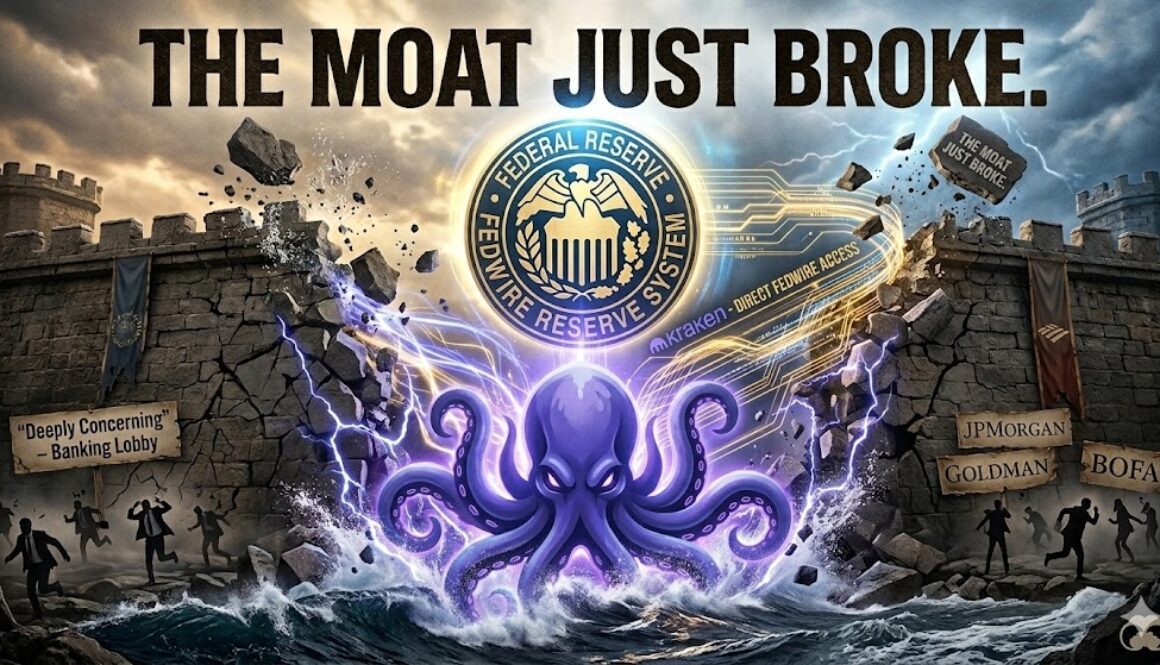
Kraken Gets a Federal Reserve Master Account.
Kraken Gets a Federal Reserve Master Account. Banks Are Panicking.
For the first time in US history, a crypto bank has direct access to the Federal Reserve’s core payment infrastructure. The banking lobby responded within hours — and their reaction tells you everything about what’s really at stake.
For decades, there was an invisible wall between crypto and real money. Not a regulatory wall. Not a technical wall. A plumbing wall. The Federal Reserve’s master account system — the pipes that move actual dollars between actual institutions — was sealed off from the crypto industry. You could build the best exchange in the world and still had to beg a bank to touch the rails.
That changed this week.
Kraken Financial became the first crypto bank in US history to receive a Federal Reserve master account, granting it direct access to the central bank’s core payment systems including Fedwire. The approval came from the Federal Reserve Bank of Kansas City and marks a historic milestone for an industry that has spent years fighting for legitimacy in the eyes of traditional finance.
What a Master Account Actually Means
Until now, Kraken relied on partner banks to move US dollars in and out of its platform. Every deposit and withdrawal passed through an intermediary — adding friction, cost, and counterparty risk. A Federal Reserve master account eliminates that dependency entirely.
With direct Fed access, Kraken can settle transactions itself through Fedwire, the real-time gross settlement system used by virtually every major financial institution in the United States. This means faster deposits and withdrawals for institutional clients, lower operational costs, and — critically — the credibility of operating as a directly connected participant in the US banking system rather than a peripheral player relying on others.
A Federal Reserve master account gives an institution direct access to the Fed’s payment services, including Fedwire for real-time settlement. It is considered essential infrastructure for operating as a bank nationally in the United States. Until this week, access was limited to federally insured depository institutions — traditional banks.
The account approved for Kraken Financial is a “limited purpose” or “skinny” master account — a restricted version that provides access to payment rails but excludes certain services available to traditional banks, such as interest on reserves held with the Fed or access to emergency lending facilities. The Federal Reserve has been developing this structure for non-traditional financial institutions.
The Banking Lobby Responded Within Hours
Within hours of Wednesday’s announcement, major banking trade groups released statements criticizing the decision. The reaction was swift, coordinated, and revealing.
We are deeply concerned that the Federal Reserve Bank of Kansas City has approved an account request before the Federal Reserve Board has finalized its policy framework for those accounts. This action ignores public comment and was issued with no transparency into the process for approval.
Bank Policy Institute — representing JPMorgan, Goldman Sachs, Wells Fargo & Bank of AmericaThe Independent Community Bankers of America echoed the concern, warning that granting crypto institutions access to master accounts “poses risks to the banking system.” The American Bankers Association questioned the timing, arguing regulators should complete rulemaking before granting such approvals.
What they didn’t say, but meant: we didn’t plan for this.
What Banks Are Actually Scared Of
The banking lobby’s objections are framed around process and risk — but the underlying fear is competitive. If Kraken can access the Fed’s settlement infrastructure, every crypto-native institution will apply next. The moat that has protected traditional banks from crypto competition — exclusive access to sovereign payment rails — has developed a crack for the first time.
Kraken Financial operates as a Wyoming Special Purpose Depository Institution, meaning it is not federally insured like traditional banks. Banking advocates argue this creates asymmetric risk: crypto firms gaining the benefits of Fed infrastructure without the same regulatory safeguards applied to conventional banks. It’s a legitimate concern — but it’s also the same argument that has been used to slow crypto’s institutional integration for years.
Trump Picks a Side
The Kraken approval doesn’t exist in a vacuum. This week, President Trump posted directly to the banking industry, accusing major banks of holding crypto legislation hostage while posting record profits.
Trump called out the GENIUS Act and Clarity Act by name — the two pieces of legislation that would establish federal frameworks for stablecoins and digital asset market structure respectively. He warned that without legislative progress, the crypto industry would migrate to China and other jurisdictions building friendlier infrastructure.
GENIUS Act — Establishes the first federal framework for stablecoin issuance in the United States. Banks have lobbied against provisions allowing stablecoin issuers to earn yield, which would threaten their deposit base.
Clarity Act — Defines which digital assets are commodities versus securities, the question that has paralyzed institutional adoption for years. Both bills remain stalled as banks and the crypto industry negotiate terms.
The sitting president is publicly pressuring the banking lobby in real time, on social media, over crypto legislation. That is not a background policy position. It is a direct political signal with market consequences.
What It Means Going Forward
The Kraken approval is a precedent. If upheld, it opens the door for other crypto-native institutions to seek similar Fed access. The Federal Reserve is still finalizing its framework for skinny master accounts — Governor Christopher Waller indicated the structure could roll out broadly later this year.
The institutions that spent ten years calling this industry illegitimate are now watching it connect directly to the central bank. The legislative window is open. The only question is whether Congress moves before the momentum does.
Crypto’s payment infrastructure is no longer peripheral. It just became sovereign.