The Real $TRUMP Story: Mar-a-Lago’s Most Exclusive Con
The Real $TRUMP Story:
Mar-a-Lago’s Most Exclusive Con
A sitting U.S. President hosted top buyers of his personal meme coin for a “conference” inside his private club — while the coin cratered 95%. Here’s what actually happened inside.
On the morning of Saturday, April 25, 2026, limousines rolled through the gates of Mar-a-Lago, Donald Trump’s private Palm Beach club, ferrying an unusual guest list: not heads of state or Cabinet members, but the world’s largest holders of a meme coin bearing the president’s own name. They had paid — through token purchases, branded sneakers, watches and fragrances — for the right to be in the same room as the most powerful person on Earth. What they got was a 45-minute keynote, a gala steak lunch, and a champagne toast. What they didn’t get was a coin worth anywhere near what they paid.
The Setup: Access for Sale
The event was organised by Fight Fight Fight LLC, the issuer of the $TRUMP memecoin and a company run by Bill Zanker, a longtime Trump promoter. Zanker opened the conference before legendary boxer and celebrity Mike Tyson took the stage to warm up the crowd. The conference’s own marketing described it, without apparent irony, as “the most exclusive crypto & business conference in the world.”
Admission was not purchased with a ticket. Instead, rankings were determined by the amount of $TRUMP tokens held, combined with purchases of Trump-branded merchandise — sneakers, watches and fragrances — made between March 12 and April 14. The top 297 qualifying holders attended the full conference and gala luncheon. The top 29 earnt a private reception and champagne toast with the president himself, though one attendee noted Trump’s appearance at the reception was brief.
“From the top of mind, he didn’t mention his memecoin a single time.”
— Morten Christensen, attendee and founder of AirdropAlert.com, speaking to BloombergThe Speakers: A Who’s Who of Crypto Finance
The day-long programme positioned itself as a serious finance and technology forum. Tether CEO Paolo Ardoino, Ark Invest founder Cathie Wood, and Anchorage Digital CEO Nathan McCauley joined panels on topics ranging from financial inclusion and the role of the U.S. dollar to the intersection of artificial intelligence and blockchain. Traditional finance heavyweights Tim Draper and Grant Cardone also appeared on stage, as did self-help author Tony Robbins and investor Anthony Pompliano of ProCap Financial.
Conference Speaker Lineup
- Bill Zanker — Co-founder, TRUMP memecoin / Fight Fight Fight LLC (Opening)
- Mike Tyson — Celebrity speaker
- Paolo Ardoino — CEO, Tether
- Cathie Wood — Founder & CEO, Ark Invest
- Nathan McCauley — CEO, Anchorage Digital
- Tim Draper — Venture capitalist, Draper Associates
- Grant Cardone — Investor and entrepreneur
- Tony Robbins — Author and motivational speaker
- Anthony Pompliano — Founder, ProCap Financial
- President Donald J. Trump — Keynote speaker
Trump’s Keynote: Crypto Is Mainstream — Banks, Back Off
The day’s centrepiece was Trump’s 45-minute keynote address, delivered to an audience of his own token’s biggest investors. While he did not mention the $TRUMP coin itself during the speech, he used the platform to make two significant policy statements that echoed well beyond the ballroom walls.
First, Trump declared the crypto industry mainstream, calling the crowd “some of the most successful people in the world.” He notably softened one of his signature lines, stopping short of his previous claim that the U.S. would become “the crypto capital of the world,” instead saying: “The crypto industry was created in America, its growth has been led by America, and its future will be made in America and other countries.”
Second, and more consequentially for legislative watchers, Trump made a direct pledge: he would not allow banks to derail the Digital Asset Market Clarity Act — commonly known as the Clarity Act — which represents the crypto industry’s primary legislative goal. The bill, designed to establish a regulatory framework for digital assets in the U.S., has been stalled in the Senate after banking lobby groups raised concerns that stablecoin interest-bearing products could threaten traditional bank deposit accounts. Trump told attendees the White House would not allow that opposition to sink the bill.
“The crypto industry was created in America, its growth has been led by America, and its future will be made in America and other countries.”
— President Donald Trump, keynote address, Mar-a-Lago, April 25, 2026The speech also strayed into other topics: artificial intelligence, ongoing tensions around the Iran conflict, and — in a moment that drew audible amusement — Trump-branded sneakers. Minutes before taking the podium, the White House had cancelled U.S. envoys’ planned trip to Pakistan related to Iran peace talks, underscoring the surreal nature of the event.
The Numbers Don’t Lie: A Coin in Freefall
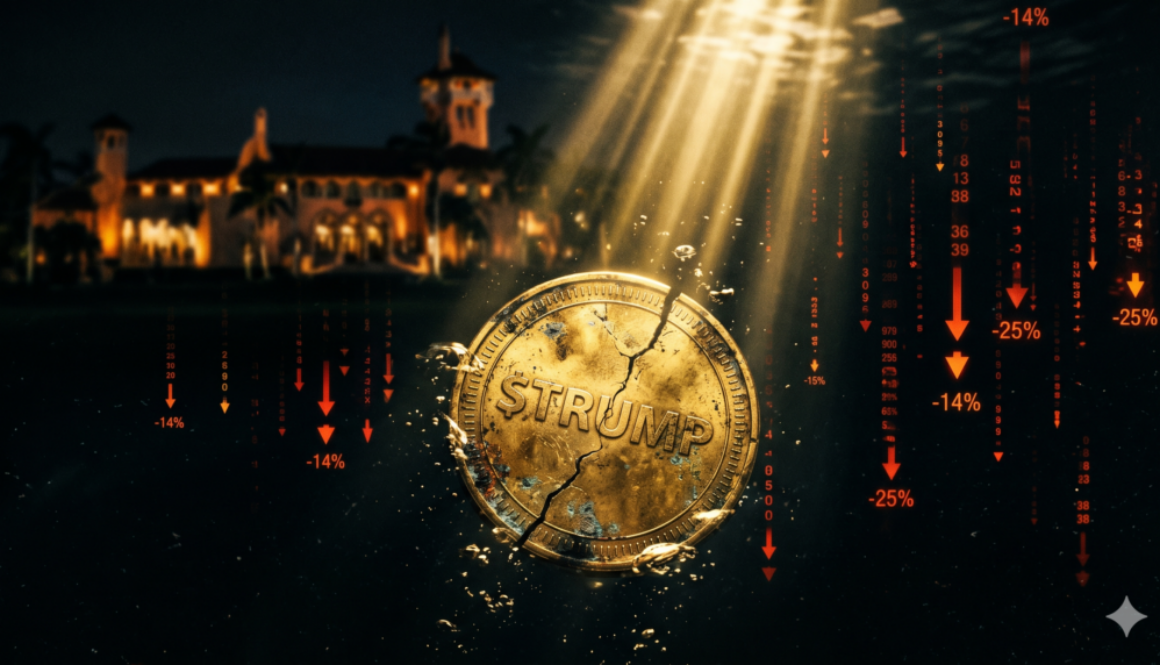
Whatever goodwill Trump’s words generated was not reflected in the token’s price. The $TRUMP coin fell 14% on the day of the conference itself, a stark illustration of the disconnect between political theatre and market fundamentals.
When the coin launched around Trump’s second inauguration in January 2025, it peaked at $75 per token. By the time attendees arrived in Palm Beach, it was trading near $2.81 — an approximate 96% decline. The cumulative holdings of all 297 conference winners stood at just $29 million according to crypto analytics firm Nansen, compared to the $148 million held by contest participants at the inaugural 2025 event held at Trump’s Washington-area golf club.
A Nansen analysis prepared for Reuters put it bluntly: “The contrast with last year’s launch is stark. When it was launched, buyers accumulated and held the token, helping fuel a sustained rally. The 2026 contest generated a moment of activity, but not the same conviction we saw in 2025. Demand just isn’t sticking.”
$1 Billion and Counting: The Family Business
The event’s ethics critics point to one number above all others. A Reuters examination found that the Trump family and affiliated entities have taken in more than $1 billion from crypto asset sales since Trump’s return to office, including at least $336 million tied specifically to meme-coin sales in the first half of 2025 alone — with potentially billions more in unrealised gains still on the table.
Among the top $TRUMP token wallets identified through blockchain analysis is one linked to crypto billionaire Justin Sun, who finished first in the contest for the second consecutive year. In a notable twist, Sun sued World Liberty Financial — the Trump family’s most lucrative crypto venture, of which he is one of the largest known investors — just days before the conference, alleging the company had frozen his holdings.
The White House has consistently defended the arrangement. Spokesperson Anna Kelly told Reuters: “President Trump’s assets are in a trust managed by his children. There are no conflicts of interest.” Government ethics experts have repeatedly challenged that framing, noting the situation has little modern precedent for a sitting president.
What’s Next: The Trump Billionaires Club & New Ventures
Fight Fight Fight used the conference to announce two new ventures. The first is the “Trump Billionaires Club” game — a mobile title in which players grow their empire by acquiring businesses and digital collectibles using $TRUMP coin. Originally expected by end of December 2025, the game is now slated for a May 2026 launch. The second is “$Trump Coin Club” — billed as an invitation-only membership offering luxury sporting event suites, private dinners and exclusive experiences.
Meanwhile, Democratic leaders have called for formal investigations into the Trump family’s crypto activities. The convergence of presidential authority, active legislation over the industry being discussed, and direct personal financial benefit from that same industry has intensified scrutiny from both government ethics watchdogs and lawmakers on both sides of the aisle.
The Bottom Line
What took place at Mar-a-Lago on April 25 was, on the surface, a private crypto conference with a world-class speaker list, steak and seafood, and Trump-branded swag sent home with guests. Beneath the surface, it was something considerably more complex: a sitting president of the United States charging access — not in dollars, but in purchases of his own branded token and merchandise — for a seat in his presence. The coin they bought to be there lost 14% in value on the very day they arrived.
For retail investors who piled into $TRUMP near its launch, the story is mostly one of deep losses. For the Trump family, a Reuters examination suggests the story is one of extraordinary gain. Whether that duality constitutes a conflict of interest — or simply an unprecedented new model for political brand monetisation — remains a question that Congress, the courts, and history will ultimately have to answer.