
Jeff Bezos dismisses AI job fears, predicts labor shortage as workers brace for automation
Jeff Bezos and other tech leaders are publicly dismissing AI job displacement fears, but federal labor data reveals a more complex reality: while mass unemployment hasn’t materialized, hiring has collapsed in junior roles and AI-linked layoffs are accelerating. For institutional investors, this divergence between executive optimism and measurable workforce contraction signals execution risk in tech sector valuations and potential regulatory pressure on automation spending.
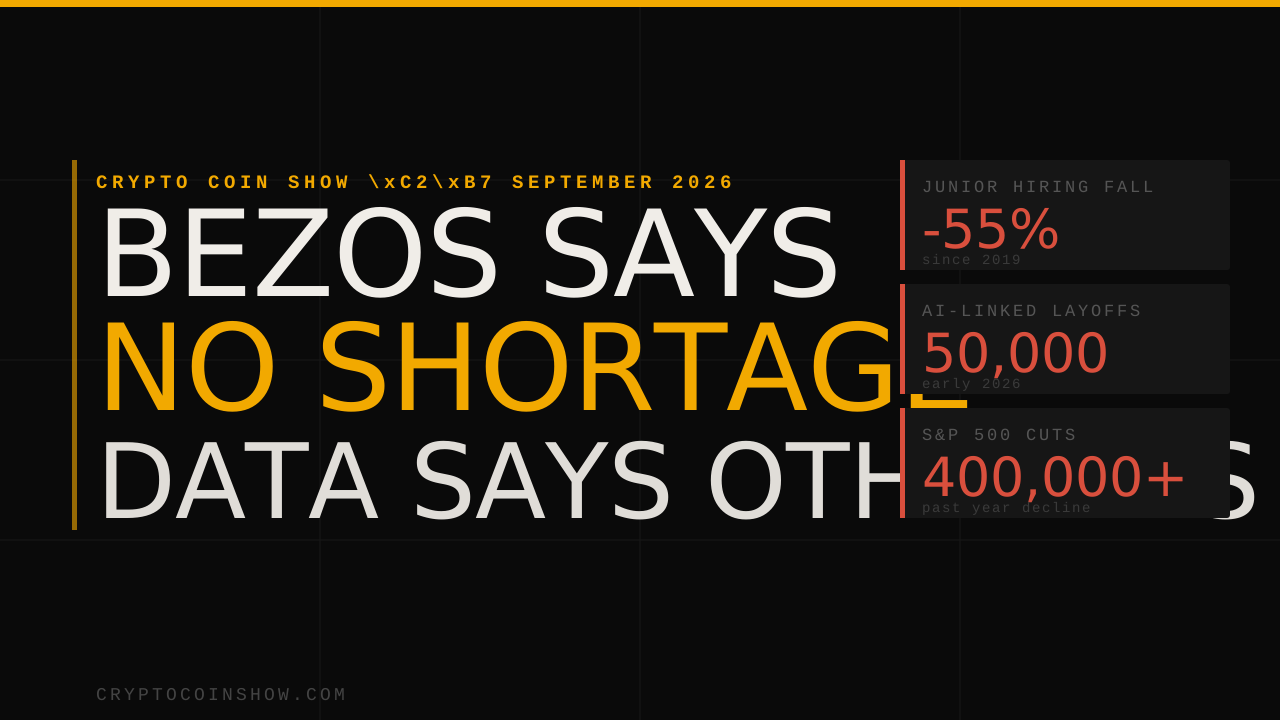
- Junior developer hiring fell 55% since 2019, signaling structural damage to entry-level labor markets despite overall employment stability
- S&P 500 companies cut 400,000+ roles in the past year, the first annual decline since 2016, while AI-linked layoffs reached 50,000 in early 2026 alone
- Goldman Sachs estimates AI suppressed U.S. payroll growth by 16,000 jobs monthly over the past year, concentrated in junior and support positions
- 55% Decline in junior developer job hiring since 2019 versus baseline
- 400,000 S&P 500 employment reduction in past year, first annual cut since 2016
- 16,000 Monthly AI-driven U.S. payroll suppression per Goldman Sachs estimate
Jeff Bezos recently claimed that artificial intelligence will create labor scarcity rather than displacement, arguing that productivity gains will ultimately benefit workers and raise global living standards. His position echoes a growing chorus of technology executives who are pushing back against warnings from figures like OpenAI’s Sam Altman about mass job displacement.
Yet the gap between this narrative and labor market reality is widening. Federal data, corporate layoff announcements, and hiring trends tell a story of concentrated, measurable workforce damage that contradicts the optimistic framing from tech leadership.
The disconnect is most visible in the entry-level job market. Junior developer positions, a traditional pipeline for tech talent, have contracted 55% since 2019, a sharper decline than the broader labor market has experienced.
This is not cyclical weakness tied to broader economic conditions; it reflects a structural shift in hiring priorities as companies deploy AI tools to handle tasks previously assigned to early-career employees.
S&P 500 Companies Post First Annual Employment Decline Since 2016
Large corporations have begun cutting headcount at scale. S&P 500 companies shed more than 400,000 roles over the past year, marking the first annual employment decline since 2016. This reduction occurred against a backdrop of steady GDP growth and record corporate profits, eliminating the usual economic rationale for workforce contraction.
The timing is instructive: the acceleration coincides directly with widespread corporate AI adoption following ChatGPT’s launch in late 2022.
The impact is increasingly visible in AI-specific layoff announcements. Challenger, Gray & Christmas, a leading outplacement firm, has tracked nearly 50,000 job cuts explicitly linked to AI implementation by American companies in the first weeks of 2026 alone, representing roughly 17% of all layoffs disclosed during that period.
Goldman Sachs research offers a quantified measure of the broader effect: AI deployment has suppressed U.S. payroll growth by approximately 16,000 jobs per month over the past twelve months.
Columbia Business School professor Daniel Keum has identified the mechanism: the damage is not occurring through mass terminations but through a deliberate reduction in hiring, particularly for junior positions. Companies are deploying AI tools to automate tasks historically performed by entry-level and support staff, eliminating the need to hire replacements as those roles naturally turn over.
One in Four American Workers Now Use Generative AI on the Job
Adoption of AI tools in the workplace has accelerated rapidly. The Federal Reserve’s 2025 household survey found that roughly one in four American workers now use generative AI on the job, and 81% of those users report that it saves them time.
Census Bureau data shows that about 18% of firms had adopted AI by the end of 2025, but the Federal Reserve estimates that 78% of the labor force works at companies that have deployed the technology, indicating that AI infrastructure is spreading faster than formal adoption metrics capture.
This rapid deployment has not triggered the broad-based job apocalypse that some tech leaders predicted. Sam Altman, OpenAI’s CEO, has acknowledged that he was “pretty wrong” about the social and economic consequences of AI, citing a personal experiment in which he allowed an AI system to manage his Slack and email messages.
That exercise reportedly convinced him that people still place high value on authentic human interaction, shifting his views on the scale of displacement.
Yet even as Altman recalibrated his public stance, Meta began cutting approximately 8,000 staff positions in the same week, explicitly tying the restructuring to AI investment priorities. The pattern, executives minimizing displacement risk while simultaneously accelerating automation, reflects competing incentives within the tech sector itself.
Automation Risk Disproportionately Threatens Women and Junior Workforce Globally
The International Labor Organization estimates that 75 million jobs worldwide face meaningful automation risk from generative AI, with that risk concentrated in specific demographic groups. In high-income countries alone, approximately 30 million positions, representing a 5.1% share of those labor markets, face displacement from AI automation.
Women face 2.5 times the automation risk of men according to ILO research, meaning gender-based job market inequality may deepen as AI deployment accelerates.
This uneven impact creates a fundamental problem for junior workers and recent graduates entering the labor market. The traditional pathway, starting in entry-level positions, gaining experience, and advancing to mid-career roles, is contracting precisely at the entry point.
With junior developer hiring down 55% since 2019 and AI-linked job cuts concentrated in support and administrative functions, young workers face limited opportunities to accumulate the human capital and network effects that historically led to career progression.
For institutional investors, this dynamic carries material implications. Tech sector valuations have incorporated assumptions about sustained productivity growth and margin expansion from AI deployment.
However, if that productivity comes at the cost of reduced hiring, compressed wage growth for entry-level talent, and regulatory scrutiny over automation-driven displacement, the realized financial benefits may diverge materially from current consensus estimates.
Regional labor markets dependent on tech employment, particularly in high-income countries, may also face demand shock as automation reduces hiring velocity.
The core question facing investors is whether tech executives will maintain their current deployment pace if regulatory pressure mounts. The U.S. Congress has begun examining AI labor market effects; the Senate Judiciary Committee has already requested testimony from major tech firms about automation-driven workforce reductions. If policymakers conclude that AI-driven hiring reductions warrant restrictions or labor standards, the implementation timeline and compliance costs could materially alter the ROI calculations that have justified aggressive AI capital spending. Watch for Congressional hearings scheduled in Q2 2026 and any proposed legislation explicitly linking AI deployment to minimum hiring thresholds or severance obligations.