
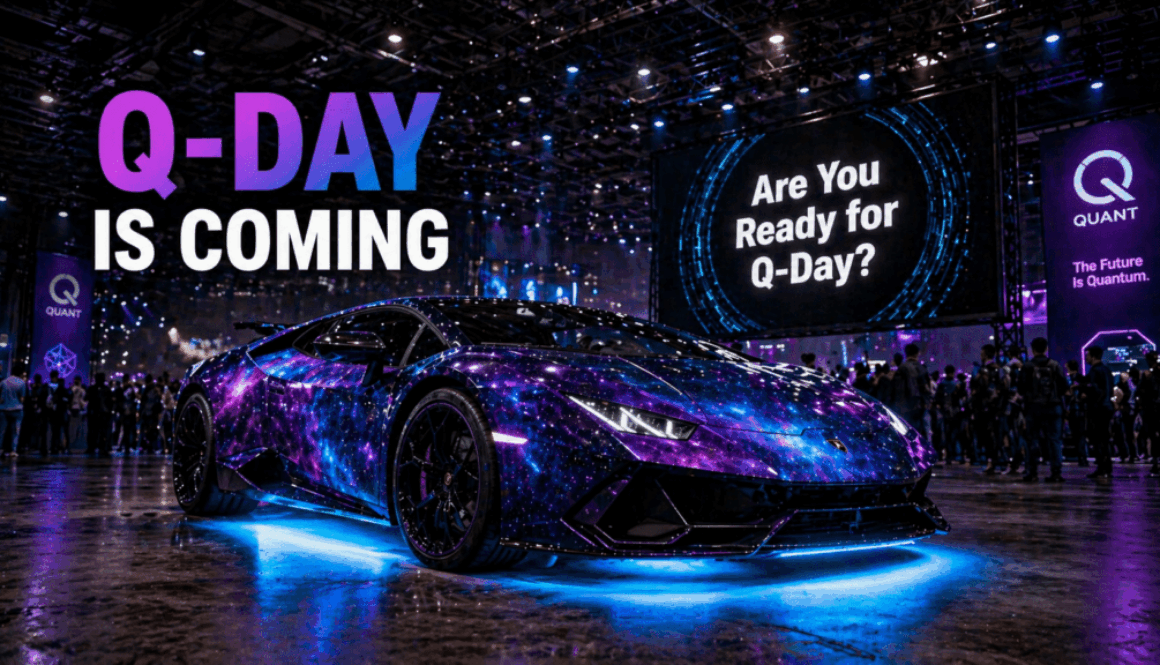
Q-Day Is Coming. Your Wallet Is Already Being Targeted.
Q-Day Is Coming.
Your Wallet Is Already
Being Targeted.
In a candid conversation at Bitcoin 2026, Krown Technologies CEO James Stephens warned that quantum computers may be capable of cracking Bitcoin wallet keys by 2027 — and the harvest of public keys has already begun.
The Threat Landscape
Seated inside a galaxy-wrapped Lamborghini on the floor of Bitcoin 2026 in Las Vegas — the same car bearing the words “Wen Lambo?” and “Are You Ready for Q-Day?” on the booth behind it — James Stephens didn’t mince words. “We are in the harvest now, decrypt later timeframe,” he said. “They’ve already started harvesting these public keys — and they’ll decrypt them later.” The remark, delivered with the calm of someone who has been sounding this alarm since 2022, lands differently now that quantum computing milestones are arriving ahead of schedule.
Stephens cited a cascade of recent developments that have compressed the timeline. NIST, the U.S. standards body, has moved its post-quantum cryptography deadline from 2040, to 2035, and now to 2030. Google recently announced that cracking classical encryption requires 20 times fewer qubits than previously estimated on a quantum computer. And most tellingly, a cryptographic key tied to a Bitcoin wallet — however small — has already been broken. “Every time we find out something new it seems to be every single week,” Stephens said, “and every time there are these aha moments, everything moves up.”
His personal timeline estimate: a first major breach event by 2027 or 2028. That is not a distant horizon. It is months away. And the complacency Stephens sees across the industry — in teams, in companies, in the broader conversation — may prove to be the most dangerous vulnerability of all. “Complacency on these teams and in these companies,” he said flatly, “are the real threat and the real killer.”
“Q-Day is not going to arrive on some horse with a trumpet sounding. It’s going to happen quietly. It’s going to happen lethally — and it will be everywhere.”— James Stephens, CEO, Krown Technologies
A Founder Forged by Fraud
Stephens didn’t arrive at this mission from a research lab or a government agency. He arrived through personal loss. Nearly a decade ago, he was scammed, hacked, and defrauded in the crypto space — the full spectrum of threats that plague digital asset holders today. That experience became the catalyst for Krown Technologies, and for Qastle. “I looked at the threats. I knew what they were. I saw what was not being addressed,” he said. Back in 2022 and 2023, when he was already talking about quantum vulnerabilities, the response was polite but dismissive. “People would pat you on the back and say, that’s great, keep it up.” Now, he said, the phone doesn’t stop ringing.
What Gets Attacked — And How
A crucial distinction Stephens draws: the Bitcoin protocol itself is not the primary target. The vulnerability lives at the wallet level — specifically in the cryptographic keys that prove ownership of funds. Current wallet security relies on the assumption that deriving a private key from a public key is computationally infeasible. Quantum computing, at sufficient scale, invalidates that assumption entirely.
Hardware wallets, long considered the gold standard of Bitcoin security, offer no meaningful protection in a post-quantum world. “I have people who had cold wallets and they actually put theirs on Qastle,” Stephens noted, referring to Krown’s flagship quantum-resistant wallet. “The level of protection is cold-wallet level — even though we are a hot wallet.” For holders reluctant to move assets they haven’t touched in a decade, Stephens is sympathetic but direct: the threat doesn’t care how long you’ve held.
The Qastle Approach: Fighting Quantum with Quantum
Krown Technologies’ answer to the quantum threat is their Qastle wallet, built from the ground up with post-quantum cryptography. At its core is a partnership with Quantum Emotion, which provides Quantum Random Number Generation (QRNG) — what Stephens distinguishes as true entropy, as opposed to the pseudo-randomness used by most existing “quantum-resistant” solutions. The technology has been validated through IBM’s Qiskit framework using electron tunneling. The principle, as Stephens frames it: fight quantum with quantum.
Beyond the QRNG layer, Qastle stacks over six different post-quantum cryptographic algorithms (PQCs), each deployed where it performs best — whether for lattice-based signatures or key encapsulation. Stephens describes it as a layered defense: “however it sits, the QRNG on the keys and everything sits where it’s most powerful in defense.”
Users can bridge and swap assets without ever leaving the Qastle environment — covering Bitcoin, Ethereum, Solana, Base, and the Krown network natively — removing the need to expose keys on external DEXes or centralized exchanges. The philosophy is total containment: keep people protected by keeping them inside a secured perimeter.
The Camelot Ecosystem
Qastle is one organ in a larger body. Stephens describes Krown’s broader product vision using a medical analogy: imagine the Krown network as the human body, and every product in the ecosystem — Qastle, Excalibur, and what’s still to come — as the organs running inside it, all self-sustaining, all secured under the same chain. He calls this ecosystem Camelot. “We’re slowly putting all the organs into place under the chain,” he said. The roadmap is deliberate, not rushed — each piece added only when it can be executed without sacrificing innovation or standards.
Beyond the Wallet: Social Engineering and DeFi
Quantum attacks are not the only front. Stephens flagged social engineering — the human manipulation tactics that fuel billions of dollars in crypto fraud every year — as a parallel battle Krown is preparing to fight. He teased a forthcoming announcement targeting this threat specifically, calling scammers “the scum of the earth” and framing their defeat as a personal mission. With a string of high-profile DeFi hacks and protocol vulnerabilities marking the early months of 2026, the timing couldn’t feel more urgent.
Krown also plans to extend quantum protection to decentralized applications (DApps), either directly or through a licensing model, allowing the broader DeFi ecosystem to shelter under the same cryptographic umbrella as Qastle users.
What’s Coming Next
Stephens revealed a major product announcement ahead of his Tuesday keynote at the Genesis Stage: Excalibur, a dedicated quantum cold wallet currently in prototyping. It is designed for holders who want the physical reassurance of hardware storage without sacrificing post-quantum protection — the best of both worlds, delivered under the Camelot banner.
On the partnership front, Krown has locked in a six-year deal with the Bitcoin Conference series — including as title sponsor of the Miami event — and a matching six-year agreement with Canada’s Futurist Conference in Toronto, positioning Qastle as the official quantum wallet of both events. A five-year exclusive arrangement with Quantum Emotion means no competing quantum wallet products can reach this sector without going through Krown. As quantum headlines multiply over the coming years, attendees at every major Bitcoin event will see Qastle front and center. That, Stephens says, was always the plan.
How to Get Protected Now
Qastle is available today on the App Store and Google Play. Users can sign up and begin storing assets immediately, with Bitcoin, Ethereum, Solana, Base, and the Krown network supported natively from the main screen. Subscription options include monthly and annual plans, with two months free on the annual tier. Once inside Qastle, assets are protected at rest — no further action required. The message from Stephens is simple: don’t wait to be one of the people who wakes up and wishes they had moved sooner.