Franklin Templeton completed its acquisition of 250 Digital on June 22, 2026, formally launching Franklin Crypto as its dedicated active digital asset management division.
The $1.78 trillion asset manager is integrating crypto-native active strategies with its institutional infrastructure to meet growing demand from large investors.
Franklin Templeton will invest capital directly into these strategies.
This closes the transaction announced on April 1, 2026. The move underscores Franklin Templeton’s multi-year commitment to digital assets, building on its early experiments with blockchain infrastructure since 2018, including launching one of the first U.S. registered funds to use public blockchains for transactions and share ownership.
Leadership Team Anchors New Division
Christopher Perkins serves as Head of Franklin Crypto, with Seth Ginns as Chief Investment Officer. They partner with Franklin Templeton Digital Assets veteran Tony Pecore. The division reports to Sandy Kaul, Head of Innovation.
“This is an exciting addition for Franklin Templeton, and we’re pleased to welcome Chris, Seth and the 250 Digital team to our firm. Together, their investment talent and differentiated strategies strengthen our capabilities in digital assets and position us among a small group of global asset managers with a dedicated, institutional-grade crypto investment management team.”
Institutional Scale Meets Active Crypto Capabilities
Franklin Templeton reported $1.78 trillion in assets under management as of May 31, 2026.
Franklin Crypto builds directly on the firm’s existing dedicated digital asset unit, which focuses on fundamental research, active portfolio construction, and institutional-grade risk oversight.
The new division targets institutional clients seeking actively managed cryptocurrency exposure within a regulated, globally distributed framework.
It combines specialized crypto execution with Franklin Templeton’s established infrastructure and client base.
Franklin Crypto will roll out actively managed cryptocurrency strategies to institutional investors worldwide.
The integration positions the firm to capture demand for sophisticated digital asset solutions as institutions allocate more capital to the asset class through established managers.
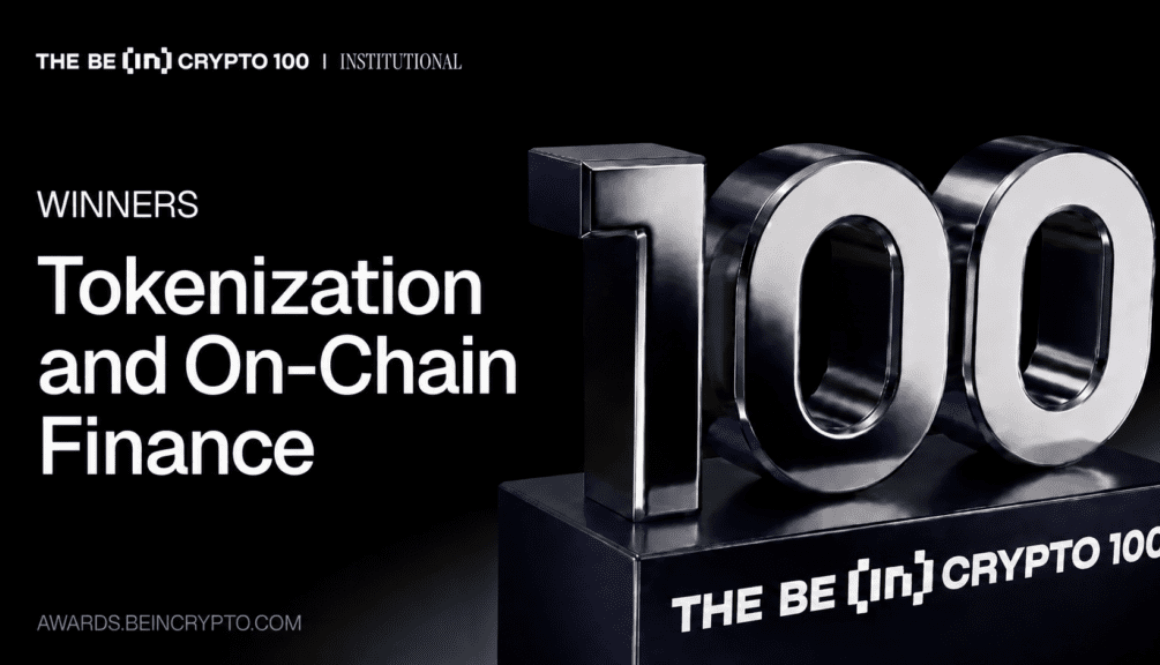
The BeInCrypto Institutional 100 Awards 2026 enters its final stage with the Tokenization & On-Chain Finance pillar narrowed to 16 shortlisted firms across four categories.
This pillar focuses on the firms building the regulated infrastructure for tokenized real-world assets, on-chain settlement, stablecoin payments, and autonomous agent payments.
The winners were announced at Proof of Talk in Paris on June 2, 2026. The firms listed below are alphabetized within each category. They are not ranked.
Welcome to the BeInCrypto x @ProofOfTalk Institutional 100 Awards, live from the iconic Louvre Palace in Paris.
Tonight we recognize the institutions and leaders shaping the future of digital asset finance across 25 categories.
This category recognizes platforms bringing regulated securities, money market funds, real estate, and private credit on-chain at institutional scale.
Shortlisted Firm
Why It Made the Shortlist
Apex Group
Apex Group, which services $3.5 trillion in assets, operates Tokeny. In March 2026, Tokeny launched the T-REX Ledger on Polygon as a multi-chain orchestration layer for ERC-3643 assets. The platform has set a $100 billion tokenization target by June 2027.
Figure
Figure listed on Nasdaq under FIGR in September 2025. The company has originated more than $20 billion in loans on Provenance Blockchain. In early 2026, it also launched the On-Chain Public Equity network and tokenized FIGR stock.
Franklin Templeton
Franklin Templeton’s BENJI tokenized money market fund suite crossed $1.98 billion in AUM by April 2026. The fund is now deployed across more than eight public blockchains, giving it the broadest chain coverage among institutional tokenized funds.
Securitize
Securitize held its position as the largest tokenization platform by AUM. It posted record Q1 2026 revenue of $19.5 million and powers BlackRock’s BUIDL, which now holds more than $3 billion in assets. The firm also has a $1.25 billion SPAC merger with Cantor Equity Partners II in progress.
Best On-Chain Finance Infrastructure
This category recognizes the infrastructure firms providing the cross-chain, deposit-token, wallet, and settlement layers that make institutional on-chain finance work.
Shortlisted Firm
Why It Made the Shortlist
BitGo
BitGo became the first crypto-native infrastructure firm to list on the NYSE, trading under BTGO in January 2026. The company raised $212.8 million at a $2.08 billion valuation and supports roughly $104 billion in assets across wallet, custody, and settlement services.
Chainlink
Chainlink CCIP secures $33.6 billion across more than 60 blockchains. Its SWIFT integration creates a path for more than 11,000 banks to access on-chain finance. Chainlink also has major institutional partnerships with UBS, Mastercard, DTCC, and Euroclear.
J.P. Morgan
Through Kinexys, J.P. Morgan brought JPM Coin, now JPMD, to public blockchains. The rollout included Base in 2025 and Canton Network in January 2026. The bank is also working on tokenized-deposit interoperability with DBS.
Privy
Stripe acquired Privy in June 2025 to expand its on-chain infrastructure stack. Privy’s embedded wallet API now powers more than 75 million accounts across 1,000-plus developer teams, including Hyperliquid, OpenSea, and Farcaster.
Best Stablecoin Infrastructure
This category recognizes firms powering the issuance, distribution, and settlement of regulated stablecoins across crypto markets, B2B payments, and global card networks.
Shortlisted Firm
Why It Made the Shortlist
Circle
Circle issues USDC, the second-largest stablecoin globally. USDC circulation rose to $75.3 billion by Q4 2025, while Circle reported $1.25 billion in H1 2026 revenue after its June 2025 NYSE IPO and the passage of the federal GENIUS Act.
Mastercard
Mastercard’s Multi-Token Network supports USDC, EURC, USDG, PYUSD, FIUSD, and SoFiUSD. Its March 2026 partnership with SoFi made SoFiUSD the first stablecoin issued by a US nationally chartered bank on a public blockchain.
Paxos
Paxos issues USDG, PYUSD, USDP, and PAXG. USDG supply reached roughly $2.75 billion by May 2026 through the Global Dollar Network, which shares reserve revenue with distribution partners. Paxos operates under MAS, MiCA, and NYDFS oversight.
Visa
Visa’s stablecoin settlement volume reached a $7 billion annualized run rate by April 2026. The network expanded to nine blockchains and supports USDC settlement for US issuers and acquirers through Cross River Bank and Lead Bank.
Best Autonomous Agentic Payments Platform
This category recognizes platforms building production payment rails for autonomous AI agents. These systems use stablecoins and open standards such as x402 to settle machine-to-machine transactions.
Shortlisted Firm
Why It Made the Shortlist
Circle
USDC anchors major agentic payment systems across Coinbase’s x402 network and Solana’s Pay.sh. Circle is also building Arc, a Layer 1 blockchain designed for stablecoin settlement and agentic commerce.
Coinbase
Coinbase launched Agent.market in April 2026 on the x402 protocol. The network already has more than 69,000 active AI agents settling over 165 million transactions worth $50 million in USDC, mainly on Base.
Mesh
Mesh reached a $1 billion valuation after a $75 million Series C in January 2026. Its AI Wallet allows agents to transact across more than 300 wallets and exchanges. Stellar and Tempo were added as settlement layers in May 2026.
Solana
The Solana Foundation launched Pay.sh with Google Cloud in May 2026. The open-source agentic payment gateway uses x402 and stablecoins on Solana. The network processed roughly $650 billion in stablecoin volume in February 2026.
About the BeInCrypto Institutional 100
The BeInCrypto Institutional 100 is an annual research program covering 25 categories across six pillars: Capital Markets & Infrastructure, Access to Digital Assets, Tokenization & On-Chain Finance, Enterprise Blockchain, Regulation & Governance, and Retail to Crypto Bridge.
The 2026 evaluation window ran from April 2025 through March 2026.
Shortlists were selected through BeInCrypto’s editorial research methodology and blind scoring by an external panel of institutional digital asset practitioners.
Each category follows one of three scoring tracks, depending on the data profile of the market. Public filings, regulatory registers, audited reports, on-chain data, ETF flow trackers, and nominee disclosure forms were used where available.
Final blended scores are not published. Inclusion on the shortlist reflects the combined outcome of research and judge review.