
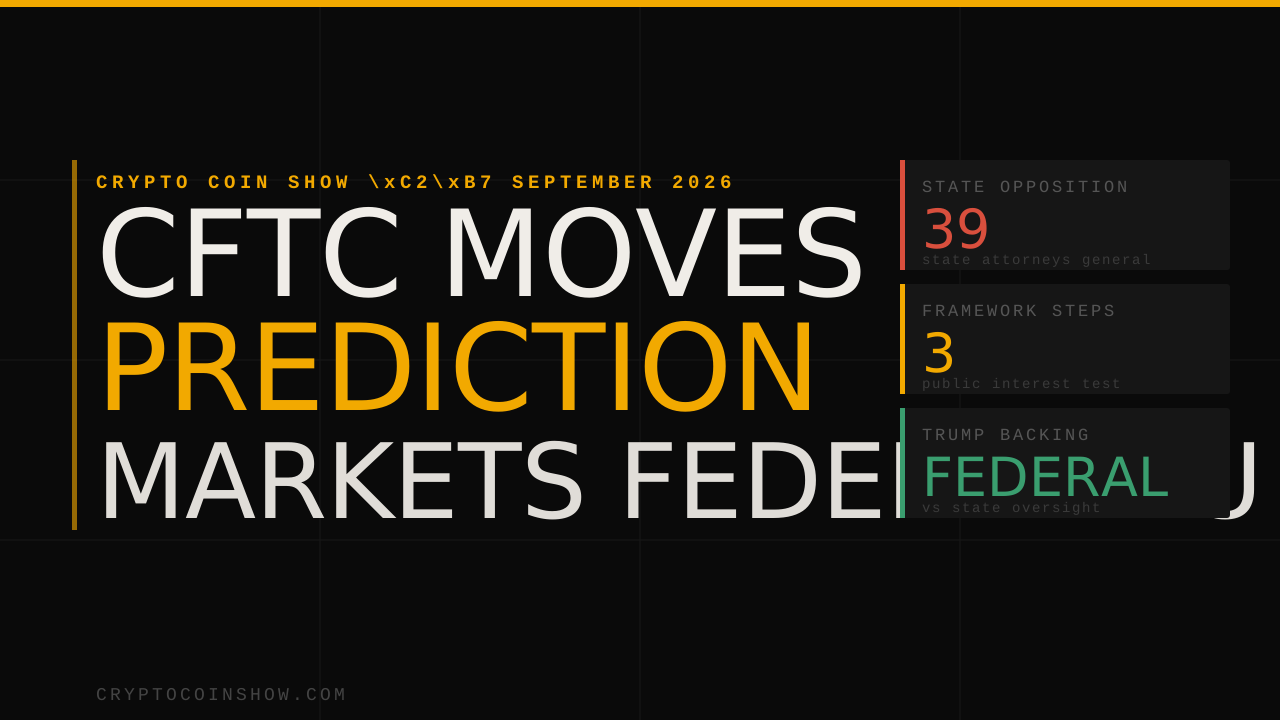
CFTC proposes first prediction market rules as Trump backs federal oversight over states
The CFTC has unveiled its first formal regulatory framework for prediction markets, establishing a three-step test to determine which event contracts serve the public interest, a move that directly challenges state-level gambling enforcement and resolves a core question for institutional platforms seeking federal legitimacy. President Trump’s backing of exclusive federal oversight has intensified a legal conflict with 39 state attorneys general, making this framework a watershed moment for the industry’s regulatory architecture.
- CFTC proposes three-step test banning contracts tied to terrorism, assassination, war, gaming, and unlawful conduct
- President Trump stated federal CFTC oversight is “critically important,” directly opposing 39 state attorneys general
- Framework includes 45-day public comment period, then 60-day implementation window after final adoption
- 39 State attorneys general have filed opposition to federal prediction market oversight
- 45 Days allocated for public comment on the CFTC’s proposed regulatory framework
- 60 Days after final adoption before the CFTC rule becomes officially effective
On June 10, 2026, the Commodity Futures Trading Commission formally proposed the first comprehensive framework for regulating prediction markets, establishing clear criteria for which event contracts can operate legally under federal law.
The proposal centers on Section 5c(c)(5)(C) of the Commodity Exchange Act and introduces a transparent three-step test that will govern contract approval going forward.
The timing is significant: this framework arrives amid an accelerating legal battle between federal regulators and state authorities over jurisdiction, with President Trump recently declaring that CFTC oversight must remain exclusive to preserve market integrity.
For institutional investors and platform operators, the framework’s flexibility represents both opportunity and ambiguity. Rather than imposing rigid categorical bans, the CFTC is adopting a “balancing test” that weighs factors such as hedging utility, price discovery benefits, and the risk of encouraging illegal activity.
This approach signals that the agency intends to allow sophisticated trading venues to operate while maintaining safeguards against contracts that directly facilitate unlawful conduct.
CFTC Chairman Selig Announces Three-Step Test Banning Terrorism, Assassination, and War Contracts
Michael Selig, who serves as both CFTC chairman and the commission’s sole sitting member on what should be a five-member panel, unveiled the proposed framework in a statement emphasizing its transparency and durability.
The three-step test asks whether a contract references a real or potential event, whether it falls into a restricted category, and whether the contract contradicts the public interest.
Contracts explicitly prohibited include those tied to terrorism, assassination, war, gaming activities, and unlawful conduct, categories that broadly track existing restrictions but now operate under a cohesive analytical framework.
The proposal offers “a durable, transparent framework to identify the contracts Congress directed us to scrutinize while letting legitimate markets move forward.”
Michael Selig, CFTC Chairman
The framework’s practical application hinges on distinguishing between contracts that reference conflict as their settlement trigger versus those merely correlated with geopolitical events. A contract based on crude oil transport through the Strait of Hormuz, for instance, would pass scrutiny because settlement depends on commercial activity rather than the occurrence of war or terrorism itself.
This distinction is critical: it allows hedging and price-discovery contracts to operate while blocking those designed to profit directly from illegal acts or catastrophic events.
The balancing test’s flexibility reflects institutional market realities. Different prediction market applications, from election forecasting to commodity price hedging, generate distinct public-interest arguments. By avoiding one-size-fits-all rules, the CFTC creates space for legitimate platforms to demonstrate compliance while retaining enforcement discretion against bad actors.
This approach contrasts sharply with state-level gambling prohibitions, which typically apply blunt restrictions regardless of underlying contract sophistication or risk-management value.
Trump Administration Backs Federal Authority Against 39 State Attorneys General
President Trump’s recent statement that federal CFTC oversight is “critically important” has transformed the regulatory standoff from a technical debate into an explicitly political jurisdictional conflict.
His position directly contradicts the coalition of 39 state attorneys general, led by Nevada Attorney General Aaron Ford and Ohio Attorney General Dave Yost, who have filed opposition to federal preemption of state gambling laws.
The tension has escalated dramatically since April 2026, when the CFTC began actively suing Arizona, Connecticut, Illinois, New York, and Wisconsin to block their use of local gambling statutes against prediction market platforms.
Minnesota took the hardest line in May 2026, when Governor Tim Walz imposed felony penalties on prediction market operators, making the state the first to criminalize these markets outright.
For institutional participants, this jurisdictional divide creates compliance uncertainty despite the CFTC’s new framework. A contract that meets federal regulatory standards may still face state-level enforcement actions, particularly in jurisdictions where attorneys general view prediction markets as an end-run around gambling restrictions.
The CFTC’s aggressive litigation strategy signals intention to establish federal primacy, but final resolution likely depends on appellate court rulings or Congressional clarification of regulatory authority, neither of which is imminent.
The political backing matters because it increases the probability that the CFTC will win key cases and that the framework will survive legal challenges. Trump administration alignment with exclusive federal oversight removes a significant political obstacle to CFTC enforcement.
However, it also hardens state-level resistance, as attorneys general may view this as federal overreach into traditional state police powers over gambling and consumer protection. That dynamic sets up a prolonged legal contest regardless of the framework’s technical merits.
45-Day Comment Period and 60-Day Implementation Timeline for Rule Finalization
The CFTC’s implementation schedule creates a defined window for market participants and stakeholders to shape the final rule. Following standard Administrative Procedure Act requirements, the proposed framework will open for 45 days of public comment after initial publication.
Industry participants, state governments, consumer advocates, and compliance experts will submit formal feedback addressing the three-step test’s workability, the balancing factors’ clarity, and specific contract categories requiring guidance. This period is essential for identifying unintended consequences or gaps in the framework’s logic.
Once the CFTC adopts a final rule, another 60-day period elapses before the framework becomes officially effective, providing platforms time to audit existing contracts and update compliance procedures.
Institutional platforms should view the comment period as critical for securing favorable interpretive guidance. Submissions from major trading venues, exchanges, and market-making firms will carry weight if they demonstrate how the balancing test can operate reliably at scale without creating unworkable compliance burdens.
Similarly, academic and economic analysis of specific contract categories, such as political prediction markets or commodity weather contracts, may persuade the CFTC to provide safe harbors or expedited approval pathways for demonstrably beneficial markets.
The 60-day post-adoption window reflects a realistic implementation timeline for platforms to conduct comprehensive contract audits, legal review, and technical updates.
Exchanges operating contracts that may fall into gray areas under the new test will need to prepare fallback strategies: either seeking no-action relief from the CFTC, restructuring contracts to clearly satisfy the balancing test, or suspending trading pending official guidance.
Larger firms with robust compliance infrastructure will gain competitive advantage during this transition period, as they can complete audits faster and engage more effectively with regulators.
The CFTC’s 45-day public comment period will reveal which contract categories draw the strongest industry defense and which invite regulatory pushback, directly shaping the final test’s interpretation and enforcement priorities. Watch specifically for whether the agency issues supplemental guidance on political event contracts and whether state attorneys general file amicus curiae briefs opposing the framework before it is adopted, such filings would signal whether states intend to challenge the rule’s legality in court immediately after finalization.