
Payward valued at $21 billion as Nasdaq Ventures deploys $100 million stake
Nasdaq’s $100 million investment into Payward, Kraken’s parent company, at a $21 billion valuation signals institutional adoption of tokenized equities and positions the exchange operator as a major player in regulated crypto trading infrastructure. The deal follows similar moves by NYSE owner Intercontinental Exchange and Deutsche Börse, indicating that legacy financial infrastructure firms are now using crypto platforms as distribution channels for on-chain securities.
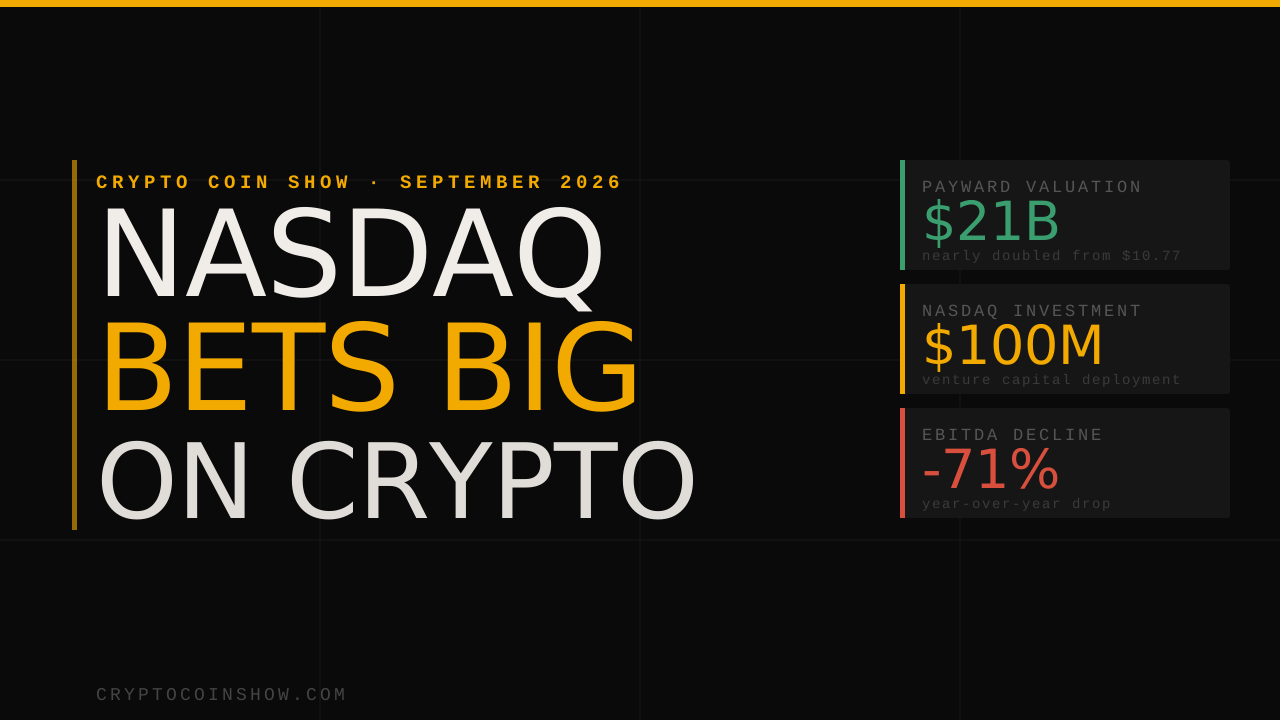
- Nasdaq Ventures commits $100 million to Payward, valuing the firm at $21 billion, up from $10.77 billion in September
- Kraken will distribute Nasdaq Equity Tokens starting Q2 2027, with voting rights identical to ordinary shares
- Payward’s adjusted EBITDA fell 71% year-over-year to $23 million despite 42% growth in funded accounts to 6.6 million
- $100M Nasdaq Ventures’ investment into Payward, conditional on Q2 2027 tokenized equity launch
- $21B Payward valuation implied by Nasdaq deal, exceeding Deutsche Börse’s $13.3B implied valuation
- 71% Year-over-year decline in Payward’s adjusted EBITDA to $23 million in Q2 2024
Nasdaq has committed $100 million through its strategic investment arm to Payward, the parent company of the Kraken crypto exchange, in a deal that first reported by Cryptopolitan values the San Francisco-based firm at $21 billion. The investment builds on an existing partnership agreement from March 2026 and ties Nasdaq’s technology and product roadmap directly to Kraken’s platform as a distribution channel for on-chain securities. In exchange, Kraken will become the primary retail outlet for Nasdaq Equity Tokens, or NETs, which the exchange operator plans to launch no earlier than the second quarter of 2027.
NYSE and Deutsche Börse Already Backing Crypto Exchanges at Competing Valuations
Nasdaq is the third major exchange operator this year to take a strategic stake in a regulated crypto platform, following Intercontinental Exchange’s $25 billion valuation of OKX in March and Deutsche Börse’s acquisition of a 1.5% stake in Payward itself in April. ICE’s NYSE investment in OKX included a board seat and an agreement to distribute NYSE tokenized equities to OKX’s 120 million users.
Deutsche Börse’s April purchase, which valued Payward at roughly $13.3 billion based on its $200 million check, now appears significantly undervalued relative to Nasdaq’s latest implied valuation of $21 billion.
The valuation discrepancy raises questions about Payward’s fundamental progress between April and now.
Nasdaq Surveillance Technology and Tokenized Equity Distribution Mark Broader Infrastructure Bet
Under the agreement, Payward has committed to deploying Nasdaq’s market surveillance technology across all asset classes it trades, crypto, equities, tokenized equities, futures, and options. This arrangement effectively embeds the exchange operator’s compliance and risk infrastructure into Kraken’s core trading systems. In return, Kraken will serve as a distribution point for tokenized stocks that replicate ordinary shares, including voting rights, rather than merely offering price exposure as most tokenized equities do today.
The structure reflects a broader institutional shift: legacy exchanges are no longer competing with crypto platforms but rather using them to reach retail customers and test new asset classes on blockchain infrastructure.
Nasdaq’s move echoes earlier efforts by traditional finance firms to embed themselves in the on-chain ecosystem, though it goes further by tying equity distribution directly to a single retail broker.
Payward’s Profitability Collapse Contradicts Rising Valuation
Payward’s second-quarter shareholder letter, published in August, revealed significant operational deterioration despite the company’s rising headline valuation. Adjusted EBITDA collapsed 71% year-over-year to just $23 million, down from approximately $80 million in the prior-year quarter, even as adjusted revenue grew 17% to $508 million.
Total trading volume fell 18% to $310 billion as spot crypto activity declined, though the company reported a 42% increase in funded accounts to 6.6 million.
Payward raised $800 million in November 2025 at a $20 billion valuation, a round that included $200 million from Citadel Securities, yet current third-party estimates valued the company at only $10.77 billion as of early September.
Nasdaq’s $21 billion implied valuation therefore represents a significant re-rating in a matter of weeks, driven entirely by the strategic partnership value of the token distribution agreement rather than underlying financial performance.
Public Market Listing Delayed Until Q2 2027 as Company Pursues Acquisition Growth
Payward’s path to a traditional public listing remains stalled. The company filed a confidential S-1 with the SEC in November 2025, paused the process in March, and now targets a debut no earlier than Q2 2027, the same quarter Nasdaq’s tokenized equities are scheduled to launch.
Alongside the delay, Payward shed approximately 150 employees, signaling a pivot away from rapid scaling toward more sustainable operations.
The company has instead pursued growth through acquisition, closing the derivatives platform Bitnomial for up to $550 million.
The Nasdaq investment will be formally governed by terms of the partnership agreement, with the tokenized equity launch timeline now serving as a key operational milestone. Watch whether Payward’s profitability metrics improve in the coming quarters and whether the Q2 2027 NET launch actually meets that deadline, as any delay would signal execution risk for Nasdaq’s broader tokenization strategy and potentially pressure Payward’s valuation ahead of its planned IPO window.