Editorial Summary
North Carolina’s introduction of the Bitcoin Reserve and Investment Act represents a significant institutional endorsement of cryptocurrency as a state-level treasury asset, potentially accelerating a broader trend of public sector Bitcoin adoption across the United States. The proposal’s structured framework—including custody protocols, governance oversight, and restrictions on liquidation—signals growing sophistication in how government entities approach digital asset management. For institutional investors, this development underscores Bitcoin’s transition from speculative asset to recognized store of value within traditional fiscal policy frameworks.
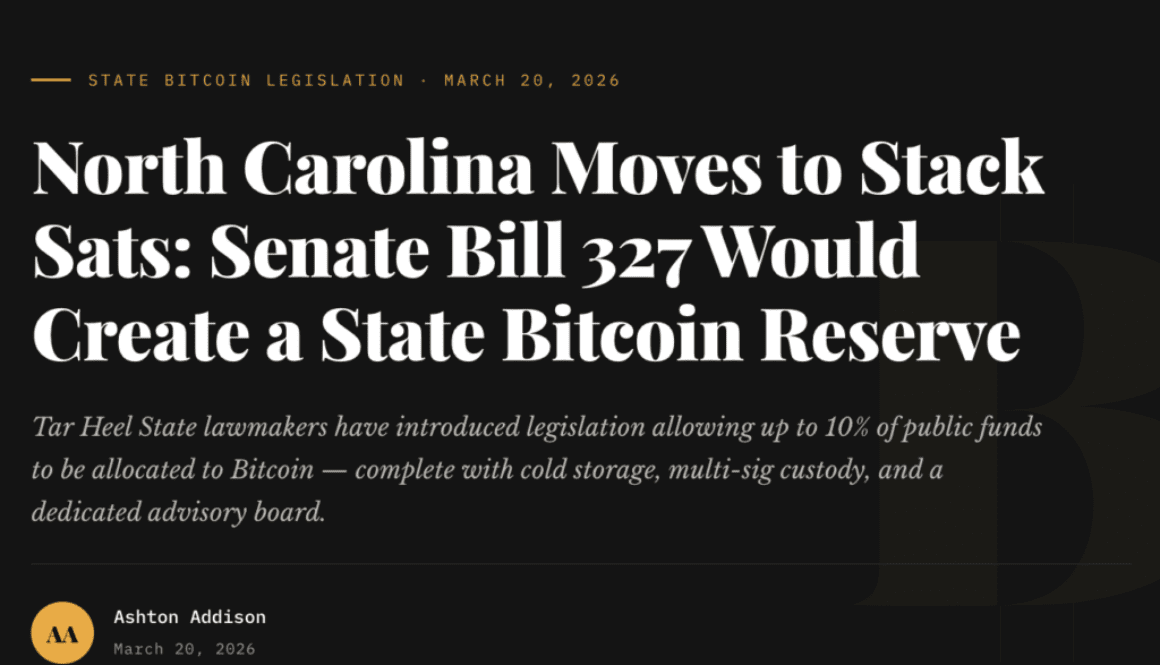
North Carolina lawmakers introduced legislation Wednesday to establish a state-controlled Bitcoin reserve, marking the latest phase in an emerging wave of governmental cryptocurrency adoption across America. Senate Bill 327, formally titled the North Carolina Bitcoin Reserve and Investment Act, would authorize the Office of the State Treasurer to allocate up to 10% of public funds into Bitcoin as a core component of the state’s long-term financial strategy. Sponsored by Senators Johnson and Overcash, the bill advanced through its first Senate reading before referral to the Rules and Operations Committee. The proposal articulates three primary objectives: establishing a Strategic Bitcoin Reserve anchored within state treasury operations, promoting Bitcoin as a recognized financial innovation, and positioning North Carolina as a jurisdictional leader in state-level cryptocurrency adoption at a time when institutional and governmental interest in digital assets continues accelerating.
Operational Framework and Asset Management Protocols
The legislation establishes a comprehensive operational structure designed to ensure institutional-grade custody and management of state Bitcoin holdings. Under the proposal, the Treasurer’s office would maintain Bitcoin reserves in cold storage wallets utilizing multi-signature authentication—a security standard widely recognized as institutional best practice within the cryptocurrency industry. The bill mandates creation of a dedicated department within the Treasurer’s office to assume direct custody of these assets, ensuring state control and eliminating reliance on third-party custodial arrangements. This structural approach addresses a primary concern institutional investors have historically raised regarding governmental cryptocurrency adoption: the necessity for demonstrable, accountable asset management divorced from speculative trading dynamics.
The reserve would incorporate a Bitcoin Economic Advisory Board composed of industry experts tasked with providing ongoing guidance on strategy, market conditions, and asset allocation decisions. The bill mandates monthly audits to verify reserve balances, security integrity, and performance metrics, with all audit findings and reserve data subject to quarterly reporting requirements to the General Assembly. These reports would also be made publicly available through the Treasurer’s website, establishing transparency mechanisms that align with institutional governance expectations. Bitcoin acquisitions would be conducted exclusively through regulated U.S.-based exchanges, with bulk purchases strategically timed to capitalize on favorable market conditions—a procurement methodology reflecting sophisticated portfolio management rather than reactive decision-making. The legislation notably includes provisions directing the Treasurer to explore Bitcoin mining operations as a potential mechanism for increasing state holdings, suggesting a forward-looking approach to reserve accumulation beyond direct market purchases.
Liquidation protocols embedded within the bill reflect a long-term holding philosophy consistent with strategic reserve principles. Any sale of Bitcoin from the reserve would require approval from at least two-thirds of both chambers of the General Assembly, a supermajority threshold designed to prevent opportunistic liquidation in response to short-term price volatility. Permitted uses of the reserve are explicitly constrained to severe financial crises, approved investment strategies, critical infrastructure funding, economic development projects, and support for Bitcoin-related research, education, and business incentives. The bill further permits the reserve to back bonds as an alternative financing mechanism for public projects, a provision that could enable the state to leverage its Bitcoin holdings as collateral for capital infrastructure development without requiring immediate asset liquidation.
Broader State-Level Bitcoin Adoption Trends and Regulatory Context
North Carolina’s proposed legislation reflects an accelerating trend of Bitcoin adoption at the state government level across the United States, signaling a fundamental shift in how elected officials and treasury managers regard cryptocurrency as a fiscal policy instrument. Texas, New Hampshire, and Arizona have already enacted laws permitting state fund allocation to Bitcoin, while Maryland, Iowa, Kentucky, Michigan, South Dakota, Illinois, Tennessee, and Missouri have advanced similar legislative proposals. This coordinated movement—spanning both traditionally pro-innovation and fiscally conservative jurisdictions—suggests Bitcoin reserve policies are transcending partisan divisions and achieving bipartisan institutional legitimacy. The geographic and ideological diversity of participating states indicates that state-level Bitcoin adoption addresses genuine treasury management concerns rather than representing fringe technology enthusiasm.
Additional states including Oklahoma, Utah, and Pennsylvania have advanced bills that remain in committee proceedings, indicating the pipeline for additional state-level Bitcoin reserve legislation extends considerably beyond current enacted or advanced proposals. This proliferation of legislative activity reflects several converging factors: persistent inflation concerns regarding traditional fiat currency reserves, recognition of Bitcoin’s demonstrated store-of-value characteristics over extended periods, increasing institutional acceptance of cryptocurrency as a legitimate asset class, and heightened competition among states to position themselves as technology-forward jurisdictions capable of attracting blockchain-native businesses and talent. North Carolina’s specific proposal notably includes provisions encouraging state advocacy for federal regulations favorable to Bitcoin—a provision suggesting state treasurers recognize their collective interest in federal regulatory clarity and supportive policy frameworks.
The regulatory compliance provisions embedded within North Carolina’s bill demonstrate sophisticated engagement with existing legal frameworks. The legislation explicitly requires adherence to federal and state laws governing cryptocurrency holdings and taxation, ensuring the proposed reserve operates within established legal parameters rather than attempting to circumvent regulatory structures. This compliance-first approach strengthens the political viability of the proposal by addressing concerns that state Bitcoin reserves might create regulatory complications or expose state governments to unforeseen legal liability. The emphasis on federal regulatory advocacy simultaneously signals that state treasurers recognize current federal cryptocurrency frameworks as incomplete and that state-level adoption creates constituencies advocating for improved national regulatory clarity.
Institutional Implications and Market Significance
For institutional investors tracking Bitcoin adoption trajectories, North Carolina’s legislative initiative carries substantial significance as a data point confirming that governmental adoption extends beyond individual states to encompass systematic policy frameworks. The proposal’s emphasis on custody protocols, governance structures, and transparent reporting mechanisms demonstrates that state governments are approaching Bitcoin reserves with institutional sophistication rather than speculative intent. This institutionalization of state-level adoption creates positive network effects: as multiple states establish reserves following similar frameworks, Bitcoin liquidity within governmental contexts increases, regulatory frameworks consolidate around established practices, and Bitcoin’s utility as a treasury asset becomes increasingly embedded within state fiscal policy. These dynamics reinforce Bitcoin’s transition from speculative asset to institutional-grade financial instrument.
The structure of North Carolina’s proposal also signals growing recognition among state officials that Bitcoin offers advantages as a long-term store of value relative to traditional cash reserves experiencing inflation erosion. A 10% allocation threshold represents a meaningful but not dominant position within state treasury allocations, suggesting policymakers view Bitcoin as a portfolio diversification strategy rather than a speculative concentration bet. The requirement for supermajority legislative approval for liquidation establishes a commitment mechanism that prevents short-term political pressures from forcing disadvantageous asset sales during temporary price downturns. For institutional investors evaluating macroeconomic dynamics, state-level Bitcoin reserve adoption indicates that institutional money is increasingly prepared to regard Bitcoin as a legitimate long-term holding within diversified portfolios rather than a transient technological phenomenon.
Looking forward, the aggregated effect of multiple states implementing Bitcoin reserves creates conditions for sustained institutional Bitcoin demand divorced from retail speculation or venture capital cycles. As states accumulate Bitcoin holdings over extended periods, state treasuries become sophisticated market participants with multi-decade time horizons—precisely the type of institutional holder traditionally valued within financial markets. The proposed quarterly reporting and public transparency mechanisms establish accountability structures that could serve as models for additional institutional Bitcoin adoption. For investors assessing Bitcoin’s institutional adoption trajectory, North Carolina’s legislative initiative represents evidence that governmental Bitcoin adoption is transitioning from experimental pilots to systematic, governance-embedded financial policy.