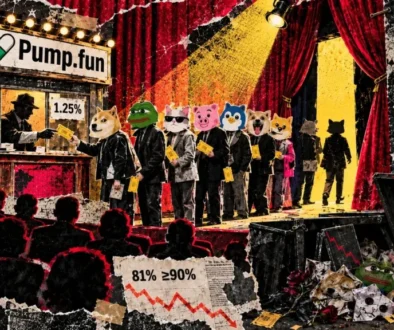
President Donald Trump is once again at the center of the memecoin mania
Donald Trump’s $203,000 VIP conference tickets for an April 25 memecoin event, which dangle direct access to the president, have triggered formal ethics complaints from senior Democratic senators and raised sharp questions about a sitting president profiting from token sales tied to his name. The event’s scheduling conflict with the White House Correspondents’ Dinner, combined with Trump’s family’s financial stake in the underlying token, has created a high-stakes test of how institutional investors, regulators, and Congress will treat presidential crypto ventures.
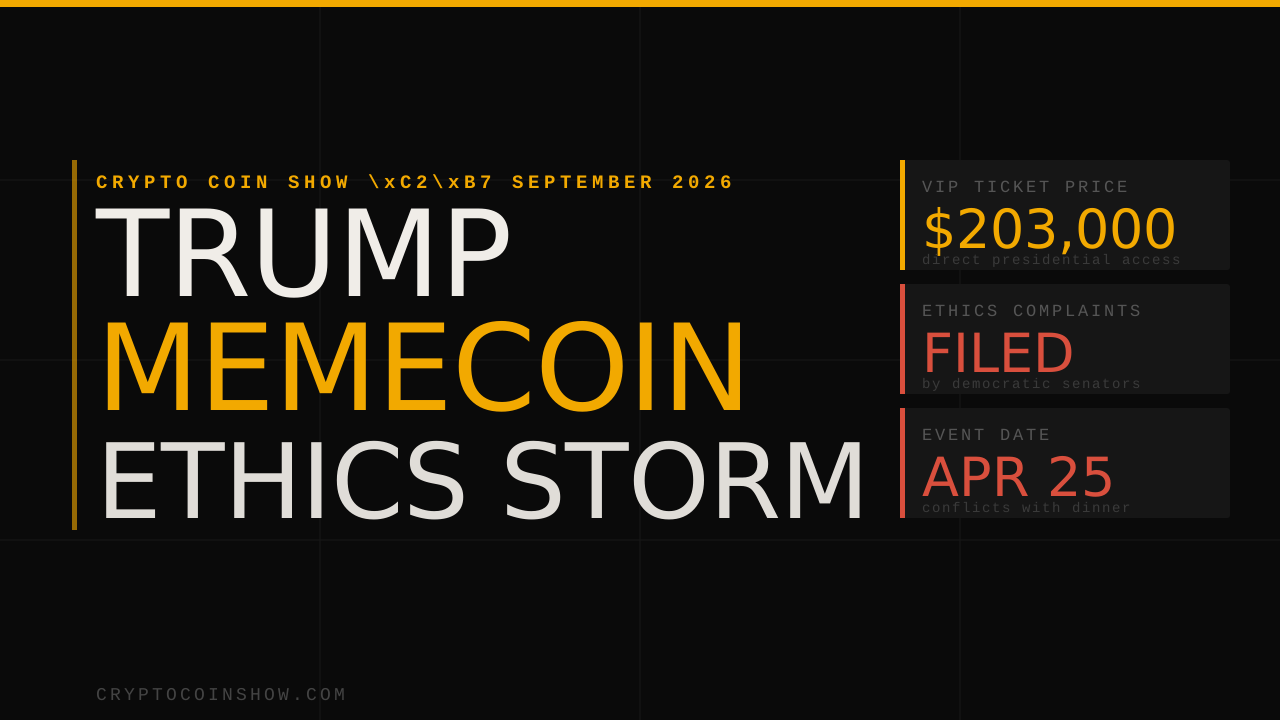
- VIP conference seats sell for $203,000, explicitly offering access to President Trump as an attendee incentive
- April 25 event conflicts with White House Correspondents’ Dinner Trump has already committed to attend
- Fight Fight Fight LLC, which controls a significant portion of TRUMP memecoin, is organizing the Mar-a-Lago conference
- $203K Price of VIP conference seats dangling Trump attendance as exclusive benefit
- April 25 Conference date overlapping sitting president’s prior White House commitment
- Fight Fight Fight LLC Trump-linked entity controlling major TRUMP memecoin stake and conference
President Donald Trump has positioned himself at the center of a memecoin ecosystem that is now generating direct revenue from his political office and brand, a move that has triggered formal ethics scrutiny from Congress.
The Mar-a-Lago memecoin conference, billed as “The Most Exclusive Crypto & Business Conference in the World,” is selling VIP seats for $203,000 apiece, with the core selling point being guaranteed access to President Trump himself.
This structure creates a direct financial incentive for attendees to purchase tickets in order to gain proximity to the sitting president, a dynamic that has alarmed ethics-focused lawmakers and fueled debate about whether a sitting chief executive should profit from token-related ventures bearing his name.
The event is scheduled for April 25, the same day as the White House Correspondents’ Dinner, to which Trump has already committed. White House officials have indicated the memecoin conference has not yet been added to the president’s official schedule, creating ambiguity about whether Trump will actually attend the event whose premium pricing depends on his presence.
This scheduling conflict raises a practical question: if Trump cannot attend due to his prior commitment, the central value proposition of the $203,000 VIP package evaporates, yet ticket sales would have already been completed and revenue collected.
Democratic senators demand accountability as TRUMP token generates family wealth
Senators Adam Schiff of California, Elizabeth Warren of Massachusetts, and Richard Blumenthal of Connecticut have formally expressed concern about the conference structure and the underlying memecoin arrangement.
Their criticism centers on a core ethical issue: a sitting president and his family members are enriching themselves through a cryptocurrency token marketed under the Trump brand while holding elected office.
This arrangement differs sharply from the traditional ethics expectation that sitting presidents place assets in blind trusts or divest from active business interests to avoid conflicts of interest.
Senator Jon Ossoff of Georgia offered particularly sharp language, calling the arrangement “gobsmacking” and describing it as an enrichment plan for Trump’s entire family. Ossoff challenged his Republican colleagues to defend the president’s direct involvement in the memecoin venture while serving as chief executive.
He argued that Congress should demand accountability from every government official trading in Trump-linked tokens, positioning the issue as a governance problem that transcends partisan lines.
Representative Sam Liccardo, a Democrat representing Silicon Valley, articulated the downstream risk in blunt terms. “It doesn’t take any imagination to see how a cryptocurrency issued by Trump or his family members will quickly become a tool of bribery and foreign manipulation,” Liccardo stated.
His concern reflects an institutional worry: if a sitting president’s token can be purchased to gain political access, foreign actors or domestic interests seeking regulatory favor could exploit the arrangement to influence policy.
Senator Lummis signals discomfort despite pro-crypto stance
The criticism is not confined to Democrats. Senator Cynthia Lummis of Wyoming, a Republican with strong crypto credentials and a consistent advocate for digital asset regulation, has expressed “pause” about the memecoin conference.
While Lummis’s spokesperson Katie Warbinton stated that Trump is the most pro-crypto president in history, the senator notably declined to defend or endorse the conference dinner itself, a signal that even Republican crypto allies are uncomfortable with the specific structure of the April 25 event.
Lummis’s hesitation is significant because it suggests the ethics concern crosses ideological lines and reflects discomfort among lawmakers who generally favor crypto industry growth.
The White House and Trump have repeatedly downplayed any conflict of interest concerns, arguing that the president’s involvement in crypto is no different from his prior business activities. However, the presence of Fight Fight Fight LLC, a Trump-linked entity that controls a substantial portion of the TRUMP memecoin alongside other Trump family interests, complicates that defense.
The fact that the same entity is organizing the Mar-a-Lago conference creates a direct financial chain: ticket sales to the conference generate revenue that flows to an entity heavily invested in the TRUMP token’s success.
TRUMP token price surge and postponement rumors create trading volatility
Rumors that the April 25 conference could be postponed have circulated as the scheduling conflict with the White House Correspondents’ Dinner becomes more apparent. Any postponement would be significant because the TRUMP memecoin has already experienced price volatility tied to conference announcements and speculation about Trump’s attendance.
The first memecoin dinner event triggered a race to purchase TRUMP tokens, followed by national news coverage and subsequent protests when the conference occurred.
The pattern demonstrates how institutional investors and retail speculators are using Trump’s political calendar and crypto announcements as trading signals.
The official TRUMP memecoin website includes a disclaimer stating that the president’s actual attendance at the April 25 event is not guaranteed, yet that risk is being priced into the $203,000 VIP ticket. This structure creates a scenario where capital is deployed based on uncertainty, attendees are paying for access to a president whose schedule remains unconfirmed.
If Trump ultimately attends the White House Correspondents’ Dinner instead of the Mar-a-Lago conference, the value destruction for VIP ticket holders would be instantaneous and complete.
The core question facing institutional investors and regulators in the coming weeks is whether Trump’s attendance at the April 25 conference will be confirmed or whether a postponement will be announced, either outcome will trigger significant price movement in the TRUMP memecoin and will test whether the SEC or other federal agencies determine that selling access to a sitting president via cryptocurrency raises securities law or corruption statute issues that require enforcement action.
Original reporting: cryptopolitan.com